Picture this. A customer clicks “buy,” the payment (or promise of payment) goes through, and your warehouse team packs the order with care. Three days later, the shipment bounces back to you. No sale. No customer. Just a box full of wasted shipping costs sitting on your dock.
If that scenario sounds painfully familiar, you already know what NDR and RTO are doing to your bottom line.
This guide breaks down NDR management in e-commerce in plain language. We’ll cover what NDR actually means, why it happens, and the exact strategies D2C brands in India (and beyond) are using in 2026 to reduce failed deliveries and RTO before they eat into profit. No jargon overload, just practical steps you can start using this week.
What Is NDR in E-commerce?
NDR stands for Non-Delivery Report. It’s the status a courier partner assigns to a shipment when a delivery attempt fails.
Think of it as a red flag on your order dashboard. It doesn’t mean the order is lost forever. It means something went wrong at the customer’s end, or the courier’s end, and someone needs to act fast before that order slides into a full return. If you want the full breakdown with examples, our complete NDR and RTO explainer covers every reason code in detail, and iThink Logistics’ guide to NDR in logistics offers a useful courier-side perspective too.
NDR Full Form and Meaning
The NDR full form, Non-Delivery Report, is fairly self-explanatory once you see it in action. Every time a delivery agent can’t hand over a package, the courier logs the reason and flags it as NDR. Common tags include “customer not available,” “address incorrect,” or “customer refused.”
Here’s the part most sellers miss: an NDR is a window of opportunity, not a dead end. Handle it within the first attempt cycle, usually 24 to 48 hours, and most orders still get delivered.
NDR vs RTO: What’s the Difference?
This trips up a lot of new sellers, so let’s clear it up.
- NDR happens after one failed delivery attempt. The order is still active and can be saved.
- RTO (Return to Origin) happens after the courier gives up, usually after two or three failed attempts, and sends the package back to your warehouse.
In simple terms, NDR is the warning sign. RTO is the consequence of ignoring it. Every RTO started life as an unresolved NDR, which is exactly why NDR management matters so much.
Why NDR Happens: Common Reasons for Failed Deliveries
Understanding why deliveries fail is the first step toward fixing them. The causes generally fall into two buckets.
Customer-Related Reasons
- Customer not available. They’re at work, traveling, or simply didn’t expect the delivery that day.
- Wrong or incomplete address. Missing house number, no landmark, or a mistyped pin code.
- Customer unreachable. Switched-off phone, wrong number entered at checkout.
- Customer refused delivery. Change of mind, found it cheaper elsewhere, or never really intended to pay (a common COD problem).
- Rescheduling requests. The customer wants delivery on a different day.
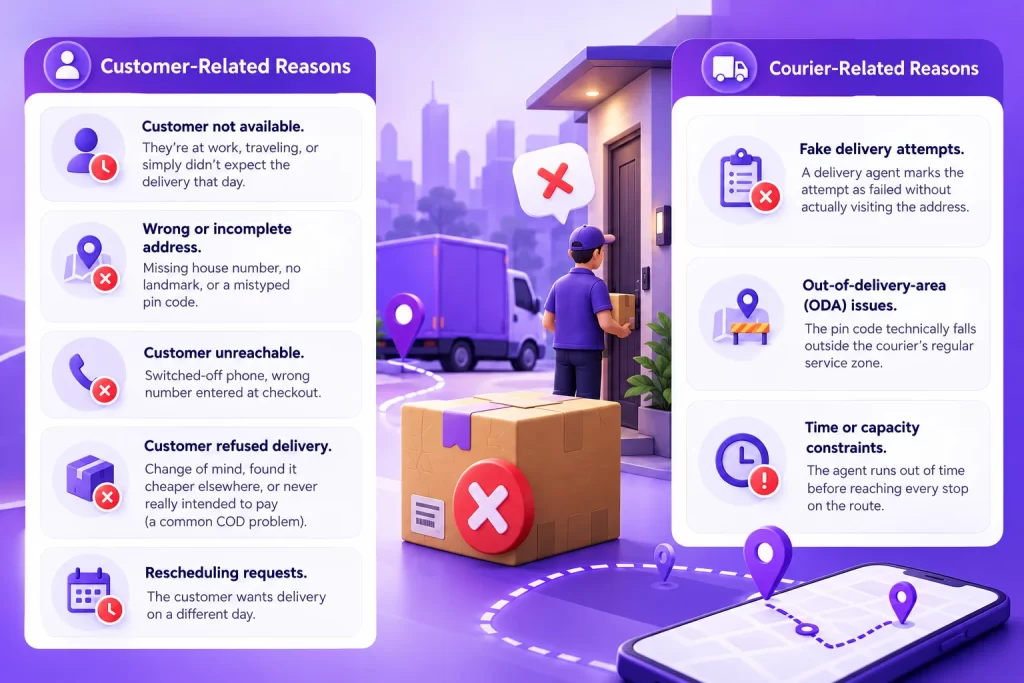
Courier-Related Reasons
- Fake delivery attempts. A delivery agent marks the attempt as failed without actually visiting the address. It happens more often than sellers realize, and it’s worth learning how to identify and dispute fake delivery attempts before they inflate your RTO numbers.
- Out-of-delivery-area (ODA) issues. The pin code technically falls outside the courier’s regular service zone.
- Time or capacity constraints. The agent runs out of time before reaching every stop on the route.
If you’re seeing a pattern of one reason dominating your NDR reports, that’s your clue. A spike in “address incorrect” tags, for example, usually points to a checkout problem, not a courier problem.
The Real Cost of NDR and RTO for E-commerce Brands
Here’s why this topic deserves more attention than most sellers give it. RTO isn’t just a missed sale. It’s a double cost.
You pay shipping once to send the order out, and again to bring it back. Add in repackaging, potential product damage, and the inventory sitting idle in transit instead of on your shelf ready to sell. Most sellers underestimate this because they only look at the courier invoice. Once you calculate the true shipping cost per order, including reverse logistics and failed-attempt fees, the real number is usually much higher than expected.
Industry estimates suggest RTO can eat into contribution margins by a meaningful percentage for categories like fashion and lifestyle, where impulse buying and COD refusals are common.
There’s also a softer cost that’s easy to overlook: customer trust. A failed delivery, especially one that wasn’t really the customer’s fault, leaves a bad taste. That customer may never order from you again, and they might mention the experience to friends or in a review.
How NDR Converts Into RTO: The Timeline
Most courier partners follow a similar pattern:
- First attempt fails. Order is flagged as NDR with a reason code.
- Reattempt window opens. Typically 24 to 48 hours to fix the issue and confirm reattempt.
- Second attempt. If the same issue persists (wrong number, no response), the courier tries again.
- Third attempt or timeout. After two to three failed attempts, most couriers automatically mark the shipment for RTO.
This means you usually have a very short window, often less than 24 hours, to catch and resolve an NDR before it’s out of your hands. That’s why speed matters more than almost anything else in NDR management.
How to Reduce RTO in E-commerce: Proven Strategies
Now for the part you actually came here for. Reducing RTO isn’t about one magic fix. It’s a layered approach that starts before the order even ships and continues after it comes back.
Stage 1: Reduce RTO Risk at Checkout (Before Dispatch)
The cheapest RTO to deal with is the one that never happens. A few checkout-level changes make a huge difference:
- Incentivize prepaid orders. Offer a small discount (even ₹20 to ₹50) for paying upfront instead of choosing COD. If you’re still heavily COD-dependent, our guide on how to convert COD orders to prepaid walks through nudges that actually move the needle.
- Add order confirmation for COD. A quick WhatsApp or SMS confirmation before dispatch filters out low-intent buyers.
- Validate addresses at checkout. Use pin code auto-fill and mandatory landmark fields. This is covered in depth in our piece on address validation for e-commerce in India.
- Flag high-risk pin codes and orders. Some refusals aren’t accidental. Pairing checkout rules with proper COD fraud detection and prevention stops repeat offenders before they ever ship.
Stage 2: Real-Time NDR Management (During Transit)
This is where automated NDR management earns its keep. Once a shipment is flagged, speed is everything.
- Automated alerts. The moment an NDR is raised, trigger an instant WhatsApp, SMS, or IVR call to the customer.
- Self-service resolution. Let the customer confirm availability, update their address, or reschedule delivery through a simple link. Pairing this with branded tracking pages also cuts down on “where is my order” tickets, so your support team isn’t fielding both at once.
- Alternate contact capture. Ask for a backup phone number at checkout so you’re never stuck with just one unreachable line.
- Dedicated NDR follow-up team. Even with automation, a human touch for complex cases (like repeated refusals) improves recovery rates.
A well-built automated dispatch workflow can handle a large share of this without manual intervention, which matters a lot once your order volume scales past a few hundred shipments a day.
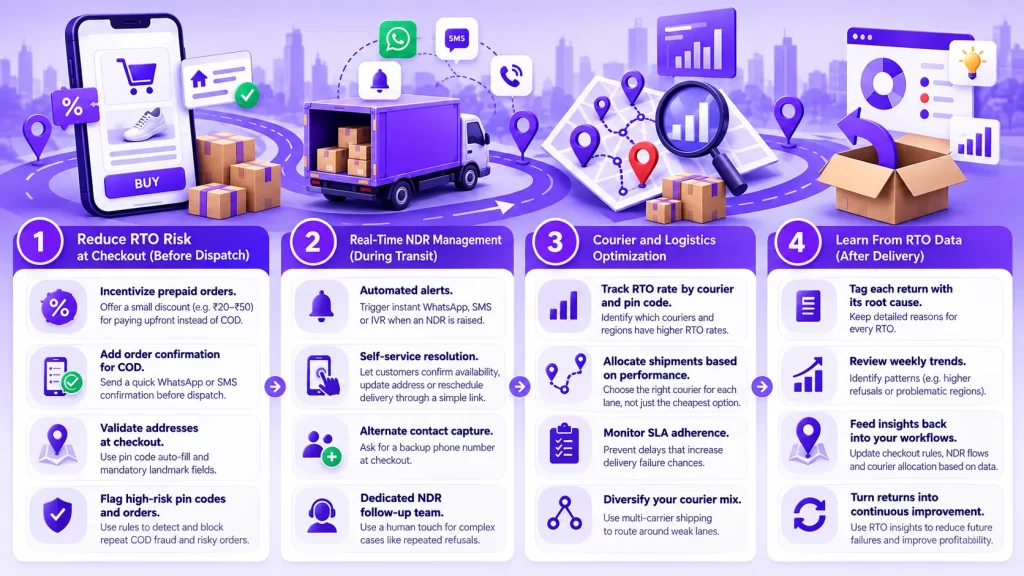
Stage 3: Courier and Logistics Optimization
Not every courier performs the same way in every region. This is a detail a lot of sellers overlook.
- Track RTO rate by courier and pin code. Some couriers are excellent in metro cities but weak in Tier 3 towns.
- Allocate shipments based on performance, not just cost. The cheapest courier isn’t always the cheapest option once RTO costs are factored in. This is exactly the case we make in why AI-based courier allocation is crucial for e-commerce brands, and our follow-up on reducing RTO with smart courier allocation breaks down the lane-wise logic in practical terms.
- Monitor SLA adherence. Delayed deliveries increase the chance of the customer being unavailable when the agent finally arrives. A regular courier performance scorecard makes this easy to track month over month.
- Diversify your courier mix. If you’re relying on a single courier, setting up multi-carrier shipping gives you the flexibility to route around weak lanes instead of absorbing the RTO hit.
Stage 4: Learn From RTO Data (After Delivery)
Once orders return, don’t just restock and move on. Treat every RTO as data.
- Tag each return with its root cause.
- Review weekly trends: is refusal up? Is one region consistently problematic?
- Feed those insights back into your checkout and NDR workflows.
This closes the loop and turns returns automation for D2C brands into a continuous improvement process rather than a one-time cleanup task.
NDR Management Software and Tools in 2026
Manually calling every customer with a failed delivery simply doesn’t scale once you’re shipping hundreds of orders a day. That’s where NDR management software comes in.
Most modern platforms offer:
- Real-time NDR detection across multiple courier partners in one dashboard
- Automated WhatsApp, SMS, and IVR flows triggered the moment a delivery fails
- Customer self-service links to confirm, reschedule, or correct address details
- Analytics dashboards showing NDR reasons, courier-wise RTO rates, and recovery percentages
In 2026, the shift is clearly toward AI-assisted prioritization. Instead of treating every NDR the same, smarter systems now flag which failed deliveries are most likely to be recovered and route effort there first. If you’re evaluating options, our breakdown of NDR management software built for D2C brands covers what to actually look for beyond flashy dashboards.
Prepaid vs COD: The RTO Comparison
This deserves its own quick section because the difference is dramatic.
Prepaid orders typically see RTO rates in the low single digits, since the customer has already paid and has real commitment to the purchase. COD orders, on the other hand, frequently see RTO rates several times higher, because there’s little to no cost for the customer to simply refuse the package at the door.
That doesn’t mean you should eliminate COD entirely. For a large share of first-time buyers in India, COD builds trust. It does mean, though, that you need clean cash flow processes on the back end. Understanding the COD remittance cycle helps you plan working capital around the delay between delivery and payout, which gets worse the more RTOs you’re absorbing.
What a Good RTO Rate Looks Like in 2026
So what’s actually “normal”? RTO rates vary heavily by category and region, but here’s a rough benchmark:
- Below 15% is generally considered healthy for most categories.
- 15% to 25% is common, especially for COD-heavy or fashion-focused stores.
- Above 25% signals it’s time to audit your checkout, courier mix, and NDR process urgently.
Tier 1 cities usually perform better than Tier 3 and rural areas, where address quality and delivery infrastructure are less consistent. One metric worth tracking alongside RTO is your first attempt delivery rate (FADR), since a low FADR is usually the earliest warning sign that RTO is about to climb.
Final Thoughts
NDR management isn’t a back-office chore you can ignore until it becomes a problem. It’s a direct lever on your profitability, your cash flow, and how customers feel about your brand.
The brands that win at this in 2026 aren’t necessarily the ones with the biggest logistics budgets. They’re the ones who act fast on every NDR, use data to fix root causes instead of just reacting, and make it as easy as possible for customers to complete their delivery. That last point matters more than people think. Strong post-purchase customer experience is often what separates a one-time buyer from a repeat customer.
Start small if you need to. Pick one strategy from this guide, whether it’s automating your NDR alerts or adding a prepaid discount at checkout, and measure the impact over the next 30 days. Small, consistent fixes compound into a real drop in your RTO rate.
Ready to tighten up your delivery process? Audit your last month of NDR data, tag the top three reasons for failure, and fix the biggest one first. That single step alone often moves the needle more than people expect.
Frequently Asked Questions
NDR (Non-Delivery Report) is flagged after a single failed delivery attempt, and the order can still be saved. RTO (Return to Origin) happens after repeated failed attempts, when the courier gives up and sends the shipment back to the seller.
Most courier partners in India make two to three attempts over 24 to 72 hours before marking a shipment for RTO, though this can vary by courier and delivery zone.
Yes, significantly. COD orders have much higher RTO rates than prepaid orders because customers can refuse the package without any financial loss. Offering a small prepaid discount is one of the most effective ways to reduce this risk.
Most modern NDR management tools support multi-courier integration, pulling delivery exception data from partners like Delhivery, Bluedart, Ekart, XpressBees, and DTDC into a single dashboard, rather than requiring you to check each courier portal separately.
A fake delivery attempt happens when a courier agent marks a delivery as failed without actually visiting the address. Most courier partners allow sellers to raise a complaint or escalation ticket through their dashboard, and tracking this pattern by agent or route helps identify recurring offenders.

Kapil Pathak is a Senior Digital Marketing Executive with over six years of experience in the logistics and supply chain industry. He specializes in SEO, SEM, and multi-channel campaign management. He has a strong track record of building strategies that boost brand visibility and generate qualified leads. His work focuses on driving growth for D2C and B2B technology companies through data-driven digital marketing initiatives.