You’ve spent thousands on ads, nailed your product, and finally got a customer to click “Buy Now.” The order is dispatched. Tracking shows “delivery attempted.” But here’s the thing: your customer never saw the delivery agent. No call. No doorbell. Nothing. Sound familiar?
If you’re running a D2C brand in India, fake delivery attempts are probably costing you more than you realize. They inflate your RTO rates, destroy customer trust, and quietly eat into your margins every single month.
Courier fraud in ecommerce isn’t just an operational headache. It’s a revenue leak that compounds over time. And the worst part? Most brands don’t even know it’s happening until the damage is done.
In this guide, we’ll break down exactly what fake delivery attempts look like, why they happen, how to prove them, and most importantly, how to prevent them using smart technology and better courier accountability. Whether you’re shipping 100 orders a day or 10,000, this is the playbook you need. Let’s get into it.
What Is a Fake Delivery Attempt?
A fake delivery attempt happens when a courier delivery agent marks a shipment as “attempted but undelivered” without actually visiting the customer’s address. In some cases, the delivery boy marks the parcel as delivered without delivery ever taking place.
Here’s what it typically looks like:
- The tracking status updates to “delivery attempted, customer unavailable”
- The customer receives no call, SMS, or doorbell ring
- The shipment enters NDR (Non-Delivery Report) status
- After 2-3 fake attempts, the order is marked for Return to Origin (RTO)
This is different from a genuine failed delivery, where the agent actually visits the address but can’t complete the handover due to legitimate reasons like a locked house, incorrect address, or customer refusal. If you’re unfamiliar with how NDR and RTO cycles work, our detailed guide on what NDR and RTO mean in ecommerce covers the fundamentals.
The key difference? Intent. A failed delivery is an operational reality. A fake delivery attempt is deliberate delivery status manipulation by the courier agent.
Why Do Couriers Mark Fake Delivery Attempts?
Understanding the “why” helps you build better prevention systems. Here are the most common reasons behind courier partner fraud for D2C brands:
1. Route Optimization Gone Wrong
Delivery agents are assigned 80-150 deliveries per day in metro cities. When the route is inefficient or the address is slightly out of the way, some agents skip those deliveries and mark them as attempted.
2. Cash on Delivery Avoidance
COD orders require agents to collect cash and account for it. Some agents prefer to skip COD deliveries (especially high-value ones) to avoid the hassle of cash handling and reconciliation.
3. End-of-Day Pressure
Courier companies track delivery completion rates. When an agent can’t finish all deliveries by cutoff time, marking remaining orders as “attempted” is the path of least resistance.
4. Incentive Manipulation
In some courier networks, agents are incentivized per attempt rather than per successful delivery. This creates a perverse incentive to log fake attempts without actually visiting the address.
5. Address Confusion
Sometimes agents genuinely can’t locate an address but instead of calling the customer, they simply mark it as attempted. While not malicious, the result is the same: your customer doesn’t get their order.
The Real Cost of Courier Fraud for D2C Brands
Let’s talk numbers. Because fake delivery attempts don’t just cause inconvenience. They cause real financial damage.
Direct costs include:
- Forward shipping charges (non-refundable in most cases)
- RTO shipping charges (you pay for the return too)
- Product damage during unnecessary transit
- Repackaging and restocking costs
- Payment gateway fees on refunds
Indirect costs include:
- Lost customer lifetime value (they won’t order again)
- Negative reviews and social media complaints
- Increased WISMO (Where Is My Order) support tickets
- Higher customer acquisition costs to replace churned buyers
- Brand reputation damage
For a D2C brand shipping 5,000 orders per month with even a 5% fake attempt rate, you’re looking at 250 orders entering unnecessary RTO cycles. At an average shipping cost of ₹80-120 per direction, that’s ₹40,000-60,000 in wasted logistics spend monthly. And that’s before counting the lost revenue from those orders.
These hidden costs add up fast. If you haven’t audited your freight spend recently, our article on the hidden cost of manual freight reconciliation explains how automation can surface these leaks.
Courier manipulation leading to RTO is one of the biggest silent killers of D2C profitability in India.
How to Identify Fake Delivery Attempts
Before you can fight the problem, you need to spot it. Here are the red flags that indicate NDR fraud in your ecommerce operations:
Pattern Recognition
- Same agent, repeated “customer unavailable” marks across multiple orders in the same area
- Attempts logged at unusual hours (e.g., 6:30 AM or 9:45 PM when no one would reasonably attempt delivery)
- Bulk NDR entries at the same timestamp, suggesting the agent marked multiple orders as attempted simultaneously
- No corresponding call logs to the customer before marking the attempt
Customer Feedback Signals
- Customers calling your support saying “no one came”
- Social media complaints about courier not calling before delivery
- Repeated delivery attempt SMS not received by customers
- High NDR rates in specific pin codes served by specific agents
Data Anomalies
- Delivery attempt GPS coordinates don’t match the customer’s address
- Time gap between “out for delivery” and “attempted” is suspiciously short
- Specific courier partners consistently showing higher NDR rates than others
If you’re using a multi-carrier shipping platform, you should be able to pull these reports and identify patterns quickly. If you’re relying on manual tracking, these signals often go unnoticed until the damage accumulates.
How to Prove a Fake Delivery Attempt
Whether you’re disputing with your courier partner or helping a customer file a complaint, proof is everything. Here’s how to build your case:
1. GPS Data Verification
Most modern courier apps log GPS coordinates when a delivery is marked as attempted. Request this data from your courier partner. If the coordinates don’t match the delivery address, you have clear evidence of shipment status fraud.
2. Call Log Records
Ask for call logs showing whether the agent attempted to contact the customer. No call + no delivery = strong evidence of a fake attempt.
3. Customer Testimony
Reach out to the customer immediately after an NDR is logged. A simple automated message asking “Did someone attempt to deliver your order?” can provide real-time verification.
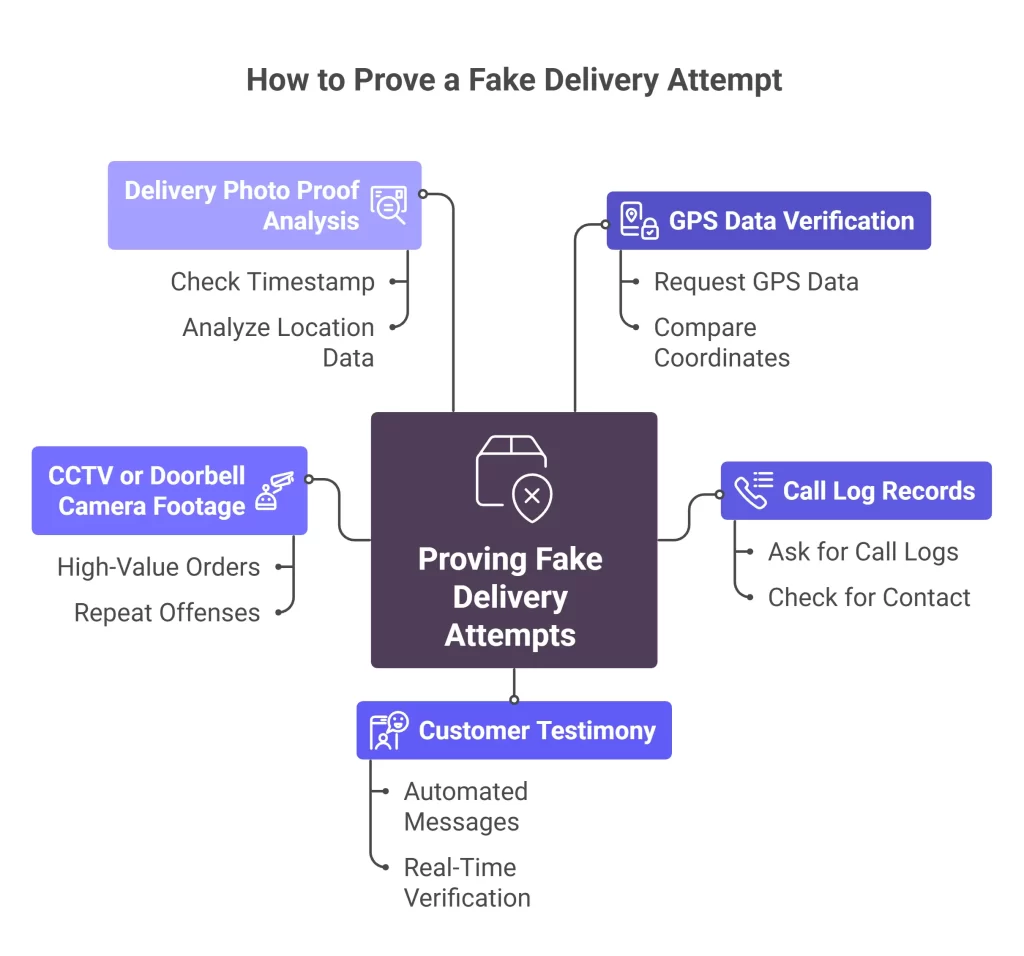
4. CCTV or Doorbell Camera Footage
For high-value orders or repeat offenses, customers can provide security camera footage showing no delivery agent visited during the logged attempt window.
5. Delivery Photo Proof Analysis
If the courier provides photo proof of attempt (like a picture of a closed door), check the metadata. Does the timestamp match? Does the location data align? Sometimes agents reuse old photos.
Building a systematic process for POD verification and dispute resolution is essential for any brand serious about ecommerce shipping fraud prevention.
7 Proven Ways to Prevent Fake Delivery Attempts
Now for the actionable part. Here’s how smart D2C brands are eliminating courier fraud from their operations:
1. Implement OTP-Based Delivery Verification
OTP-based delivery is the single most effective tool against fake delivery attempts. The customer receives a one-time password that must be shared with the delivery agent to complete the handover. No OTP = no delivery confirmation possible.
This eliminates the possibility of a delivery boy marking delivered without delivery because the system won’t allow status completion without the verification code.
Pro tip: Watch out for fake OTP delivery scams where agents call customers and ask for the OTP without actually being at the door. Educate your customers to only share OTP when they physically receive the package.
2. Use AI-Powered NDR Management
Automated NDR systems can flag suspicious patterns in real-time. Instead of waiting for manual review, AI courier allocation and NDR automation tools can:
- Instantly verify attempt legitimacy using GPS data
- Auto-trigger customer confirmation calls within minutes of an NDR
- Reroute orders to different agents if fraud is detected
- Score delivery agents based on historical performance
Learn more about why AI-powered courier allocation is crucial for ecommerce brands and how it directly combats fake delivery attempts.
Metaport’s NDR management module is built specifically for this purpose, catching fake attempts before they snowball into RTOs.
3. Deploy GPS-Based Delivery Confirmation
Require that delivery status can only be updated when the agent’s GPS location is within a defined radius of the delivery address. This is called geo-fencing, and it makes delivery status manipulation nearly impossible.
Combined with e-POD (electronic proof of delivery) that includes timestamped photos and location data, you create an airtight verification system.
4. Build Courier Performance Scorecards
Track and score every courier partner (and individual agents where possible) on metrics like:
- First-attempt delivery rate
- NDR-to-RTO conversion rate
- Customer complaint frequency
- GPS compliance rate
- Average delivery time after “out for delivery”
Use this courier performance scorecard to make data-driven decisions about which partners handle which pin codes, order values, and product categories.
5. Enable Smart Courier Allocation
Not all courier partners perform equally in all areas. A smart dispatch allocation system analyzes historical data to automatically assign orders to the best-performing courier for each specific pin code, order type, and delivery speed requirement.
This reduces fake attempts because you’re routing orders to partners with proven delivery track records in that area. Our deep dive on reducing RTO with smart courier allocation shows exactly how this works in practice.
6. Set Up Automated Escalation Workflows
Create automated escalation triggers:
- If NDR is logged without a preceding call to customer → auto-escalate
- If same agent logs 3+ NDRs in one hour → flag for review
- If customer disputes attempt within 30 minutes → priority re-attempt
An escalation matrix that operates in real-time keeps courier partners accountable and reduces the window for fraud. If your dispatch process is still manual, consider automating your ecommerce dispatch workflow as the foundation for these escalation systems.
7. Leverage Branded Tracking Pages
When customers can track their orders on your branded tracking page (instead of a generic courier page), they’re more engaged and more likely to report discrepancies immediately. This creates a feedback loop that catches fake attempts faster.
Branded tracking pages cut WISMO tickets because customers have real-time visibility, and they can flag issues directly through your interface. That same visibility helps you catch fake delivery attempts within minutes instead of days.
How to File a Complaint for Fake Delivery Attempts
If you’re a consumer dealing with this issue, or if you’re helping your customers navigate the process, here’s the escalation path:
Step 1: Contact the Seller
Report the issue to the ecommerce brand or marketplace. They can raise a dispute with the courier partner directly.
Step 2: Complain to the Courier Company
File a formal complaint with the courier’s customer service. Reference the tracking number, date, and time of the alleged attempt. Request GPS logs and call records.
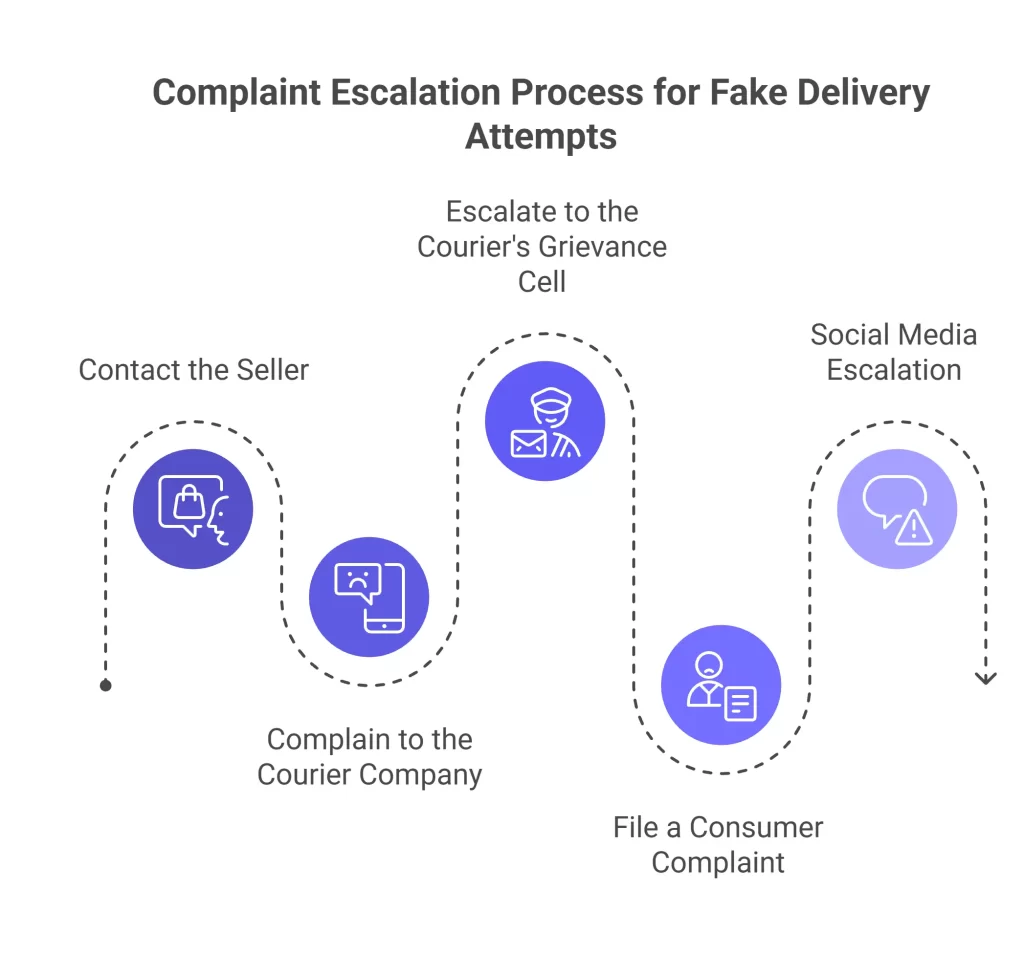
Step 3: Escalate to the Courier’s Grievance Cell
If the initial complaint doesn’t resolve the issue, escalate to the grievance redressal officer. Most courier companies are required to have one.
Step 4: File a Consumer Complaint
If all else fails, you can file a complaint on the National Consumer Helpline (NCH) or through the consumer forum. A consumer court complaint against courier companies for repeated fake attempts is valid and has legal standing in India.
Step 5: Social Media Escalation
Sometimes a public post tagging the courier company gets faster results than formal channels. Document everything before going public.
The Role of Technology in Eliminating Courier Fraud
Manual monitoring simply doesn’t scale. When you’re shipping hundreds or thousands of orders daily, you need technology that works in the background, catching anomalies and preventing fraud before it impacts your bottom line.
Here’s what a modern ecommerce logistics SaaS platform should offer:
- Real-time delivery analytics with GPS verification
- Automated NDR management with instant customer confirmation
- AI-powered courier allocation based on performance data
- Multi-carrier platform capabilities for easy partner switching
- Courier performance dashboards with fraud detection alerts
- Branded tracking pages for customer engagement and feedback
- Automated dispatch workflows that optimize for delivery success
Platforms like Metaport are built specifically for D2C brands that want to take control of their shipping operations. Instead of relying on aggregators who may not prioritize your fraud concerns, a SaaS-based approach gives you direct visibility and control over every shipment.
The difference between a logistics aggregator and a SaaS platform is crucial here. Aggregators often have commercial relationships with courier partners that can create conflicts of interest when you raise fraud disputes. A SaaS platform puts you in the driver’s seat.
What’s the Difference Between a Failed Delivery and a Fake Attempt?
This distinction matters for your internal processes and courier negotiations:
| Factor | Genuine Failed Delivery | Fake Delivery Attempt |
|---|---|---|
| Agent visited address | Yes | No |
| Customer was contacted | Usually yes | No |
| GPS matches address | Yes | No or missing |
| Legitimate reason exists | Yes (locked, refused, wrong address) | No |
| Pattern of repetition | Random | Systematic |
| Resolution | Re-attempt usually succeeds | Re-attempt often “fails” again |
Understanding this difference helps you categorize NDRs correctly and take appropriate action. Not every NDR is fraud, but every fake attempt will show up as an NDR.
Building a Long-Term Anti-Fraud Strategy
Preventing courier fraud isn’t a one-time fix. It requires ongoing vigilance and systematic improvements:
Short-term (Week 1-2):
- Activate OTP-based delivery for all orders
- Set up automated customer confirmation after every NDR
- Pull NDR reports and identify top offending pin codes/agents
Medium-term (Month 1-3):
- Implement courier performance scorecards
- Switch to smart courier allocation based on data
- Set up automated escalation workflows
- Deploy GPS-based delivery confirmation requirements
Long-term (Quarter 2+):
- Build a multi-carrier strategy with performance-based allocation
- Negotiate SLAs with courier partners that include fraud penalties
- Implement AI-powered anomaly detection
- Create a continuous feedback loop between customer experience and courier selection
Wrapping Up
Fake delivery attempts and courier fraud in ecommerce aren’t going away on their own. As D2C brands scale, the problem only gets bigger. But the brands that invest in smart technology, data-driven courier management, and systematic fraud prevention are the ones that protect their margins and keep customers coming back.
The key takeaways:
- Identify fake attempts through pattern recognition and data analysis
- Prove fraud using GPS data, call logs, and customer verification
- Prevent it with OTP delivery, AI-powered NDR management, and smart allocation
- Hold partners accountable with performance scorecards and automated escalations
- Scale your prevention with technology that works in the background
Your courier partners should be extensions of your brand, not liabilities. If they’re not delivering (literally), it’s time to take control.
Ready to eliminate fake delivery attempts from your operations? Explore how Metaport’s intelligent shipping platform gives D2C brands complete visibility and control over their courier performance. Because every order deserves a real delivery attempt.
Frequently Asked Questions
A fake delivery attempt is when a courier agent marks a shipment as “attempted” without actually visiting the customer’s address. Unlike a genuine failed delivery where the agent physically visits but can’t hand over the package, a fake attempt involves deliberate status manipulation with no real effort made.
Brands can use AI-powered NDR automation, GPS geo-fencing, OTP-based delivery verification, and real-time analytics to catch fraud automatically. Smart courier allocation platforms route orders to reliable partners, while automated escalation workflows flag suspicious patterns instantly.
Yes. In India, you can escalate through the courier’s grievance cell, then file on the National Consumer Helpline or consumer forum. Document all evidence including tracking screenshots and timestamps. These complaints are legally valid and have resulted in compensation orders.
OTP delivery requires customers to share a one-time password upon physically receiving the package, making it impossible to mark orders as delivered without handover. Beware of scams where agents call asking for OTP without being at the door. Always combine OTP with GPS verification.
Track first-attempt delivery rate, NDR-to-RTO conversion ratio, GPS compliance percentage, time between “out for delivery” and attempt status, and customer complaint frequency. These metrics help identify specific partners or agents responsible for fake attempts and courier-initiated RTOs.

Kapil Pathak is a Senior Digital Marketing Executive with over six years of experience in the logistics and supply chain industry. He specializes in SEO, SEM, and multi-channel campaign management. He has a strong track record of building strategies that boost brand visibility and generate qualified leads. His work focuses on driving growth for D2C and B2B technology companies through data-driven digital marketing initiatives.