Every growing ecommerce brand hits the same wall. Orders pour in from Shopify, Amazon, and Flipkart, but the backend can’t keep up. Your ops team scrambles to copy-paste order details into spreadsheets, manually assign couriers, and generate shipping labels one by one. The fix? Learning how to automate ecommerce dispatch workflows so your operations scale without the chaos. This guide breaks down exactly how to do it, stage by stage, from order placement to carrier handover. Sound familiar?
If you’re running an ecommerce business in India and still relying on manual processes to move orders from “placed” to “shipped,” you’re bleeding time, money, and customer trust. The good news? You don’t have to. In 2026, ecommerce dispatch automation isn’t a luxury reserved for enterprise brands. It’s accessible, affordable, and absolutely essential for anyone serious about scaling.
This guide walks you through exactly how to automate ecommerce dispatch workflows, stage by stage, from the moment an order lands to the second it’s handed over to a carrier. No fluff. Just actionable steps you can implement today.
Why Automate eCommerce Dispatch Workflows? What It Means and Why It Matters
Let’s start with the basics. When we talk about how to automate ecommerce dispatch workflows, we’re referring to the entire sequence of steps that happens between a customer clicking “Buy Now” and the package leaving your warehouse.
Ecommerce dispatch automation means using software to handle these steps with minimal human intervention. Instead of your team manually processing each order, an automated dispatch system pulls orders from all your sales channels, validates addresses, selects the best courier, generates AWBs (airway bills) and shipping labels, creates manifests in bulk, and schedules pickups, all in minutes.
The impact is dramatic. Tasks that typically consume 3 to 4 hours of manual work can be completed in 30 to 45 minutes with the right automation in place. That’s not just a time saving. It’s the difference between shipping 200 orders a day and shipping 2,000.
How to Automate eCommerce Dispatch Workflows in 5 Stages
To truly automate ecommerce dispatch workflows, you need to understand the five critical stages. Think of them as dominoes. When the first one tips, the rest should fall automatically.
Stage 1: Order Ingestion and Channel Aggregation
Every ecommerce brand today sells across multiple channels. Shopify, Amazon, Flipkart, WooCommerce, Meesho, your own website. The first step in any automated shipping workflow is pulling all these orders into a single, unified dashboard.
This is where API integration and channel aggregation come in. A good ecommerce workflow automation tool connects to every marketplace and storefront you sell on, syncing orders in real time. No more logging into five different seller panels. No more exporting CSVs and merging them manually.
The moment an order is placed anywhere, it should appear in your dispatch management system, ready for processing. Platforms like Metaport offer seamless integrations with major marketplaces, ERPs, and WMS systems, so your order ingestion happens on autopilot.
Stage 2: Pre-Shipping Validation and Address Intelligence
Here’s where most manual workflows start breaking down. Before a shipment can be dispatched, you need to verify several things. Is the delivery address complete and correct? Is the pincode serviceable by your courier partners? Are there any COD verification requirements?
Pre-dispatch validation automates all of this. Advanced systems use address validation algorithms to auto-correct incomplete addresses, check pincode serviceability across your carrier network, flag high-risk orders (like repeat RTO addresses), and verify COD orders through automated IVR or WhatsApp confirmation.
This single stage can reduce your RTO (Return to Origin) rate by 15 to 25 percent. That’s thousands of rupees saved on reverse logistics every month. Metaport’s Pre-Shipping module handles this entire layer, catching problems before they become expensive mistakes.
Stage 3: AI-Powered Carrier Allocation
This is the brain of your dispatch workflow. Once an order is validated, the system needs to decide which courier partner should deliver it. And this decision matters more than most brands realize.
Manual courier selection typically follows a simple rule: “Send everything through Courier X because we negotiated a good rate.” But that ignores delivery speed, pincode performance, weight-based pricing differences, and carrier reliability for specific regions.
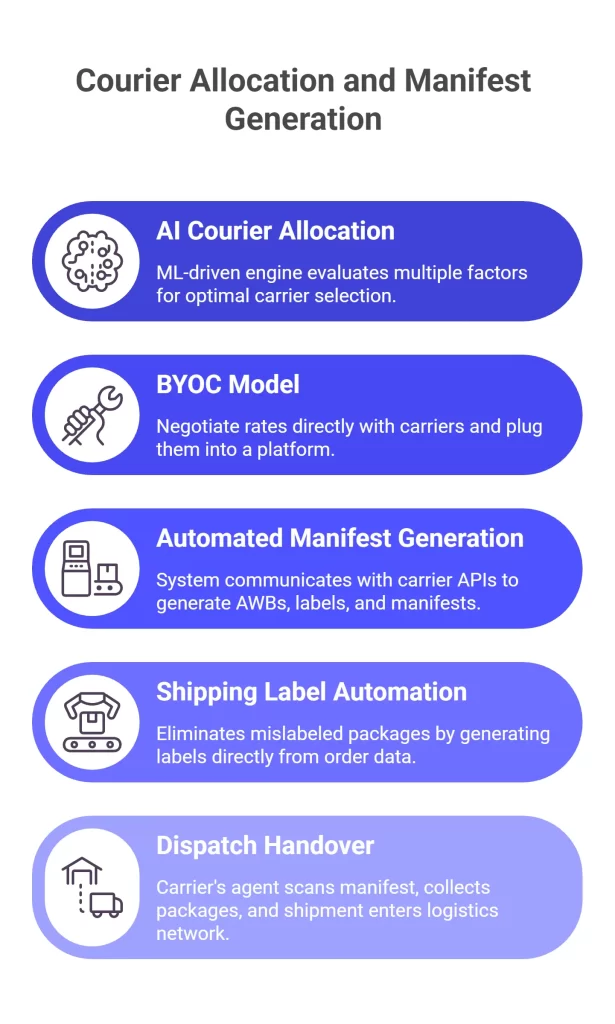
AI courier allocation changes the game entirely. An ML-driven courier selection engine evaluates multiple factors in real time, including cost per shipment, estimated delivery date, carrier performance history for the specific pincode, shipment weight and dimensions, and whether the order is prepaid or COD.
The result? Each order gets matched with the optimal carrier automatically. Some brands even use the BYOC (Bring Your Own Courier) model, where they negotiate rates directly with carriers and plug them into a carrier-agnostic platform. This gives you the flexibility of using your own contracts while still benefiting from intelligent, rule-based automation.
Want to understand why this matters? Read more about why AI courier allocation is crucial for ecommerce brands and how BYOC helps brands ditch aggregators.
Stage 4: Automated Manifest Generation and Label Creation
Once a carrier is assigned, the next step is generating the AWB number, printing the shipping label, and creating the manifest. In a manual setup, this involves logging into each carrier’s portal, entering shipment details, downloading labels, and compiling manifests. For 500 orders a day, this alone can take hours.
With automated manifest generation, the entire process happens in seconds. The system communicates with carrier APIs, generates AWBs in bulk, creates print-ready shipping labels, and compiles manifests automatically. Your warehouse team simply prints and sticks. No data entry. No carrier portal juggling.
Shipping label generation automation also eliminates one of the most common sources of dispatch errors: mislabeled packages. When a machine generates the label directly from order data, the chance of a wrong address or incorrect weight drops to near zero.
Learn how Metaport’s Manifestation module automates this entire stage end to end.
Stage 5: Dispatch Handover and Real-Time Tracking Initiation
The final stage is the physical handover. The carrier’s pickup agent arrives, scans the manifest, collects the packages, and the shipment officially enters the logistics network.
In an automated workflow, this stage triggers several things simultaneously. The order status syncs across all sales channels. The customer receives a shipping confirmation with a branded tracking link. Real-time tracking initiation begins via webhook triggers. And your internal dashboard updates to reflect the dispatch.
This is where your dispatch workflow connects to your tracking and customer engagement systems. The handover isn’t the end of the journey. It’s the beginning of the delivery experience.
Manual vs. Automated Dispatch: A Side-by-Side Comparison
Still wondering if the effort to automate ecommerce dispatch workflows is worth it? Let’s put the numbers side by side.
| Parameter | Manual Dispatch | Automated Dispatch |
|---|---|---|
| Order processing time | 3-5 minutes per order | 5-10 seconds per order |
| Daily capacity (2-person team) | 200-300 orders | 2,000-5,000 orders |
| Label/manifest errors | 5-8% error rate | Less than 0.5% error rate |
| Carrier selection | Fixed or gut-based | AI-optimized per shipment |
| Cost per shipment | Higher (suboptimal carrier matching) | 10-20% lower on average |
| Shipping SLA compliance | 70-80% | 92-98% |
| Scalability | Requires hiring | Scales with software |
The difference isn’t marginal. It’s transformational. And as your order volume grows, the gap between manual and automated only widens.
How Metaport Automates the Entire Dispatch Pipeline
There are several ecommerce workflow automation tools available in 2026, but the architecture matters. Most logistics aggregators lock you into their carrier network and charge per-shipment commissions. A SaaS shipping platform like Metaport takes a fundamentally different approach.
With Metaport, you get a cloud-based logistics platform that covers every stage of the dispatch workflow. Multi-carrier shipping with BYOC flexibility, so you use your own negotiated rates. AI-powered dispatch allocation that optimizes every shipment. Automated manifestation and bulk shipment processing. Real-time order status sync across all channels. And deep integrations with Shopify, Amazon, Flipkart, WooCommerce, and major ERP and WMS systems.
The key difference? You own your carrier relationships. You own your data. And you pay a flat platform fee instead of per-shipment commissions. For a deeper comparison, check out this guide on logistics aggregator vs SaaS platform.
Key Metrics to Track After Automating Dispatch
Automation without measurement is just hope with better software. Once you automate ecommerce dispatch workflows across your operations, track these KPIs religiously:
- Order-to-ship time: The hours between order placement and carrier handover. Target: under 4 hours for same-day dispatch.
- Manifest accuracy rate: Percentage of manifests generated without errors. Target: 99.5% or higher.
- Pickup success rate: How often the carrier successfully picks up on the first attempt. Target: 95% or above.
- Cost per shipment: Your blended shipping cost across all carriers. Track weekly trends.
- SLA compliance rate: Percentage of orders delivered within the promised timeframe.
- RTO rate: Percentage of orders returned to origin. Pre-shipping validation should push this below 5%.
Metaport’s Analytics dashboard gives you real-time visibility into all these metrics, so you can spot issues before they snowball.
Common Pitfalls When Automating Dispatch (And How to Avoid Them)
Automation isn’t a magic wand. Here are the mistakes brands commonly make:
- Automating a broken process. If your warehouse layout is chaotic and your SKU management is a mess, automation will just make bad things happen faster. Fix the foundation first.
- Ignoring exception handling. Not every order fits neatly into a workflow. Build rules for edge cases like oversized items, restricted pincodes, or high-value shipments.
- Choosing an aggregator when you need a platform. Aggregators are great for startups shipping 50 orders a day. But once you cross 500 or more daily orders, you need the control and cost efficiency of a SaaS platform with BYOC support.
- Not training your warehouse team. The best software is useless if your floor team doesn’t know how to use it. Invest in onboarding.
- Setting and forgetting carrier allocation rules. Carrier performance changes. Review and update your allocation logic monthly based on fresh data.
The Bottom Line
If you’re serious about scaling your ecommerce operations in 2026, the decision to automate ecommerce dispatch workflows isn’t optional. It’s the single highest-ROI investment you can make in your logistics stack. From order ingestion to carrier handover, every manual touchpoint is an opportunity for errors, delays, and unnecessary costs.
The brands winning in Indian ecommerce right now aren’t just selling better products. They’re shipping smarter. They’re using AI-powered dispatch, automated manifestation, intelligent carrier allocation, and real-time analytics to deliver faster, cheaper, and more reliably than their competitors.
Ready to automate your dispatch workflow? Explore Metaport’s full platform or get in touch with the team to see how it works for your specific use case.
Frequently Asked Questions
A logistics aggregator offers multi-carrier access but charges per-shipment commissions and locks you into their rates. A SaaS platform like Metaport lets you bring your own courier contracts (BYOC), control carrier allocation rules, and pay a flat fee, delivering lower costs and more flexibility at scale.
AI courier allocation uses machine learning trained on historical shipment data to match each order with the best carrier. It evaluates pincode, weight, cost, SLA performance, and payment mode in real time, continuously improving accuracy unlike static rule-based systems.
Manifestation is the process of registering a shipment with a carrier by generating an AWB number and a manifest listing all packages for pickup. Automating this step eliminates manual data entry, reduces labeling errors, and enables bulk processing, which is essential for tracking and scheduled pickups.
Yes. Pre-shipping validation catches bad addresses, AI carrier allocation picks the best-performing courier per pincode, and automated COD verification confirms buyer intent before dispatch. Together, these steps can cut RTO rates by 15 to 25 percent, saving significant reverse logistics costs.
Most platforms offer native API integrations with Shopify, WooCommerce, and Indian marketplaces like Amazon and Flipkart. You simply install a plugin or connect via API keys, and orders sync in real time. Metaport also integrates with ERP and WMS systems for a fully unified workflow.

Kapil Pathak is a Senior Digital Marketing Executive with over six years of experience in the logistics and supply chain industry. He specializes in SEO, SEM, and multi-channel campaign management. He has a strong track record of building strategies that boost brand visibility and generate qualified leads. His work focuses on driving growth for D2C and B2B technology companies through data-driven digital marketing initiatives.