If you’re a D2C brand struggling with high return rates, the most effective way to reduce RTO is smart courier allocation, an AI-driven approach that matches every order to the best-performing carrier for that specific delivery context. Every failed delivery means double shipping costs, inventory stuck in transit, damaged products, and a customer experience that erodes trust.
Industry data shows that Indian e-commerce brands face average RTO rates of 25-35%, with some categories like fashion and accessories hitting 40%+. For brands operating on razor-thin margins, this isn’t just an inconvenience. It’s an existential threat to profitability.
Yet most brands still rely on generic courier assignment, a one-size-fits-all approach that ignores the nuances of pin codes, courier strengths, and order-level risk. If you’re still wondering what NDR and RTO actually mean in e-commerce and how they impact your bottom line, understanding these fundamentals is the first step toward solving the problem.
The good news? Brands that reduce RTO with smart courier allocation see 30 to 48% fewer failed deliveries while maintaining COD volume and improving contribution margins. In this comprehensive guide, we’ll break down exactly how to implement this strategy for your brand.
What Is RTO and Why Does It Hit D2C Brands So Hard?
RTO (Return to Origin) occurs when a shipment fails to be delivered and is sent back to the seller. Common reasons include:
- Customer unavailability or repeated delivery attempt failures
- Incorrect or incomplete shipping addresses
- Fake orders (especially prevalent in COD)
- Customer refusal at doorstep
- Customer changed their mind post-purchase
- Courier-related issues (wrong attempts, early RTO marking)
The True Cost of RTO for E-commerce Brands
For D2C brands, RTO isn’t just a logistics metric. It’s a profitability killer that compounds across multiple cost centers:
| Cost Component | Impact |
|---|---|
| Forward shipping cost | Paid but completely wasted |
| Reverse shipping cost | Additional expense on top of forward |
| Product damage in transit | Inventory loss (2x transit exposure) |
| Blocked working capital | Cash flow strain for 15-25 days |
| Repackaging & QC | Operational overhead per returned unit |
| Customer acquisition cost | Wasted if order ultimately fails |
| Marketplace penalties | Rating drops, visibility loss |
Let’s do the math: If your average order value is ₹1,200, forward shipping costs ₹80, reverse shipping costs ₹70, and you factor in packaging, QC, and handling, each RTO costs you approximately ₹200-250 in direct losses. At 30% RTO on 10,000 monthly orders, that’s ₹6-7.5 lakhs per month evaporating from your bottom line.
For brands operating on 15-20% contribution margins, this can be the difference between profitability and burning cash. That’s exactly why the urgency to reduce RTO with smart courier allocation has never been higher.
Why Generic Courier Assignment Causes High RTOs
Most brands, especially those using basic logistics aggregators, assign couriers based on:
- Cheapest available rate
- Default partner preference
- Random rotation or round-robin
- Single courier dependency
This is fundamentally flawed. Not all couriers perform equally across every geography, order type, or customer segment. A courier that delivers 98% successfully in metro cities may drop to 75% in Tier-3 towns. When you assign a weak-performing courier to a high-risk pin code, you’re practically guaranteeing a failed delivery.
This is precisely why AI-powered courier allocation has become crucial for e-commerce brands because human intuition and static rules simply can’t process the thousands of variables that determine delivery success.
The Problem with One-Size-Fits-All Shipping
- No pin code intelligence Courier A might excel in South Delhi but struggle in rural Rajasthan. Without granular data, you’re shipping blind.
- No order-risk assessment A high-value COD order to a first-time buyer in a high-RTO zone needs fundamentally different handling than a prepaid repeat order to a metro customer.
- No real-time performance tracking Yesterday’s best courier might be overwhelmed today due to capacity constraints, weather, or operational issues.
- No learning loop Failed deliveries don’t inform future allocation decisions, so the same mistakes repeat endlessly.
- No dynamic adaptation Festival seasons, sales events, and regional disruptions require real-time reallocation that static systems can’t provide.
The brands that understand multi-carrier shipping strategy gain a structural advantage. They have options, data, and the ability to optimize dynamically rather than being locked into a single courier’s limitations.
How Smart Courier Allocation Helps Reduce RTO: The Complete Mechanism
Smart courier allocation uses data, AI, and automation to match every order with the best-performing courier for that specific delivery context. Here’s how brands reduce RTO with smart courier allocation across multiple intelligence layers:
1. Pin Code-Level Performance Analysis
The foundation of smart allocation is granular, pin code-level delivery data. Instead of knowing that “Courier A has 90% delivery rate nationally,” the system knows:
- Courier A has 97% success in pin code 110001 (Connaught Place) but only 78% success in pin code 303503 (rural Rajasthan)
- Courier B has 92% success in Tier-2 cities of Maharashtra but 85% in Northeast India
- Courier C dominates remote areas with 88% success where others average 70%
This pin code-level intelligence means every order gets routed to the courier with the highest probability of successful delivery for that exact location.
2. Real-Time Courier Performance Scoring
Static historical data isn’t enough. The best systems track real-time performance including:
- Current SLA adherence (are they delivering on time today?)
- Active capacity utilization (are they overwhelmed?)
- Recent delivery success rates (last 7-day rolling average)
- NDR resolution speed (how quickly do they reattempt?)
- Current serviceability status (any temporary disruptions?)
This dynamic scoring ensures allocation decisions reflect current reality, not just historical averages.
3. Order-Level Risk Assessment
Smart allocation doesn’t just look at the courier. It evaluates the order itself through multiple risk dimensions:
- Payment method COD orders carry 3-5x higher RTO risk than prepaid
- Customer history Repeat buyers have 60-70% lower RTO than first-time buyers
- Order value Unusually high-value COD orders may indicate fraud
- Product category Fashion (size/fit issues) has higher RTO than electronics
- Address quality Incomplete addresses, landmark-only addresses flag potential failures
- Time of order Late-night COD orders from new customers show higher RTO patterns
- Geographic risk Certain pin codes have historically elevated RTO regardless of courier
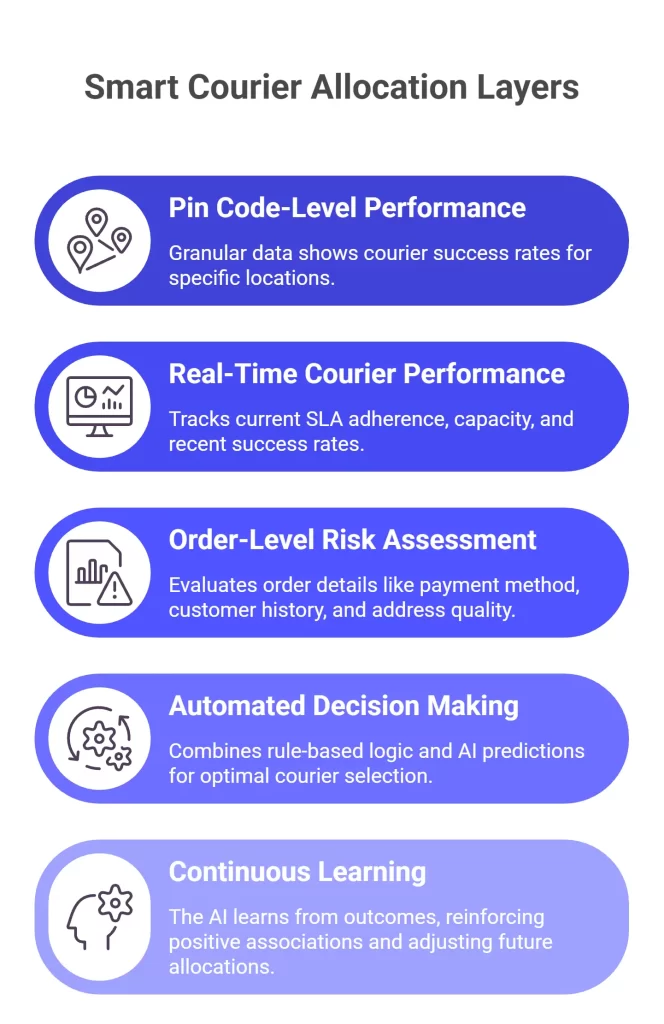
4. Automated Rule-Based + AI-Driven Decisions
The most effective platforms combine multiple decision layers:
- Rule-based logic “Always use Courier X for prepaid orders above ₹2,000 in Zone A”
- AI predictions “Based on 100,000+ historical deliveries, Courier Y has 94.2% success probability for this specific order profile”
- Dynamic fallbacks “If Courier X is at capacity or experiencing delays, automatically route to next-best performer”
- Exception handling “Flag this order for manual review due to multiple risk indicators”
When you automate your e-commerce dispatch workflow, these decisions happen in milliseconds. No manual intervention needed, no human bias, no delays.
5. Continuous Learning and Optimization
The AI doesn’t just make decisions. It learns from outcomes:
- Every successful delivery reinforces positive courier-pin code associations
- Every RTO feeds back into the model, adjusting future allocations
- Seasonal patterns are detected and pre-emptively addressed
- New courier partners are rapidly evaluated and integrated into the scoring model
Key Metrics to Track When You Reduce RTO with Smart Courier Allocation
Implementing smart courier allocation isn’t a set-and-forget solution. You need to monitor these metrics continuously to ensure ongoing optimization:
Delivery Performance Metrics
| Metric | What It Tells You | Target Benchmark |
|---|---|---|
| First Attempt Delivery Rate (FADR) | How often couriers deliver on the first try | >85% |
| RTO % by Courier | Which couriers have the highest return rates | <15% |
| RTO % by Pin Code | Geographic hotspots for failed deliveries | Identify top 50 problem zones |
| SLA Adherence | Are couriers meeting promised timelines? | >90% |
| NDR Resolution Rate | How effectively are non-deliveries being rescued? | >60% |
| Fake Delivery Attempt % | Couriers marking attempts without actually trying | <2% |
Order-Level Risk Metrics
| Metric | What It Tells You | Action Trigger |
|---|---|---|
| COD RTO Rate vs. Prepaid RTO Rate | The true cost of COD | If gap >20%, increase prepaid incentives |
| RTO by Product Category | Which products get returned most | Category-specific courier rules |
| RTO by Customer Segment | First-time vs. repeat buyer behavior | Risk-based allocation tiers |
| Address Validation Failure Rate | How many orders have risky addresses | Auto-correction or verification |
| Order Cancellation Pre-Dispatch | Catching bad orders before shipping | Fraud scoring threshold |
Financial Impact Metrics
| Metric | What It Tells You |
|---|---|
| Cost per RTO | Total financial impact of each failed delivery |
| Shipping cost as % of AOV | Overall logistics efficiency |
| Contribution margin improvement | Bottom-line impact of RTO reduction |
| Working capital freed | Cash flow improvement from fewer RTOs |
Step-by-Step Framework to Reduce RTO with Smart Courier Allocation
Here’s a comprehensive implementation framework for D2C brands:
Step 1: Audit Your Current RTO Data
Before optimizing, understand your baseline thoroughly:
- What’s your overall RTO rate (last 90 days)?
- Break it down: Which couriers contribute most to RTO?
- Which pin codes/zones are consistently problematic?
- What percentage of RTO is COD vs. prepaid?
- What are the top 5 reasons for delivery failure?
- Is there a day-of-week or time-of-day pattern?
- Which product categories have the highest RTO?
Pro tip: If you’re currently struggling with manual data reconciliation across multiple couriers, you’re not alone. Understanding the hidden costs of manual freight reconciliation is often the wake-up call brands need to invest in automation.
Step 2: Integrate Multiple Courier Partners
You can’t optimize allocation with a single courier. Integrate with 4-6+ courier partners to give the system meaningful options. Each courier will have different strengths:
- Courier A Strong in metros, fastest delivery, premium pricing
- Courier B Best COD handling and NDR resolution in Tier-2 cities
- Courier C Excellent coverage in Northeast/remote/hilly areas
- Courier D Most cost-effective for low-risk prepaid orders
- Courier E Specialized in heavy/bulky shipments
- Courier F Best same-day/next-day capability in select cities
The key insight here is that brands increasingly want to bring their own courier (BYOC) rather than being limited to an aggregator’s pre-selected panel. This gives you negotiating power, relationship ownership, and the flexibility to add niche carriers for specific use cases.
Step 3: Implement AI-Powered Smart Courier Allocation Logic
Deploy a platform that offers:
- Pin code-level courier performance scoring with daily updates
- Real-time SLA and capacity monitoring across all partners
- Order risk scoring (COD fraud detection, address validation, customer scoring)
- Automated courier assignment with customizable rules
- Machine learning models that improve with every shipment
- A/B testing capability to evaluate new couriers or rule changes
- Override capability for manual intervention when needed
The difference between a basic logistics aggregator and a true SaaS platform becomes critical here. Aggregators give you access to couriers; SaaS platforms give you intelligence, control, and data ownership to make smarter decisions.
Step 4: Layer in Pre-Shipment Verification
Smart allocation works best when combined with pre-shipment intelligence:
- IVR/WhatsApp order confirmation for COD orders above a threshold
- Address validation and auto-correction using AI-powered address parsing
- COD-to-prepaid conversion nudges offering small discounts for prepaid payment on high-risk orders
- Fraud scoring to cancel suspicious orders before dispatch (saving shipping costs entirely)
- Duplicate order detection catching accidental or fraudulent repeat orders
- Customer verification OTP or callback for first-time high-value COD orders
Step 5: Optimize the Post-Dispatch Experience
RTO reduction doesn’t stop at dispatch. The post-purchase experience plays a crucial role:
- Proactive delivery communication Keep customers informed about shipment status via WhatsApp/SMS
- Branded tracking pages Reduce anxiety and WISMO (Where Is My Order) queries. Learn how branded tracking pages cut WISMO tickets while improving customer confidence in delivery
- AI-powered estimated delivery dates Setting accurate expectations reduces cancellations. Discover how AI-estimated delivery dates boost conversions and reduce post-purchase anxiety
- NDR management automation When delivery fails, instant customer outreach to reschedule or confirm address
- Delivery slot preferences Let customers choose convenient delivery windows
These post-dispatch optimizations work synergistically with smart allocation. Together, they create a last-mile customer experience that becomes a competitive edge rather than just a cost center.
Step 6: Create a Continuous Improvement Loop
Brands that treat RTO reduction as an ongoing operational discipline rather than a one-time project achieve 18 to 24% additional improvement in year two through systematic learning and optimization.
Your improvement loop should include:
- Weekly RTO analysis Identify new patterns, emerging problem zones, courier degradation
- Bi-weekly allocation rule reviews Are current rules still optimal? What needs adjustment?
- Monthly courier scorecards Hold partners accountable with data-driven performance reviews
- Quarterly strategy reviews Adjust allocation strategy, evaluate new courier partners, review AI model performance
- Continuous AI training Feed new delivery outcome data into models for ongoing accuracy improvement
Results: What Happens When Brands Reduce RTO with Smart Courier Allocation
When D2C brands implement intelligent, data-driven courier allocation comprehensively, the results are transformative:
Before vs. After Comparison
| Metric | Before Smart Allocation | After Smart Allocation |
|---|---|---|
| Overall RTO rate | 25-35% | 12-18% |
| Courier assignment method | Cheapest/random/default | Pin code-optimized AI routing |
| Order risk assessment | None | AI-powered multi-factor scoring |
| Freight reconciliation | Manual, error-prone | Automated, real-time |
| NDR handling | Reactive (24-48hr delay) | Proactive (instant outreach) |
| Delivery success visibility | Post-facto reports | Real-time dashboards |
| Cost per shipment optimization | Static rates | Dynamic best-rate selection |
| Customer delivery experience | Generic tracking | Branded, proactive communication |
Typical Timeline of Results
- Week 1-2: Platform integration, historical data analysis, baseline establishment
- Week 3-4: Initial AI allocation goes live, first improvements visible (8-12% RTO reduction)
- Month 2-3: AI model matures with more data, significant improvement (20-30% RTO reduction)
- Month 4-6: Full optimization with pre-shipment verification, NDR automation (30-48% RTO reduction)
- Month 6+: Continuous compounding improvements, seasonal pattern mastery
Why a SaaS Platform Beats Traditional Aggregators to Reduce RTO
Traditional logistics aggregators offer multi-carrier access but often lack the intelligence layer needed for true RTO optimization:
What Aggregators Typically Offer:
- Access to multiple couriers through single integration
- Basic rate comparison
- Single dashboard for tracking
- Standard label generation and manifest creation
What They Typically Lack:
- Transparency You don’t see granular courier-level performance data by pin code
- Control Allocation logic is a black box; you can’t customize rules
- Data ownership Your shipping data lives on their platform, not yours
- BYOC flexibility You’re locked into their courier panel and negotiated rates
- AI intelligence Basic rule engines, not true machine learning
- Customization Can’t set brand-specific, category-specific, or customer-specific rules
What a SaaS Shipping Intelligence Platform Provides:
- Full visibility into courier performance by pin code, zone, and order type
- Custom allocation rules + AI recommendations you control
- BYOC capability using your own negotiated rates and preferred partners
- Real-time dashboards and exportable analytics
- Automated dispatch workflows that scale with your volume
- Branded tracking pages that enhance customer experience
- Complete data ownership, your data, your insights, your competitive advantage
- API-first architecture for seamless integration with your tech stack
Actionable Checklist: Reduce RTO with Smart Courier Allocation Starting This Week
Here’s what you can implement immediately:
Quick Wins (This Week)
- Pull your last 90 days of RTO data and segment by courier, pin code, and payment method
- Identify your top 20 worst-performing courier-zone combinations
- Implement address validation on checkout (even basic pin code verification helps)
- Set up WhatsApp/SMS order confirmation for COD orders above ₹1,000
- Create a simple rule: route high-risk pin codes away from your worst-performing courier
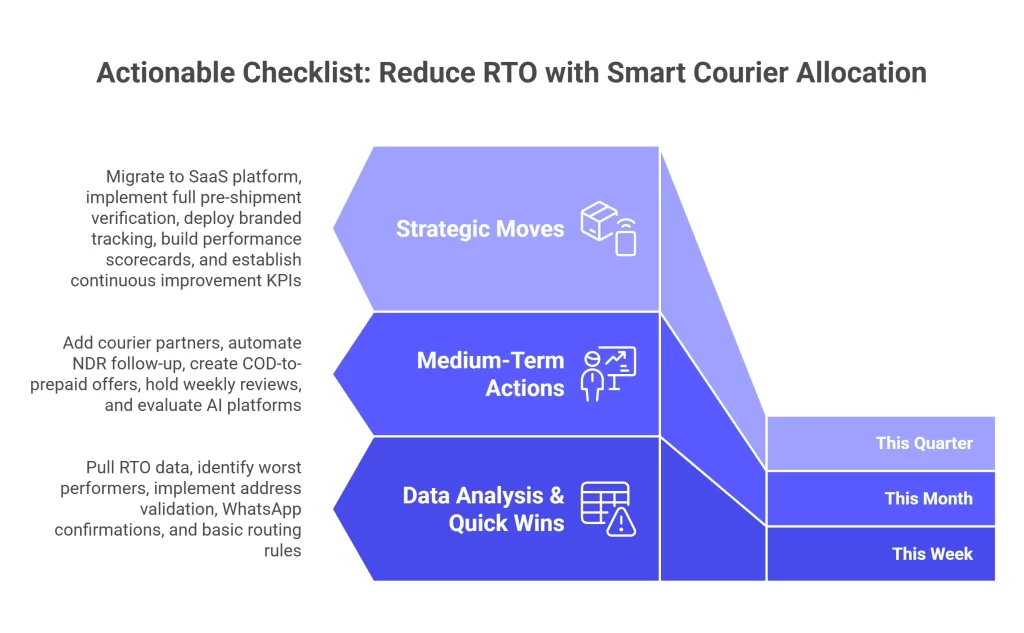
Medium-Term Actions (This Month)
- Add at least 2 more courier partners to enable optimization
- Implement automated NDR follow-up within 2 hours of failed attempt
- Set up COD-to-prepaid conversion offers for flagged orders
- Create weekly RTO review meetings with your operations team
- Evaluate AI-powered allocation platforms for implementation
Strategic Moves (This Quarter)
- Migrate to a SaaS shipping platform with AI allocation capabilities
- Implement full pre-shipment verification workflow
- Deploy branded tracking pages with proactive communication
- Build courier performance scorecards and quarterly business reviews
- Establish continuous improvement KPIs and accountability
Conclusion
In 2026’s hyper-competitive D2C landscape, shipping isn’t just a cost center. It’s a growth lever. Brands that reduce RTO with smart courier allocation don’t just save money on failed deliveries; they deliver faster, build customer trust, improve repeat purchase rates, and unlock better unit economics that fund further growth.
The data is clear: intelligent, AI-powered courier allocation can reduce RTO by 30 to 48% while maintaining COD availability and improving contribution margins by ₹3-4 per order. For a brand shipping 10,000 orders monthly, that’s ₹30,000-40,000 in monthly margin improvement, compounding as you scale.
The brands that treat RTO reduction as a strategic priority, investing in data infrastructure, AI-powered allocation, and continuous optimization, will build a structural cost advantage that competitors relying on manual processes simply cannot match.
Stop shipping blind. Start shipping smart.
Ready to Reduce RTO with Smart Courier Allocation?
MetaPort’s AI-powered shipping intelligence platform gives D2C brands full control over courier allocation, real-time performance analytics, and automated dispatch workflows, all designed to minimize RTO and maximize delivery success.
Frequently Asked Questions (FAQs)
RTO (Return to Origin) happens when a shipment fails delivery and returns to the seller. Brands lose money on forward + reverse shipping, face inventory damage, and waste customer acquisition costs. Learn more about what NDR and RTO mean in e-commerce.
It uses AI and historical data to assign each order to the courier with the highest delivery success rate for that specific pin code, payment method, and customer profile. This results in 30-48% fewer failed deliveries compared to random or cheapest-rate assignment.
No. You need multiple courier partners (ideally 4-6) because different couriers perform differently across geographies and order types. Explore multi-carrier shipping strategies to build the foundation for intelligent allocation.
Aggregators offer courier access but keep allocation logic as a black box. A SaaS platform gives you data ownership, custom AI rules, BYOC capability, and real-time analytics. Read our logistics aggregator vs. SaaS platform comparison for details.
Most brands see 8-12% RTO reduction in the first month. Results compound as the AI learns, reaching 20-30% by month 2-3 and 30-48% by month 4-6 with consistent order volume.
Not at all. Smart courier allocation maintains COD availability while reducing COD-related RTO by routing high-risk orders to couriers with the best COD success rates and layering in pre-shipment verification to filter fraudulent orders.
Related Reading:
- What Is NDR & RTO in E-commerce?
- Why AI Courier Allocation Is Crucial for E-commerce Brands
- Multi-Carrier Shipping: The Complete Guide
- BYOC: Why Brands Are Leaving Aggregators
- How to Automate Your E-commerce Dispatch Workflow

Kapil Pathak is a Senior Digital Marketing Executive with over six years of experience in the logistics and supply chain industry. He specializes in SEO, SEM, and multi-channel campaign management. He has a strong track record of building strategies that boost brand visibility and generate qualified leads. His work focuses on driving growth for D2C and B2B technology companies through data-driven digital marketing initiatives.