You’re browsing an online store. You’ve found the perfect pair of sneakers. The price is right. The reviews are solid. You’re ready to buy. But then you hit the checkout page and see this: “Delivery in 5-10 business days.” That vague promise just killed the sale. In 2026, an AI estimated delivery date in ecommerce isn’t a bonus feature. It’s the difference between a conversion and an abandoned cart. This guide shows you exactly how AI delivery date predictions boost conversions and build lasting customer trust.
This is the power of an AI estimated delivery date in ecommerce. It’s not just a nice feature. It’s a conversion engine, a trust builder, and one of the most underrated competitive advantages a brand can have today. In this guide, we’ll break down exactly how AI delivery date predictions work, why they matter more than ever, and how you can implement them to boost conversions and build lasting customer trust.
Why Estimated Delivery Dates Matter More Than Ever in eCommerce
Let’s talk about what’s really happening inside your customer’s head when they shop online. There’s always a degree of delivery anxiety. Will it arrive on time? Will it arrive at all? Can I trust this brand to keep its promise?
This shipping uncertainty is one of the biggest silent killers of ecommerce conversions. Studies consistently show that unclear or missing delivery information is among the top five reasons shoppers abandon their carts. It’s not always about price. Sometimes it’s simply about not knowing when the product will show up.
In India’s ecommerce landscape, this problem is amplified. With thousands of pin codes, varying carrier performance across regions, and seasonal disruptions during festivals and monsoons, giving customers an accurate delivery estimate is genuinely hard. But that’s exactly why it matters so much.
When you show a confident, specific estimated delivery date on your product page, you’re doing something powerful. You’re removing uncertainty. You’re setting clear customer expectations. And you’re giving shoppers the purchase confidence they need to click “Buy Now” instead of bouncing to a competitor.
The brands that understand this are already winning. The ones that don’t are leaving money on the table every single day.
AI Estimated Delivery Date eCommerce: What It Is and How It Works
An estimated delivery date, or EDD, is the specific date a customer can expect to receive their order. Simple concept. But the way it’s calculated makes all the difference.
Traditional delivery estimates are static. A brand sets a blanket rule like “3-5 business days” or “7-10 days for remote areas” and applies it across the board. These estimates don’t account for real-time carrier performance, warehouse location, or pin code-level delivery patterns. They’re averages at best and misleading at worst.
An AI delivery predictor for online stores takes a completely different approach. It uses machine learning models trained on historical shipment data to calculate a dynamic, real-time delivery date for each specific order. The prediction isn’t based on averages. It’s based on what’s actually happening right now in the logistics network.
Think of it this way. A static estimate is like checking the weather forecast for the entire country. An AI-powered EDD is like checking the forecast for your exact neighborhood, updated every hour. The difference in accuracy is massive, and so is the impact on customer behavior.
How AI Delivery Date Predictions Actually Work
So what’s happening under the hood? How does an AI system calculate that “Delivery by Friday, May 2” promise with enough confidence to display it on your product page?
The Data Inputs That Power Accurate Predictions
A machine learning delivery prediction model processes multiple data points simultaneously. These typically include:
- Carrier delivery performance by pin code. Not all carriers perform equally in all regions. An AI system tracks actual delivery times for each carrier at the pin code level, building a performance score that updates continuously.
- Warehouse proximity and inventory location. If the product ships from a warehouse in Delhi versus one in Bangalore, the transit time to a customer in Chennai will be very different. The system factors in which fulfillment center will process the order.
- Historical shipment data. Thousands of past deliveries create patterns. The model learns that Carrier X delivers to pin code 560001 in an average of 2.3 days, while Carrier Y takes 3.1 days for the same route.
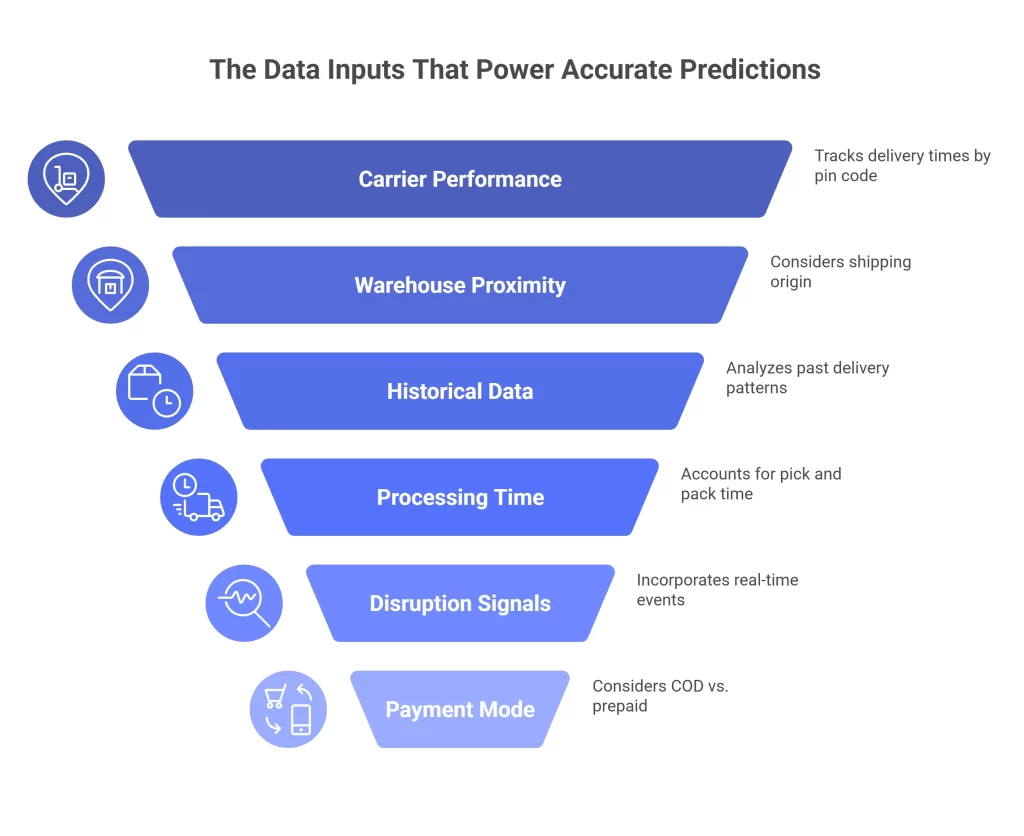
- Order processing and dispatch time. How long does it typically take your warehouse to pick, pack, and hand over the shipment? This pre-dispatch window is factored into the final estimate.
- Real-time disruption signals. Holidays, weather events, regional strikes, and carrier capacity constraints all affect delivery timelines. Advanced systems incorporate these signals for real-time recalculation.
- Payment mode. COD orders often have different processing times compared to prepaid orders. The model accounts for this.
Real-Time Recalculation vs. Static Promises
Here’s what makes AI-powered predictions fundamentally different from static estimates. They recalculate in real time. If a carrier’s performance dips in a specific region due to heavy rains, the system adjusts the predicted delivery date automatically. If your warehouse processes orders faster on Tuesdays than Fridays, the model knows that too.
This dynamic delivery date estimation means the date shown to a customer at 10 AM might be slightly different from what’s shown at 6 PM, because the underlying conditions have changed. That level of precision is what builds genuine delivery promise accuracy.
The connection to AI courier allocation is direct. The same intelligence that selects the best carrier for each shipment also feeds into the delivery date prediction. When your courier selection engine picks the fastest, most reliable carrier for a specific pin code, the EDD becomes more accurate as a natural byproduct.
5 Ways AI Estimated Delivery Date eCommerce Tools Boost Conversions
Now let’s get to the part that matters most for your business. How does an AI estimated delivery date in ecommerce actually translate into more sales? Here are five proven ways it impacts your bottom line.
1. Reduces Cart Abandonment at Checkout
Cart abandonment is the biggest leak in any ecommerce funnel. And one of the top reasons shoppers abandon? Unclear delivery timelines. When a customer reaches checkout and sees a vague “5-10 days” estimate, doubt creeps in. Will it arrive before the weekend? Before that birthday? Before the festival?
A predicted delivery date that reduces cart abandonment works because it answers the question before the doubt even forms. “Get it by Thursday” is infinitely more compelling than “Ships in 5-7 business days.” Brands that display specific delivery dates at checkout consistently see checkout conversion rates improve by 15 to 35 percent.
2. Builds Pre-Purchase Trust on Product Pages
The best place to show an estimated delivery date isn’t just at checkout. It’s on the product page itself. When a shopper sees “Delivery by May 2 to 560001” right next to the “Add to Cart” button, it acts as a powerful buyer decision trigger.
It signals that the brand has its logistics figured out. It communicates pre-purchase transparency. And it builds the kind of purchase confidence that turns browsers into buyers. Showing the delivery date on the product page is one of the simplest product page optimizations with the highest conversion impact.
3. Cuts WISMO Tickets by Setting Right Expectations
“Where is my order?” WISMO queries are the number one driver of customer support tickets for ecommerce brands. And most WISMO tickets aren’t caused by late deliveries. They’re caused by unclear expectations.
When you set an accurate delivery promise upfront, customers know exactly when to expect their package. They don’t need to call, email, or chat with support to ask. Combine this with a branded tracking page that reinforces the same delivery date, and you can reduce WISMO ticket volume by 40 to 60 percent. That’s a direct saving on customer support costs and a massive improvement in post-purchase satisfaction.
4. Lowers RTO by Aligning Customer Availability
Here’s a connection most brands miss. Inaccurate delivery dates contribute to higher RTO (Return to Origin) rates. When a customer expects delivery on Tuesday but the package arrives on Friday, they might not be home. The delivery fails. The courier reattempts. Eventually, the package returns to origin.
Accurate AI delivery predictions align the customer’s availability with the actual delivery window. The customer knows when to expect the package and plans accordingly. This simple alignment can reduce NDR (Non-Delivery Report) instances significantly. For a deeper dive into this, check out our guide on NDR and RTO in ecommerce.
5. Increases Repeat Purchase Rate Through Reliability
Trust isn’t built in a single transaction. It’s built over multiple deliveries that match the promise. When a brand consistently delivers on the date it predicted, customers notice. They remember. And they come back.
This reliability loop directly impacts customer lifetime value (CLV) and repeat purchase rate. A customer who received three orders on the exact predicted date is far more likely to order a fourth time than one who experienced even a single surprise delay. Delivery promise accuracy isn’t just an operational metric. It’s a loyalty metric.
Static vs. Dynamic Delivery Dates: A Clear Comparison
Still using blanket delivery estimates instead of an AI estimated delivery date in ecommerce? Here’s how static and dynamic approaches compare:
| Parameter | Static Delivery Estimate | AI-Powered Dynamic EDD |
|---|---|---|
| Calculation method | Fixed rules (e.g., “3-5 days”) | ML model using real-time data |
| Pin code accuracy | Same estimate for all pin codes | Pin code-level delivery prediction |
| Carrier performance | Not considered | Continuously scored and weighted |
| Disruption handling | No adjustment | Real-time recalculation for holidays, weather |
| Customer trust impact | Low (vague promises) | High (specific, reliable dates) |
| Conversion impact | Minimal | 15-35% improvement at checkout |
| WISMO reduction | None | 40-60% fewer tickets |
| Accuracy rate | 50-65% | 85-95% |
The difference is clear. Static estimates are a relic of early ecommerce. In 2026, customers expect the same precision from your delivery date as they do from a cab arriving in 4 minutes. Dynamic, AI-powered EDD delivers that precision.
How Metaport EDD Delivers Pin Code-Level Accuracy
There are several platforms offering delivery date widgets, but the depth of intelligence behind the prediction matters enormously. A surface-level estimate based on carrier-provided SLAs is very different from a prediction built on actual delivery performance data.
Metaport’s EDD Delivery Predictor is built on multi-carrier intelligence. It doesn’t just check what a carrier promises. It checks what a carrier actually delivers, at the pin code level, across thousands of historical shipments.
Here’s what makes it different:
- Pin code-level delivery estimates based on real carrier performance, not SLA documents
- Multi-carrier comparison that factors in which carrier is fastest and most reliable for each specific route
- Real-time recalculation that adjusts for holidays, weather disruptions, and carrier capacity changes
- API-driven delivery estimates that integrate directly into your product pages and checkout flow
- Smart delivery date widget that displays on your storefront without any custom development
The system works hand-in-hand with Metaport’s AI courier allocation engine. When the platform selects the optimal carrier for a shipment, the EDD automatically reflects that carrier’s actual performance for the destination pin code. The result is a delivery promise your customers can actually trust.
For brands using the BYOC (Bring Your Own Courier) model, Metaport’s EDD works with your own carrier contracts, giving you the same prediction accuracy regardless of which couriers you use.
How to Implement AI Delivery Date Predictions on Your Store
Ready to add an AI estimated delivery date to your ecommerce store? Here’s a practical, step-by-step approach.
Step 1: Connect Your Sales Channels
Start by integrating your storefront, whether it’s Shopify, WooCommerce, Magento, or a marketplace like Amazon and Flipkart, with your logistics platform. Metaport’s integrations support all major platforms, so orders and product data sync automatically.
Step 2: Integrate Your Carrier Network
Your EDD is only as accurate as the carrier data behind it. Connect all your active carriers to the platform. If you’re using the BYOC model, plug in your own contracts. The system will start collecting and analyzing carrier performance data from day one.
Step 3: Enable EDD on Product and Checkout Pages
Deploy the smart delivery date widget on your product pages and checkout flow. Most platforms offer this as a simple embed or API call. The widget should display a specific date (not a range) based on the customer’s pin code.
Best practice: ask for the pin code early. A simple “Enter your pin code for delivery date” field on the product page lets you show a personalized estimate before the customer even adds to cart.
Step 4: Monitor and Optimize with Analytics
Once live, track your delivery promise accuracy rate religiously. Compare predicted dates against actual delivery dates. Identify carriers or pin codes where accuracy is low and adjust your allocation rules accordingly. Metaport’s Analytics dashboard gives you this visibility in real time.
Key Metrics to Track After Implementing EDD
Implementing an AI estimated delivery date in ecommerce is just the beginning. To maximize its impact, monitor these KPIs weekly:
- Delivery promise accuracy rate: Percentage of orders delivered on or before the predicted date. Target: 90% or higher.
- Checkout conversion rate lift: Compare conversion rates before and after EDD implementation. Even a 5% lift translates to significant revenue.
- Cart abandonment rate: Track whether cart abandonment decreases after showing specific delivery dates.
- WISMO ticket volume: Measure the reduction in “Where is my order?” queries post-implementation.
- Repeat purchase rate: Monitor whether customers who received orders on the predicted date return more frequently.
- NDR/RTO rate: Check if accurate delivery predictions correlate with fewer failed deliveries and returns.
- Customer satisfaction (CSAT) scores: Survey customers about their delivery experience and track trends over time.
These metrics connect directly to your bottom line. A 1% improvement in checkout conversion rate at 10,000 monthly visitors could mean hundreds of additional orders. A 30% reduction in WISMO tickets could save your support team dozens of hours every week.
Common Mistakes Brands Make with Delivery Date Predictions
Before you implement an AI estimated delivery date in ecommerce, watch out for these common pitfalls:
- Showing ranges instead of specific dates. “3-5 days” doesn’t build trust. “May 2” does. Always aim for a single date, not a window.
- Using carrier SLAs instead of actual performance data. A carrier might promise 3-day delivery but actually deliver in 4.5 days on average for certain pin codes. Your EDD should reflect reality, not promises.
- Not accounting for order processing time. Your warehouse takes 4-6 hours to dispatch? That needs to be factored into the prediction. Otherwise, your EDD will consistently overpromise.
- Ignoring regional disruptions. Festivals, elections, weather events, and local holidays all impact delivery timelines. Your system needs to account for these dynamically.
- Setting it and forgetting it. Carrier performance changes over time. New routes open. Old ones degrade. Review your EDD accuracy monthly and recalibrate.
The Connection Between EDD and the Broader Delivery Experience
An AI estimated delivery date doesn’t exist in isolation. It’s one piece of a larger last-mile customer experience puzzle that includes everything from branded tracking pages and proactive shipping notifications to intelligent dispatch automation and NDR management.
When all these pieces work together, the customer experience transforms. The shopper sees a specific delivery date before purchasing. They receive a confirmation with the same date after ordering. They track their package on a branded page that reinforces the promise. And the package arrives exactly when predicted.
That’s not just logistics. That’s brand building. And in a market where D2C brands are competing fiercely for customer loyalty, this kind of delivery experience becomes your strongest competitive edge.
The Bottom Line
In 2026, showing an AI estimated delivery date in ecommerce isn’t a nice-to-have feature. It’s a fundamental expectation. Customers want specificity, not vagueness. They want confidence, not guesswork. And they reward brands that deliver on their promises with loyalty, repeat purchases, and word-of-mouth referrals.
The technology exists today to predict delivery dates with 85 to 95 percent accuracy at the pin code level. The brands implementing it are seeing higher conversions, lower cart abandonment, fewer WISMO tickets, reduced RTO rates, and stronger customer trust.
The question isn’t whether you should implement AI delivery date predictions. The question is how much longer you can afford not to.
Ready to show your customers exactly when their order will arrive? Explore Metaport’s EDD Delivery Predictor or get in touch with the team to see it in action for your store.
Frequently Asked Questions
An estimated delivery date (EDD) is the specific date a customer can expect their order at their doorstep. An expected shipping date is simply when the order leaves the warehouse. EDD factors in dispatch time, carrier transit performance, pin code serviceability, and warehouse proximity, making it the date that actually matters to your customer.
AI uses machine learning trained on thousands of historical shipments to calculate pin code-level delivery dates in real time. It factors in carrier speed, order processing time, payment mode, and disruptions like weather or holidays. This delivers 85 to 95 percent accuracy compared to just 50 to 65 percent with static “3-5 days” estimates.
Yes. Delivery uncertainty is a top reason shoppers abandon carts. Displaying a specific, pin code-level delivery date on the product page removes doubt and builds purchase confidence before checkout. Brands using this approach report 15 to 35 percent higher conversion rates.
Absolutely. Accurate delivery predictions help customers plan their availability, reducing failed delivery attempts. This directly lowers NDR (Non-Delivery Report) and RTO (Return to Origin) rates, cutting reverse logistics costs and improving freight reconciliation outcomes for Indian ecommerce brands.
Platforms like Metaport offer native API integrations with Shopify, WooCommerce, Amazon, and Flipkart. Simply connect your store, integrate your carrier network, and deploy a smart EDD widget on product and checkout pages. It displays pin code-specific delivery dates automatically with no custom development needed.

Kapil Pathak is a Senior Digital Marketing Executive with over six years of experience in the logistics and supply chain industry. He specializes in SEO, SEM, and multi-channel campaign management. He has a strong track record of building strategies that boost brand visibility and generate qualified leads. His work focuses on driving growth for D2C and B2B technology companies through data-driven digital marketing initiatives.