Your customer just clicked “Place Order.” Confetti animation plays. The order confirmation email lands in their inbox. And then… silence. For most ecommerce brands in India, the post-purchase customer experience begins and ends with a generic “Your order has been shipped” SMS. Maybe a tracking link that redirects to a courier’s cluttered website. That’s it. The relationship goes cold until the package arrives (or doesn’t).
Here’s the problem. The period between checkout and delivery is the most emotionally charged part of the customer journey. Your buyer is excited, anxious, and checking their phone constantly. Yet most D2C brands treat this window as a logistics problem rather than a brand-building opportunity.
In this guide, we’ll explore how to build a post-purchase experience in ecommerce that goes far beyond basic delivery notifications. We’ll cover proactive communication, branded tracking, engagement strategies, operational excellence, and the metrics that actually matter. Whether you’re a growing D2C brand or an established ecommerce player, these strategies will help you turn one-time buyers into loyal repeat customers.
Why the Post-Purchase Customer Experience Matters More Than You Think
Let’s start with a reality check. Acquiring a new customer costs 5-7x more than retaining an existing one. Yet most ecommerce brands pour 80% of their marketing budget into acquisition and barely 20% into retention.
The post-purchase customer journey is where retention is won or lost. Consider these numbers:
- 70% of customers say the delivery experience directly influences whether they’ll buy again
- Brands with strong post-purchase engagement see 30-40% higher repeat purchase rates
- WISMO (Where Is My Order) queries account for up to 50% of customer support tickets for Indian D2C brands
When you invest in the post-purchase experience, you’re not just making customers happy. You’re reducing support costs, increasing customer lifetime value (CLTV), and building a brand that people talk about.
According to a 2025 Salesforce report, 88% of customers say the experience a company provides is as important as its products or services, and post-purchase interactions account for over 40% of overall brand perception.
Source: Salesforce State of the Connected Customer, 2025
The Stages of the Post-Purchase Experience
Before we dive into strategies, let’s map out the complete post-purchase customer journey. Most brands only think about stages 2 and 3, but there are actually seven distinct touchpoints:
- Order confirmation – The immediate acknowledgment after purchase
- Order processing/packing – Updates while the order is being prepared
- Shipped notification – The handoff to the courier partner
- In-transit updates – Shipment milestones as the package moves
- Out for delivery alert – The final mile notification
- Delivered confirmation – Proof of delivery communication
- Post-delivery engagement – Follow-up, feedback, and relationship building
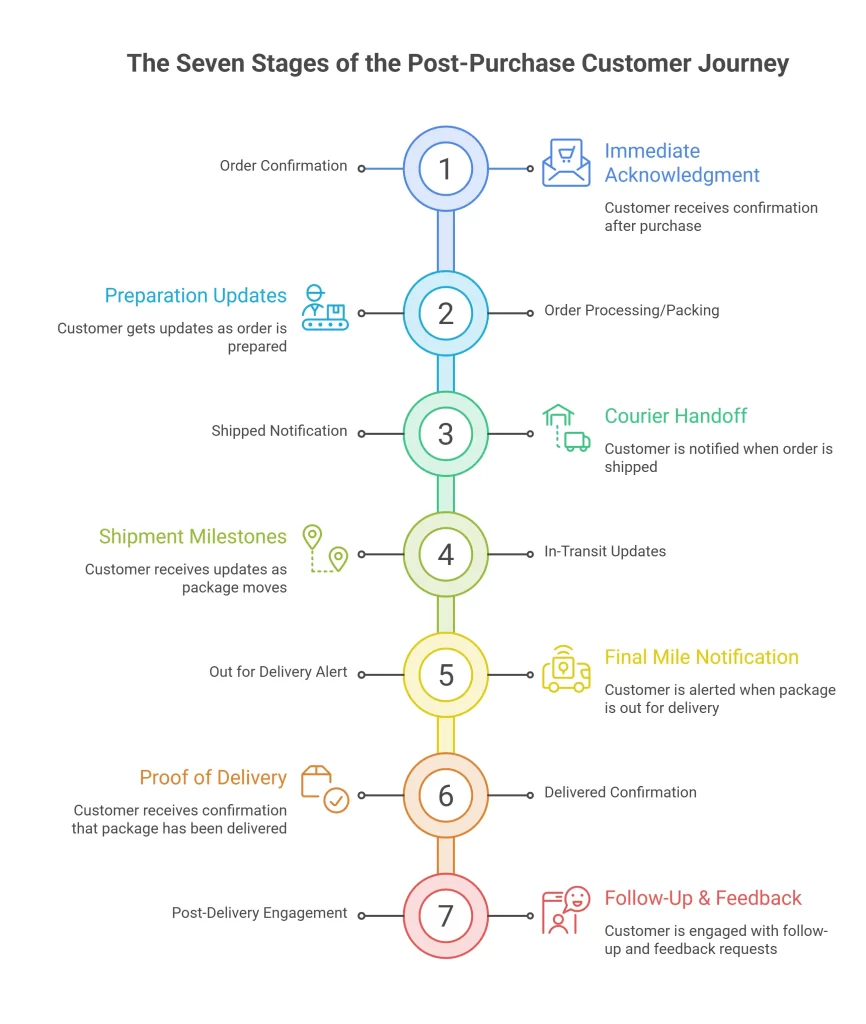
Each of these stages is an opportunity to strengthen your brand relationship. Miss even one, and you create anxiety that leads to support tickets, negative reviews, or worse, a customer who never comes back.
Beyond Basic Delivery Notifications: Proactive Communication
Generic courier SMS messages like “Your shipment AWB123456 is in transit” do nothing for your brand. They’re functional but forgettable. Here’s how to transform your post-purchase communication into something customers actually appreciate.
Personalize Every Touchpoint
Stop sending robotic updates. Instead of “Your order has been dispatched,” try “Hey Priya! Your new skincare routine is on its way. Expected delivery: Thursday by 7 PM.” The difference is subtle but powerful.
Personalized shipping notifications see 2-3x higher open rates compared to generic transactional messages. Include the customer’s name, specific product details, and a clear estimated delivery date (EDD).
Use the Right Channel at the Right Time
Indian consumers have strong channel preferences:
- WhatsApp – Best for real-time updates (out for delivery, delivered, delivery exceptions). Open rates exceed 90% in India.
- Email – Ideal for order confirmation, shipping details, and post-delivery engagement
- SMS – Good for critical alerts when WhatsApp isn’t available
- Push notifications – Effective for app-based brands with high install rates
The key is omnichannel post-purchase communication. Don’t blast the same message across all channels simultaneously. Instead, use each channel for what it does best.
Proactive Exception Communication
Here’s where most brands fail completely. When something goes wrong (a delay, a failed delivery attempt, an address issue), the customer usually finds out only when they check tracking themselves. By then, they’re already frustrated.
Proactive customer communication in ecommerce means reaching out before the customer notices a problem:
- “Your delivery is delayed by one day due to weather. New ETA: Friday”
- “We attempted delivery but couldn’t reach you. Want to reschedule?”
- “Your package is at the local hub. It’ll be out for delivery tomorrow morning”
This approach dramatically reduces NDR escalations and builds trust even when things don’t go perfectly.
Branded Tracking Pages: Own the Experience
When a customer clicks your tracking link, where do they land? If the answer is a courier partner’s website filled with competitor ads and confusing status codes, you’re losing a massive branding opportunity.
A branded tracking page is a custom-designed page on your own domain that displays real-time shipment status in your brand’s visual language. Think of it as your storefront for the post-purchase phase.
What a Great Branded Tracking Page Includes
- Your brand logo, colors, and design language
- Clear, jargon-free shipment status (not “In Transit to Destination Hub”)
- Accurate estimated delivery date
- Product image and order summary
- Cross-sell or upsell recommendations
- Customer support access (chat, WhatsApp, FAQ)
- Social media links and referral prompts
Why Branded Tracking Pages Reduce WISMO
Customers check tracking pages an average of 3-5 times per order. That’s 3-5 visits to a page you control. When the information is clear, accurate, and easy to find, customers don’t need to contact support.
Brands using branded tracking pages report 25-40% reduction in WISMO tickets. That’s a direct cost saving on your customer support team while simultaneously improving the customer experience.
Self-Service Order Tracking
Beyond the tracking page itself, give customers the ability to:
- Reschedule delivery from the tracking page
- Update their delivery address
- Choose a preferred delivery time slot
- Leave delivery instructions for the courier
- Initiate a return or exchange
This self-service order tracking approach empowers customers and reduces the load on your support team.
Post-Delivery Engagement: The Forgotten Goldmine
The package has arrived. Most brands stop communicating here. But this is actually where the real opportunity begins.
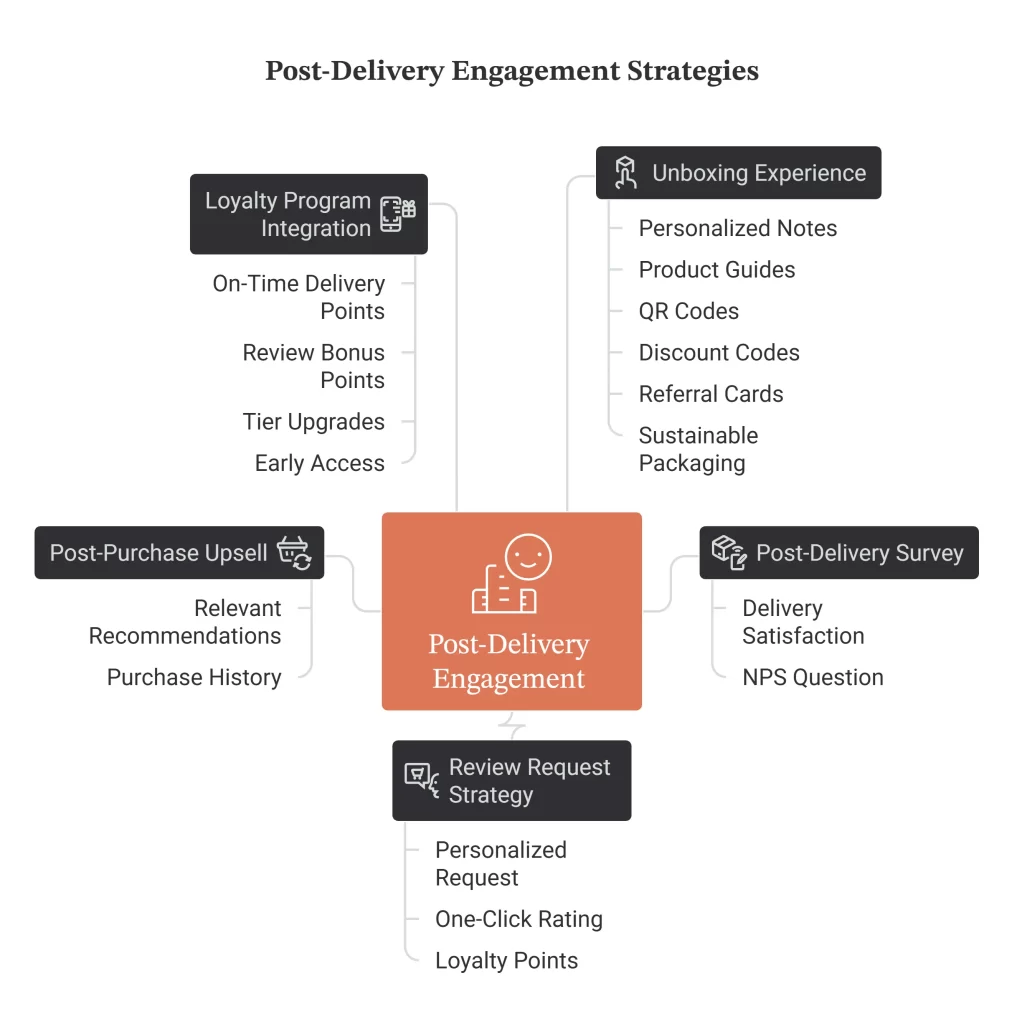
The Unboxing Experience
Before we talk about digital engagement, let’s acknowledge the physical moment. The unboxing experience is your brand’s handshake with the customer. It’s tactile, emotional, and highly shareable.
Smart D2C brands include:
- Personalized thank-you notes
- Product usage guides or tips
- QR codes linking to video tutorials
- Discount codes for next purchase
- Referral cards with incentives
- Sustainable, Instagram-worthy packaging
The unboxing moment is when customers are most likely to share on social media. Make it worth sharing.
Post-Delivery Survey and Feedback Loop
Timing matters here. Send a delivery satisfaction survey 24-48 hours after delivery. Not immediately (they haven’t opened it yet) and not a week later (the excitement has faded).
Keep it short. Two questions maximum:
- How was your delivery experience? (1-5 stars)
- Would you recommend us to a friend? (NPS question)
This customer feedback loop gives you real-time data on courier performance, packaging quality, and overall satisfaction. Use it to identify problems before they become patterns.
Review Request Strategy
Don’t ask for a product review on delivery day. Wait 5-7 days so the customer has actually used the product. Then send a personalized request:
- Reference the specific product they bought
- Make it easy (one-click rating + optional text)
- Offer a small incentive (loyalty points, not discounts)
Post-Purchase Upsell and Cross-Sell
The post-delivery period is prime time for relevant recommendations. If someone bought a face wash, suggest the matching moisturizer. If they bought running shoes, recommend performance socks.
The key word is relevant. Generic “you might also like” suggestions feel spammy. Personalized recommendations based on purchase history feel helpful.
Loyalty Program Integration
Connect your post-purchase loyalty program to the delivery experience:
- Award points for on-time delivery (gamifies the experience)
- Bonus points for leaving a review
- Tier upgrades based on purchase frequency
- Early access to new products for loyal customers
Reducing WISMO: A Complete Strategy
WISMO (Where Is My Order) queries are the single biggest driver of support costs for Indian ecommerce brands. Every WISMO ticket costs Rs. 50-150 to resolve when you factor in agent time, tools, and overhead.
Here’s a complete strategy to reduce WISMO tickets by 40-60%:
1. Set Accurate Expectations at Checkout
The problem often starts before the order is even placed. If your checkout page says “Delivery in 3-5 days” but the actual delivery takes 7 days, you’ve created anxiety from day one.
Use AI-powered estimated delivery dates that factor in courier performance, pin code distance, and historical data. Accurate EDDs at checkout reduce post-purchase anxiety significantly.
2. Increase Communication Frequency
More updates mean fewer queries. Send notifications at every shipment milestone:
- Order confirmed
- Packed and ready to ship
- Picked up by courier
- Reached transit hub
- Out for delivery
- Delivered
Six touchpoints might seem like a lot, but customers prefer over-communication to silence.
3. Make Tracking Effortless
Don’t make customers dig through emails to find their tracking link. Provide tracking access through:
- WhatsApp (reply with order number to get status)
- Your website (order lookup by phone number or email)
- Your app (push notification with deep link to tracking)
- Branded tracking page (bookmarkable URL)
4. Handle Exceptions Before They Escalate
When a shipment is delayed or a delivery attempt fails, don’t wait for the customer to reach out. Proactive communication about delivery exceptions and fake attempts shows customers you’re on top of things.
Research by Narvar found that 83% of online shoppers expect regular communication about their purchases, yet only 1 in 4 brands provides proactive updates beyond the initial shipping confirmation.
Source: Narvar Consumer Report, 2024
Delivery Experience Management (DEM): The Operational Backbone
Delivery experience management is the operational framework that makes everything above possible. It’s the system that connects your courier partners, communication channels, and customer data into one cohesive workflow.
What DEM Covers
- Real-time shipment visibility across all courier partners
- Automated trigger-based communication at each milestone
- Exception detection and proactive alerting
- Courier performance monitoring and SLA tracking
- Customer sentiment tracking post-delivery
- NDR management and resolution workflows
Why Multi-Carrier Visibility is Essential
If you’re using multiple courier partners (and you should be for optimal coverage and cost), managing the post-purchase experience becomes exponentially complex. Each courier has different tracking formats, different update frequencies, and different NDR processes.
A multi-carrier shipping platform normalizes all this data into a single view, enabling consistent communication regardless of which courier is handling the shipment.
Smart Courier Allocation Impacts CX
The post-purchase experience actually starts with courier selection. Choosing the right courier for each shipment based on pin code performance, delivery speed, and RTO history directly impacts whether the customer has a good experience.
AI-based courier allocation ensures each order is assigned to the courier most likely to deliver it successfully and on time. This upstream decision has downstream effects on every post-purchase touchpoint.
Measuring Post-Purchase Success: Metrics That Matter
You can’t improve what you don’t measure. Here are the post-purchase metrics every D2C brand should track:
Customer Experience Metrics
- Post-purchase NPS: Net Promoter Score specifically for the delivery experience (separate from product NPS)
- Customer Effort Score (CES): How easy was it for the customer to track their order and resolve issues?
- Delivery satisfaction score: Simple 1-5 rating collected post-delivery
- WISMO rate: Number of “where is my order” queries per 100 orders
Operational Metrics
- On-time delivery rate: Percentage of orders delivered by the promised EDD
- First-attempt delivery rate: Orders delivered successfully on the first try
- NDR resolution rate: Percentage of failed deliveries successfully reattempted
- RTO percentage: Orders returned to origin (lower is better)
Business Impact Metrics
- Repeat purchase rate: Percentage of customers who buy again within 90 days
- Customer lifetime value (CLTV): Revenue generated per customer over their relationship
- Support ticket volume: Total WISMO + delivery-related tickets per month
- Tracking page engagement: Views, time on page, and click-through on recommendations
Track these monthly. Look for correlations. You’ll likely find that improvements in on-time delivery and proactive communication directly drive repeat purchase rates.
Building Your Post-Purchase Strategy: A Practical Framework
Ready to put this all together? Here’s a step-by-step framework for building an ecommerce post-purchase strategy:
Foundation (Week 1-2)
- Audit your current post-purchase communication (what messages go out, when, through which channels)
- Map your customer journey from checkout to post-delivery
- Look for the biggest gaps where customers fall into silence
- Set up basic milestone-based notifications to fill those gaps
Building the Branded Experience (Week 3-4)
- Design and launch a branded tracking page on your domain
- Customize notification templates with your brand voice
- Integrate WhatsApp Business API for real-time updates
- Add proactive delay and exception alerts to your workflow
Driving Engagement (Week 5-6)
- Build post-delivery email/WhatsApp flows for feedback, reviews, and cross-sells
- Connect a loyalty program with delivery milestones
- Introduce a referral program triggered after successful delivery
- Elevate your unboxing experience with personalized touches
Ongoing Optimization
- Monitor WISMO trends and pinpoint remaining friction points
- Run A/B tests on notification timing, copy, and channels
- Evaluate courier performance impact on customer satisfaction
- Refine your strategy based on NPS and repeat purchase data
The Role of Technology in Post-Purchase CX
You don’t need to build all of this from scratch. The right technology stack makes implementation faster and more effective.
What to Look for in a Post-Purchase Platform
- Multi-courier tracking normalization
- Branded tracking page builder (no-code)
- Automated milestone-based communication triggers
- WhatsApp, SMS, and email integration
- Exception detection and proactive alerting
- Analytics dashboard with CX and operational metrics
- Easy integration with your existing OMS, WMS, and Shopify/WooCommerce store
The BYOC Advantage
If you’re using a Bring Your Own Courier model, your post-purchase platform needs to support any courier partner you onboard. This flexibility ensures that adding a new regional courier for better serviceability doesn’t break your customer communication workflow.
Conclusion
The post-purchase customer experience is no longer optional for D2C brands that want to survive in 2026. It’s the difference between a one-time transaction and a lifelong customer relationship.
Going beyond delivery notifications means treating every moment between checkout and post-delivery as a brand touchpoint. It means proactive communication when things go wrong, branded tracking that reinforces your identity, post-delivery engagement that drives loyalty, and operational excellence that makes it all possible.
Start with the basics. Fix your communication gaps. Launch a branded tracking page. Then layer in engagement, personalization, and optimization over time.
The brands winning in Indian ecommerce aren’t just the ones with the best products or the lowest prices. They’re the ones that make customers feel cared for long after the “Place Order” button is clicked.
Want to transform your post-purchase experience? Metaport helps D2C brands build branded tracking, automate milestone communication, and manage multi-courier delivery experiences from a single platform. Get in touch to see how.
Frequently Asked Questions (FAQs)
Post-purchase customer experience covers every interaction between checkout and post-delivery, including order updates, tracking, delivery, and follow-up engagement. It matters because 70% of customers say delivery experience influences repurchase decisions, directly impacting repeat purchase rate and customer lifetime value.
WISMO stands for “Where Is My Order,” the most common customer support query in ecommerce. Reduce it by providing proactive milestone notifications, branded tracking pages with clear status updates, and accurate estimated delivery dates at checkout. Brands using these strategies see 40-60% fewer support tickets.
A branded tracking page keeps customers on your domain (instead of a courier’s website), reinforces brand identity across 3-5 visits per order, enables cross-sell recommendations, and provides self-service options. This reduces WISMO, increases engagement, and drives repeat purchases through embedded loyalty and referral prompts.
Track post-purchase NPS, delivery satisfaction score, WISMO rate, on-time delivery percentage, first-attempt delivery rate, repeat purchase rate within 90 days, and customer lifetime value. These metrics connect operational performance to business outcomes and help identify where your experience needs improvement.
AI-based courier allocation selects the best courier for each shipment based on pin code performance, historical delivery speed, and RTO rates. This upstream decision directly impacts on-time delivery, reduces failed attempts and NDR issues, and ensures customers receive their orders when promised, improving overall delivery satisfaction.

Kapil Pathak is a Senior Digital Marketing Executive with over six years of experience in the logistics and supply chain industry. He specializes in SEO, SEM, and multi-channel campaign management. He has a strong track record of building strategies that boost brand visibility and generate qualified leads. His work focuses on driving growth for D2C and B2B technology companies through data-driven digital marketing initiatives.