Here’s a scenario every D2C founder has lived through at least once. Your ops dashboard shows a spike in “delivery failed” tags. Someone on your team is manually calling customers, scrolling through three different courier portals, and trying to figure out which orders are still worth saving before they turn into returns.
That chaos has a name. It’s called an NDR, and left unmanaged, it quietly becomes an RTO, a return-to-origin that costs you money twice over.
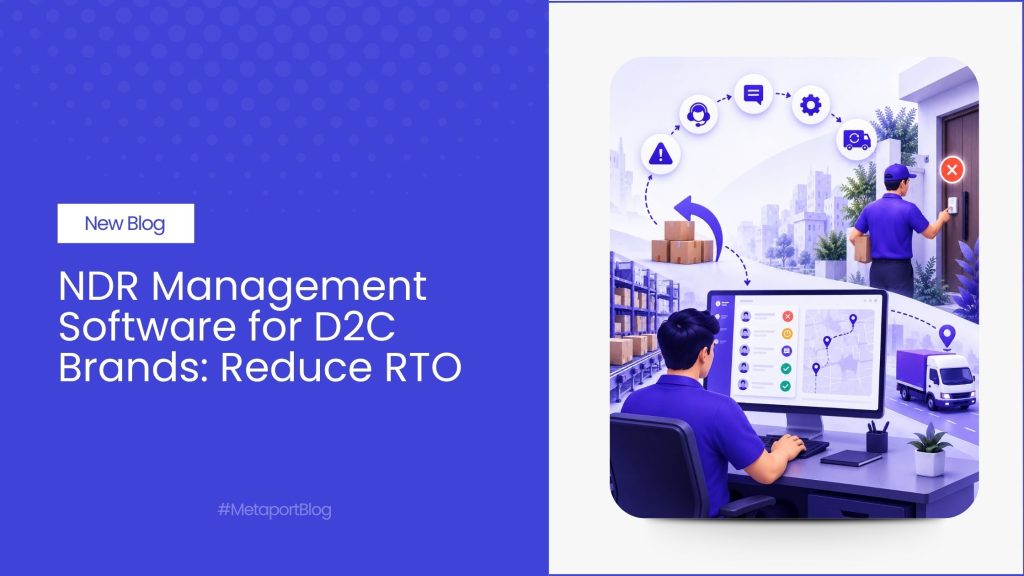
The fix isn’t more manpower. It’s NDR management software built specifically for the way D2C brands actually operate, with automated detection, smart customer outreach, and a clear path from a failed delivery attempt back to a successful one. Let’s break down how it works, why it matters more for D2C brands than almost any other business model, and what to look for before you pick a platform.
What NDR Actually Means, and Why It’s Not the Same as RTO
Before diving into software, it helps to get the terminology straight, because these two terms get mixed up constantly.
An NDR, or Non-Delivery Report, is raised the moment a courier can’t complete a delivery attempt. Maybe the customer wasn’t home. Maybe the address had a typo. Maybe the buyer simply refused the package at the door. Whatever the reason, the order isn’t cancelled yet, it’s just stuck.
RTO, or Return to Origin, is what happens if nobody fixes that NDR in time. After a set number of failed attempts, the courier sends the shipment all the way back to your warehouse.
So the relationship is straightforward: an NDR is recoverable, an RTO is a loss. Every day between those two points is a window where the right action, at the right time, saves the sale. (If you want the fuller breakdown of causes and definitions, we’ve covered that separately in our guide on what NDR and RTO mean in ecommerce.)
Why D2C Brands Feel This Pain More Than Anyone Else
Marketplaces have logistics teams, fulfillment infrastructure, and years of delivery data behind them. Most D2C brands don’t have that luxury. You’re running lean, often shipping through two or three courier partners, and relying on a support team that’s already stretched thin.
Add cash-on-delivery into the mix, which still makes up a large share of orders for most Indian D2C brands, and the problem compounds. COD orders fail far more often than prepaid ones, simply because there’s no upfront commitment locking the customer in. This is exactly why more brands are exploring how to convert COD orders to prepaid wherever it makes sense, without killing conversions.
Put those two things together, lean teams and COD-heavy order books, and you get a scenario where NDRs pile up faster than any manual process can realistically handle. That’s the exact gap NDR automation software is built to close.
What NDR Management Software Actually Does
Rather than thinking of it as one tool with one job, it’s more useful to picture the whole recovery journey as a sequence:
Detect → Diagnose → Engage → Resolve → Reattempt → Deliver → Analyze.
Detect: Catching Failures the Moment They Happen
Good software pulls delivery status directly from courier APIs in real time. Instead of finding out about a failed attempt hours or days later, you know within minutes. Speed here isn’t a nice-to-have; recovery odds drop fast the longer an NDR sits untouched. A related metric worth tracking alongside this is your first attempt delivery rate, since a low FADR is usually the earliest warning sign that RTO is about to climb.
Diagnose: Understanding Why the Delivery Failed
Every NDR comes with a reason code, whether that’s an incomplete address, an unreachable phone number, or the customer flat-out refusing the parcel. Some of these aren’t even genuine attempts. If you’ve noticed couriers marking orders as “attempted” when nothing actually happened, that’s a pattern worth reading up on in our piece on handling fake delivery attempts.
Engage: Reaching the Customer the Right Way
This is where automation earns its keep. Instead of a support agent manually dialing numbers, the software triggers outreach automatically, often through WhatsApp first, since that’s genuinely where most Indian shoppers are already checking messages, followed by SMS or an automated IVR call if there’s no response.
A simple message like “we tried delivering your order but couldn’t reach you, want us to try again tomorrow?” can recover a meaningful share of orders that would otherwise just sit there.
Resolve: Fixing the Actual Problem
Once the customer replies, the platform needs to act on it immediately, whether that means correcting a wrong pincode, updating a missing landmark, or reconfirming that yes, they still want the product. Most of this friction can actually be avoided earlier in the funnel; a solid address validation setup at checkout catches a large chunk of bad addresses before they ever become an NDR.
This is also where buyer verification matters, since some “failed deliveries” are really just customers who never intended to accept the order in the first place. Pairing NDR resolution with proper COD fraud detection stops a lot of these orders from being dispatched at all.
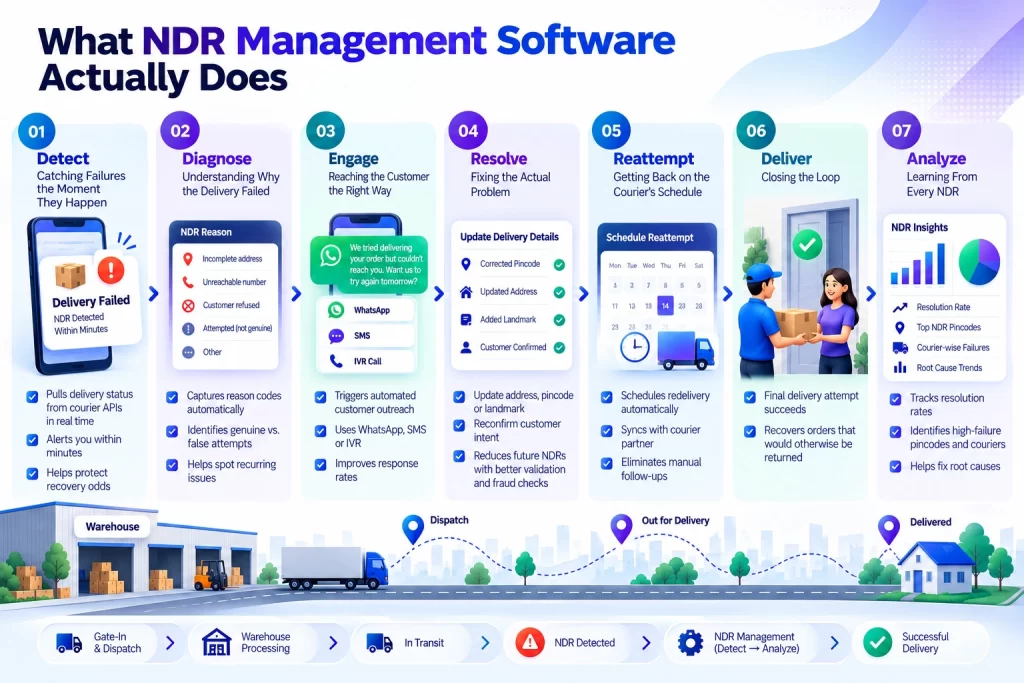
Reattempt: Getting Back on the Courier’s Schedule
Confirmed intent needs to translate into an actual redelivery slot, synced automatically with the courier partner. Manual coordination here is where a lot of recoverable orders quietly slip through the cracks.
Deliver: Closing the Loop
The final delivery attempt succeeds, and the order that was one bad address away from becoming a return actually reaches the customer.
Analyze: Learning From Every NDR
The best platforms don’t stop at recovery. They track resolution rates, flag which pincodes or couriers generate the most failures, and give you the data to fix root causes, not just individual orders.
Key Features Worth Comparing
If you’re evaluating options for your brand, here’s what genuinely matters rather than what sounds good on a landing page.
Real-time NDR detection
Anything less than near-instant alerts means you’re already behind. Delayed detection is one of the biggest silent killers of recovery rates.
Automated, multi-channel outreach
Look for WhatsApp as the primary channel, with SMS and IVR as fallbacks. A single-channel tool will miss a lot of customers who simply don’t check that one channel.
Address correction and validation
The ability for a customer to fix their own address through a link, rather than a back-and-forth phone call, removes friction on both sides.
Courier and API integrations
Whatever courier partners you use now, and whatever you might add later, the software needs to connect cleanly across a multi-carrier shipping setup. Fragmented integrations create blind spots.
A centralized NDR dashboard
One screen showing every at-risk order, its reason code, and its current status. If your team is still switching between courier portals, you haven’t actually solved the problem.
Analytics and resolution tracking
You want visibility into your NDR resolution rate over time, and ideally a breakdown by reason, courier, and pincode, so you can spot patterns before they become expensive habits.
Platform integrations
If you’re running on Shopify, WooCommerce, or a custom OMS, make sure the software plugs directly into your existing stack instead of requiring manual order exports.
Manual NDR Handling vs. Automated Recovery
It’s worth being honest about what manual handling actually looks like at scale. A support agent checking courier dashboards one by one, calling customers individually, and updating a spreadsheet to track outcomes. It works, sort of, at ten orders a day. It falls apart completely at a thousand.
Automated workflows don’t just save time, they change outcomes. Because outreach happens within minutes instead of hours, and because every failed order gets the same consistent follow-up regardless of how busy your team is that day, recovery rates end up meaningfully higher than what any manual process can sustain.
How NDR Software Actually Reduces RTO
This is the part that matters most for your bottom line. Every RTO carries a real cost, forward shipping, return shipping, repackaging, and the marketing spend already sunk into acquiring that customer. Per Inc42’s breakdown of Non-Delivery Reports, delivery exceptions are recoverable when acted on quickly, and unmanaged COD-heavy operations in India often see RTO rates climb well above global benchmarks.
NDR software attacks this problem at the exact point it can still be reversed. One of the more underrated levers here is courier choice itself; pairing NDR recovery with smart courier allocation means risky orders route to the carrier most likely to succeed in that pincode in the first place. By resolving failed attempts before the courier gives up entirely, brands using structured automation typically recover a solid share of at-risk orders that would otherwise become dead weight in a return pile. That’s not a rounding error. At meaningful order volumes, it’s the difference between a healthy margin and a slow bleed.
Where AI Fits Into the Picture
Rule-based automation alone gets you a long way, but predictive capability is becoming a real differentiator. Instead of just reacting to a failed attempt, AI-driven platforms can flag orders likely to fail before they even ship, based on pincode history, courier performance patterns, and past customer behavior. We’ve gone deeper into why this matters for order routing specifically in why AI courier allocation is crucial for ecommerce brands.
That shifts the conversation from “how do we recover this NDR” to “how do we prevent it from happening at all,” which is ultimately where the bigger long-term savings live.
Choosing the Right Platform for Your Brand
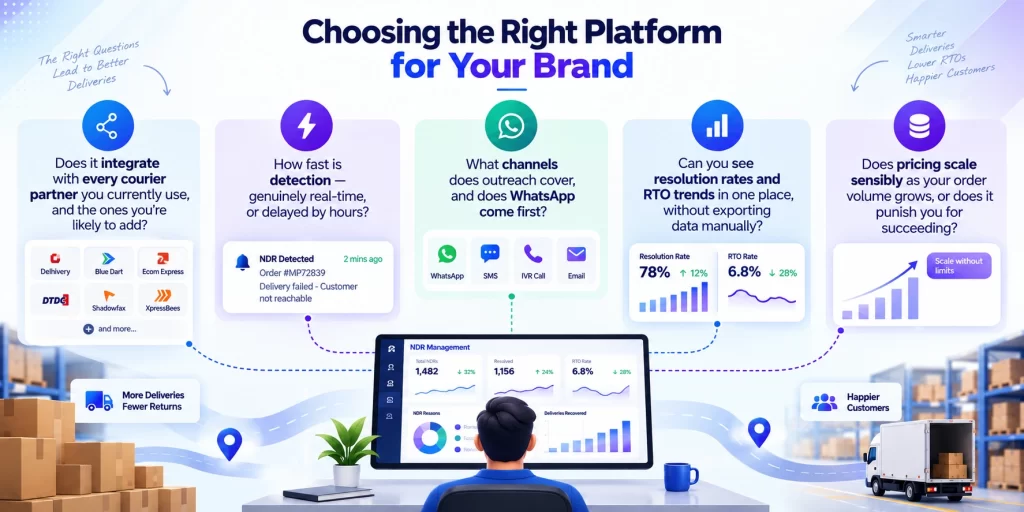
A few practical questions to run through before committing:
- Does it integrate with every courier partner you currently use, and the ones you’re likely to add?
- How fast is detection, genuinely real-time, or delayed by hours?
- What channels does outreach cover, and does WhatsApp come first?
- Can you see resolution rates and RTO trends in one place, without exporting data manually?
- Does pricing scale sensibly as your order volume grows, or does it punish you for succeeding?
If your brand also juggles multiple couriers and wants smarter allocation on top of NDR recovery, it’s worth looking at platforms that treat NDR handling as one part of a bigger logistics intelligence layer, rather than an isolated dashboard bolted onto your existing setup.
How Metaport Brings This Together
This is exactly the gap Metaport was built to close. Rather than treating NDR as a standalone dashboard, Metaport connects real-time NDR detection with automated WhatsApp, SMS, and IVR outreach, address correction, and reattempt scheduling, all synced across your courier partners in one place.
Because Metaport is a courier-neutral platform, it doesn’t stop at recovery. It combines NDR management with smart courier allocation, address validation at checkout, and COD fraud detection, so fewer orders turn into NDRs in the first place, and the ones that do get resolved faster than any manual process could manage. On top of that, brands get a single view of resolution rates, RTO trends by pincode and courier, and the underlying data to fix root causes rather than just chasing individual orders.
If failed deliveries are quietly draining your margins, it’s worth seeing what a connected NDR recovery workflow looks like inside Metaport’s platform, built specifically for D2C brands trying to reduce RTO without adding headcount.
FAQs
It’s a tool that detects failed courier delivery attempts in real time, automatically figures out why the delivery failed, and reaches out to the customer to resolve the issue before the order gets sent back as an RTO.
By acting within the recoverable window between a failed attempt and a final return. Automated outreach and quick address correction turn a chunk of would-be RTOs back into successful deliveries.
No. NDR is the failed-attempt stage, where the order can still be saved. RTO is what happens after the courier exhausts its attempts and sends the package back.
Largely, yes. Detection, customer messaging (WhatsApp, SMS, or IVR), address correction links, and redelivery scheduling can all run automatically, with human intervention only needed for edge cases.
It usually comes down to a heavy reliance on cash-on-delivery, combined with leaner support teams that can’t keep up with manual follow-up at scale.
Most modern NDR tools connect directly with Shopify, WooCommerce, and common OMS platforms, so order and delivery data sync automatically without manual exports.

Kapil Pathak is a Senior Digital Marketing Executive with over six years of experience in the logistics and supply chain industry. He specializes in SEO, SEM, and multi-channel campaign management. He has a strong track record of building strategies that boost brand visibility and generate qualified leads. His work focuses on driving growth for D2C and B2B technology companies through data-driven digital marketing initiatives.