Picture a delivery rider standing outside a building in Andheri at 4 pm. He has the parcel. He is at the right pincode, on the right road. But the address says “Flat 302, near Shiv temple,” and there are three buildings on that lane and two temples.
He calls. The phone is switched off. He waits four minutes, marks it undelivered, and moves on.
Nobody did anything wrong here. The customer typed what felt obvious to them. The rider followed the address he was given. Yet you just paid for a delivery attempt that produced nothing, and you are about to pay for a second one.
This is the quiet leak in Indian ecommerce. Brands spend heavily on courier allocation, NDR calling and RTO dashboards, all of which treat the symptom. Meanwhile the cause sits upstream, in a text box on your checkout page. That is where address validation belongs.
So let us talk about address validation for ecommerce, and specifically what it takes to make it work in India. We will cover what a good address actually contains here, why so many break, what each failure costs you, what DIGIPIN changes, and how address validation at checkout beats fixing things at the doorstep.
What Address Validation for Ecommerce Actually Means
Here is where most conversations go sideways. People use four different words for four different jobs, then wonder why the address validation tool they bought did not solve their problem.
The four things people confuse
Autocomplete suggests an address while the customer types. It speeds up input and reduces typos. It does not confirm that anyone lives there.
Validation checks whether the address is real and structurally complete. Does this pincode exist? Does it match the locality? Is there a house or flat number at all?
Verification goes further and confirms the address is deliverable, usually by checking it against courier serviceability data or geocoding it to a real point on a map.
Standardisation rewrites the address into a consistent format so downstream systems can read it. “Flt 302, B wing” becomes a structured set of fields.
Proper address validation for ecommerce uses all four together. Buying autocomplete and calling it address validation is the most common mistake I see Indian D2C brands make. Autocomplete alone will happily accept a beautifully formatted address for a building that does not exist.
So when a vendor says they do address validation, ask which of the four they actually mean. The answer is often one of them.
The Anatomy of an Indian Address
Western address validation tools assume a clean hierarchy: house number, street, city, postcode. That model works in London. It struggles here, which is why address validation built for other markets tends to disappoint Indian brands.
An Indian delivery address usually needs eight or nine components, and several of them have no equivalent abroad.
| Component | Example | Why It Matters |
|---|---|---|
| Sub-premise | Flat 302, B Wing | The single most-missed field |
| Building or society name | Sai Krupa CHS | Often the only real identifier on the lane |
| House or plot number | 14/2 | Notation varies wildly |
| Street or road | Gokhale Road North | Frequently absent in Tier-2 and Tier-3 areas |
| Landmark | Opposite Canara Bank ATM | Load-bearing in India, optional elsewhere |
| Locality and sub-locality | Dadar West | Determines the delivery beat |
| City, district, state | Mumbai, Maharashtra | Standard |
| PIN code | 400028 | Routing backbone |
| Phone number | Reachable, correct | Functionally part of the address |
That last row surprises people. In India, a phone number is not contact metadata. It is a delivery instrument. A rider who cannot reach the customer often cannot complete the drop, no matter how good the written address is. Therefore any serious address validation programme here has to treat phone accuracy as part of the same problem.
A quick comparison. Which of these would you rather hand a rider?
- Bad: “302, near temple, Andheri, Mumbai 400053”
- Good: “Flat 302, B Wing, Sai Krupa CHS, Lane 4 off New Link Road, opposite Canara Bank ATM, Andheri West, Mumbai, Maharashtra 400053”
Same customer. Same building. Wildly different odds of a first-attempt success.
Why Indian Addresses Break: Eight Root Causes
Google’s own documentation on Indian address quality identifies a specific set of failure modes. They match what you will see in your own order data.
1. Missing or wrong PIN codes. Customers copy a pincode from a neighbouring area, or type six digits from memory. Routing then sends the parcel to the wrong hub.
2. Spelling variations. Kandivali, Kandivli, Kandiwali. Humans read all three. Automated systems match none of them.
3. Non-standard component order. Some people lead with the locality, some with the building, some with the landmark. Parsers give up.
4. Colloquial references. “Behind the old post office” is perfectly clear to a neighbour and meaningless to a routing algorithm.
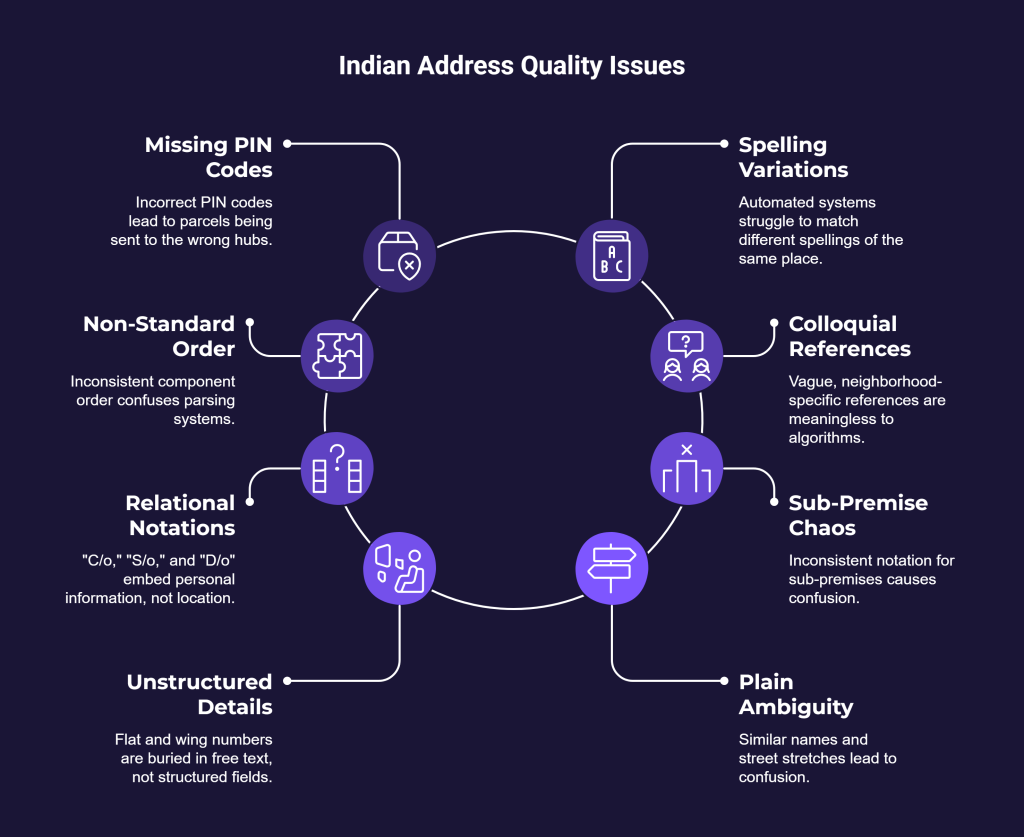
5. Relational notations. C/o, S/o and D/o embed information about people, not places, right in the middle of the address field.
6. Sub-premise notation chaos. Is it 2/1, 2-1, or “2 by 1”? All three appear, and they do not always mean the same thing.
7. Unstructured flat and wing details. The flat number ends up buried in a free-text line instead of its own field, so it never reaches the courier’s system cleanly.
8. Plain ambiguity. Two societies with similar names on the same road. One street name used for three different stretches.
Notice a pattern? Almost none of these are the customer being careless. They are the result of a country where addressing evolved socially rather than systematically. That is why generic address validation for ecommerce, built on Western assumptions, underperforms here. Effective address validation in India has to expect these eight patterns and correct for them, not treat them as user error.
What One Bad Address Actually Costs You
This is the number that gets a founder’s attention, so let us build it properly.
A failed delivery is never one cost. It is a stack:
- Forward shipping you already paid
- Reattempt cost, if the courier tries again
- NDR handling, which means calls, WhatsApp follow-ups, agent time
- Reverse shipping if it converts to RTO
- Repackaging and QC on the returned unit
- Inventory holding for the weeks the stock sat in transit
- Written-off acquisition cost, the biggest and quietest line of all
Here is an illustrative model. Swap in your own figures.
| Line Item | Indicative Cost |
|---|---|
| Forward shipping | ₹70 |
| Reverse shipping | ₹70 |
| Repack and QC | ₹40 |
| NDR handling and calls | ₹30 |
| Written-off CAC | ₹300 |
| Total per failed order | ₹510 |
Now apply volume. If you ship 20,000 orders a month and 3% fail for address-related reasons, that is 600 orders, or roughly ₹3 lakh a month. Fix even a third of those and you have found ₹12 lakh a year without spending a rupee on ads.
That framing matters. Address validation is not an ops hygiene project. It is a margin project, and it usually pays back faster than any other shipping investment on the table. If you want the fuller picture of what each shipment really costs you, our breakdown of the true shipping cost per order in India sets out the rest of the stack.
DIGIPIN: India’s New Digital Address System
Here is the part almost nobody in D2C is talking about yet.
India Post has launched DIGIPIN, a geo-coded addressing grid developed with IIT Hyderabad and NRSC (ISRO). It divides the entire country into roughly 4 by 4 metre cells and gives each one a unique 10-character alphanumeric code, formatted like XY2AB-4GTPL.
In other words, it turns a location into a code, and a code back into a location. No street name required. No landmark. No spelling.
PIN code vs DIGIPIN
| Feature | PIN Code | DIGIPIN |
|---|---|---|
| Length | 6 digits | 10 characters |
| Precision | Post office area, often several square km | About 4 by 4 metres |
| Derived from | Postal administration | GPS coordinates |
| Useful for | Routing to a hub | Finding an actual doorstep |
| Works without street names | No | Yes |
Why does this matter so much in India? Because a huge share of our delivery failures happen in places where the conventional address system simply has nothing to grab onto. Unnamed lanes. New townships. Villages where “the third house after the borewell” is a genuine address.
DIGIPIN sidesteps all of it. Customers can generate their own code through the India Post DIGIPIN portal, and ClearTax has a clear explainer on the format if you want the technical detail.
A realistic take, though. Adoption is still early. Most customers have never heard of it, and few couriers accept it as a primary field yet. So do not replace your address form with a DIGIPIN box tomorrow.
What you can do now is add it as an optional field alongside your existing address validation checks, especially for repeat customers in hard-to-serve pincodes. Early movers here will have a genuinely cleaner address book in two years than brands that wait.
Address Validation at Checkout: The Prevention Playbook
Every rupee you spend fixing addresses after the order is placed is a rupee you could have saved at checkout. So that is where your address validation should start.
Design the form for how Indians actually write addresses
- Give sub-premise its own field. Flat, wing and floor should never live in a free-text blob.
- Add a separate building or society name field. In urban India this is often the strongest identifier you have.
- Include an optional landmark field, clearly labelled. Yes, really. It is unusual by global standards and it works here.
- Auto-fill city and state from the pincode. This kills a whole class of mismatch errors instantly.
- Validate the phone number with an OTP, because an unreachable number is a failed delivery waiting to happen.
Use autocomplete, but do not stop there
Address autocomplete cuts typos and speeds up checkout. Pair it with a real address validation check that confirms the pincode, matches it to the locality, and flags addresses missing a house or flat number.
Better still, offer a map pin drop as an option. Indian customers have grown used to it from food delivery and cabs, so it no longer feels unfamiliar. A dropped pin gives you latitude and longitude, which is the most reliable delivery instruction there is.
Mind the friction trade-off
Here is the honest tension. Every extra field costs you a little conversion. Every skipped field costs you a little delivery success.
The way through is to make address validation conditional rather than universal. Do not add five mandatory fields for everyone. Instead, trigger extra prompts only when the address looks weak: no flat number, a pincode that historically underperforms, or a locality that does not match. Most customers sail through untouched. The risky ten percent get one gentle nudge.
Accurate addresses also make your delivery promises more honest, which is why they feed straight into AI-driven estimated delivery dates.
Fix It Before Dispatch: The Recovery Loop
Some bad addresses will always slip through, however good your checkout is. The question is whether you catch them while the parcel is still on your shelf or after it has travelled 400 kilometres.
Build a second address validation gate before dispatch. Before a label is generated, the system should check:
- Does the pincode exist and match the stated city and locality?
- Is there a sub-premise or house number present?
- Is the phone number valid and reachable?
- Is this pincode serviceable by at least one of your couriers?
- Does the address geocode to a real point, or does it land in a field?
Anything that fails goes into a correction queue rather than into a courier bag.
From there, reach out. In India, WhatsApp beats email by a distance for this. A short message with the address as you have it and a single “is this right?” prompt recovers a surprising number of orders. SMS and a quick IVR call work as backups.
The economics are lopsided in your favour. A WhatsApp nudge costs a rupee or two. The failed delivery it prevents costs several hundred. That is not a close call, and it is why post-order address validation pays for itself almost immediately.
This loop also overlaps neatly with fraud screening, since suspicious addresses and fake delivery attempts often surface the same red flags you are already checking for in COD fraud detection.
Pincode Serviceability and Courier Allocation
A perfect address is still useless if no courier serves that pincode reliably. Serviceability is the half of address validation that most tools skip.
Serviceability checking answers three separate questions, and it helps to keep them apart:
- Can anyone deliver here? Some pincodes have no COD service, or no service at all.
- Who delivers here well? Courier performance varies enormously by pincode, which is why a courier performance scorecard beats a single national ranking.
- What will it cost? Out-of-delivery-area pincodes carry surcharges that quietly erode margin, as covered in our piece on hidden shipping surcharges.
This is exactly where clean address data becomes operational leverage. Feed an accurate, geocoded address into smart courier allocation and the system can route to the partner with the best record in that specific pincode. Feed it a vague one and even the best allocation engine is guessing.
Garbage in, garbage routed.
Build an Address Quality Score
Most brands treat addresses as either fine or broken. A score is more useful, because it lets your address validation act proportionally instead of blocking everything or nothing.
Try something like this. Award points for each signal present:
| Signal | Points |
|---|---|
| Sub-premise or house number present | 25 |
| Pincode matches locality | 20 |
| Phone verified by OTP | 20 |
| Address geocodes to a precise point | 15 |
| Building or society name present | 10 |
| Landmark present | 10 |
Then act on the bands:
- 80 to 100: ship it, no intervention.
- 50 to 79: send one automated WhatsApp confirmation.
- Below 50: hold for manual review or a call before dispatch.
Track the average score by month, by channel and by pincode. You will quickly notice two things: COD addresses usually score lower than prepaid ones, and scores dip during festive peaks when everyone is rushing. Both are useful signals for how you staff and how you convert. If you already track D2C shipping metrics, this slots in beside them.
Bringing It Together
Address validation is the least glamorous lever in Indian ecommerce logistics and one of the most profitable. It sits upstream of almost everything else that goes wrong in last-mile delivery.
The essentials:
- Autocomplete, validation, verification and standardisation are four different jobs. Real address validation for ecommerce uses all four.
- Indian addresses carry components, like landmarks and sub-premise details, that global address validation tools ignore.
- One failed delivery costs several hundred rupees once written-off acquisition cost is counted.
- DIGIPIN is worth adopting early as an optional field, even though mainstream adoption is still some way off.
- Address validation at checkout beats correction before dispatch, and both beat a reattempt.
- Clean address data is what makes courier allocation and delivery promises accurate in the first place.
If you want a starting point this week, pull your last 500 undelivered orders and read the addresses. Not the courier status codes, the actual addresses. The pattern will be obvious within twenty minutes, and it will tell you which fix to build first.
Want to see it working? Book a Metaport demo and we will show you address checks, serviceability gating and pre-dispatch correction running on your own order flow. To understand where these failures land downstream, read our guide to NDR and RTO in ecommerce and how they hit your first attempt delivery rate.
Frequently Asked Questions
Address validation for ecommerce checks that a delivery address is real, complete and structurally correct before you ship. Autocomplete only suggests text while a customer types, so it reduces typos but confirms nothing. Verification goes a step further by checking deliverability against courier serviceability data or geocoding, while standardisation reformats the address into consistent fields. Most Indian D2C brands need all four working together, because autocomplete alone will accept a well-formatted address for a building that does not exist.
The usual causes are structural rather than careless. Missing or wrong PIN codes, spelling variations in locality names, non-standard component order, colloquial references like “near the old temple,” relational notations such as C/o and S/o, inconsistent sub-premise formats like 2/1 versus 2-1, flat and wing details buried in free text, and outright ambiguity between similarly named societies. An unreachable phone number belongs on the same list, because in India it functions as part of the delivery address.
DIGIPIN is a geo-coded addressing system from India Post, developed with IIT Hyderabad and NRSC (ISRO). It assigns a unique 10-character alphanumeric code to every 4 by 4 metre grid cell in the country. A PIN code is six digits and identifies a post office area that can span several square kilometres, so it routes a parcel to a hub. A DIGIPIN identifies an actual doorstep and works even where streets are unnamed. Adoption is still early, so treat it as an optional field for now.
It tackles one of the largest causes, though not all of them. Address validation cannot stop a customer refusing a COD order or changing their mind, which are separate problems handled by prepaid conversion and fraud screening. What address validation does fix is incomplete addresses, pincode and locality mismatches, unreachable phone numbers and non-serviceable pincodes. Since these feed directly into failed first attempts, better address validation usually lifts first attempt delivery rate before it shows up anywhere else.
Make your address validation selective rather than exhaustive. Give sub-premise, building name and landmark their own fields, auto-fill city and state from the pincode, and verify the phone number with an OTP. Then trigger extra prompts only for weak addresses, meaning those missing a house number, sitting in a historically poor-performing pincode, or failing a locality match. Offering a map pin drop helps too, since Indian customers already expect it from food delivery and cab apps. Most shoppers pass through untouched while the risky minority gets one nudge.

Kapil Pathak is a Senior Digital Marketing Executive with over six years of experience in the logistics and supply chain industry. He specializes in SEO, SEM, and multi-channel campaign management. He has a strong track record of building strategies that boost brand visibility and generate qualified leads. His work focuses on driving growth for D2C and B2B technology companies through data-driven digital marketing initiatives.