You negotiated a great courier rate. The number on your rate card looked clean, your unit economics made sense on the spreadsheet, and you launched. Then the monthly invoice arrived and the math no longer worked. The base freight was exactly what you agreed to, but the total was 30 to 40 percent higher. Welcome to the world of hidden shipping surcharges, the quiet, compounding fees that don’t show up when you sign a contract but show up relentlessly on every invoice after.
For Indian D2C brands, hidden shipping surcharges are one of the most under-examined causes of margin erosion. Founders obsess over customer acquisition cost, packaging, and discounts, yet a fuel surcharge revision or a stack of Out of Delivery Area fees can quietly wipe out the contribution margin on an entire cohort of orders. Industry analyses estimate that surcharges account for 30 to 40 percent of total shipping cost, which means the rate you quote a customer at checkout is often only 60 to 70 percent of what the carrier eventually bills you.
This article breaks down exactly what hidden shipping surcharges are, the specific fees draining your margins, the real math behind how they compound, and a practical framework for auditing and controlling them before they turn a profitable order into a loss.
What Are Hidden Shipping Surcharges?
A shipping surcharge is any additional fee a courier adds on top of the base freight rate. Some surcharges are legitimate and unavoidable, they reflect genuine costs of moving a parcel to a difficult location or handling an awkward package. What makes them hidden is not that they are secret, but that they are structurally invisible at the moment you make decisions.
When you evaluate a courier, you compare base rates. When you price a product, you use that base rate. When you offer free shipping above a cart threshold, you model it against that base rate. But the base rate is a starting point, not the price. Surcharges are applied later, calculated per shipment, and buried in invoice line items that most brands never reconcile. By the time the true cost surfaces, the order is delivered, the customer is gone, and the margin is already spent.
The gap between the rate you agreed to and the amount you are actually billed has a name worth internalising: the base-rate-to-billed-rate gap. Closing that gap is the entire game. And unlike a General Rate Increase, which carriers announce in advance, most hidden shipping surcharges appear mid-contract with little or no notice, adjusting month to month as fuel prices move and as your order mix shifts toward harder-to-serve pincodes.
The uncomfortable truth is that couriers are not doing anything wrong. Every surcharge is usually disclosed somewhere in the rate card annexure. The problem is that the fees are numerous, variable, and applied at a granularity that is impossible to track manually across thousands of shipments. That is precisely why they stay hidden in plain sight.
The Fees That Are Quietly Killing Your Margins
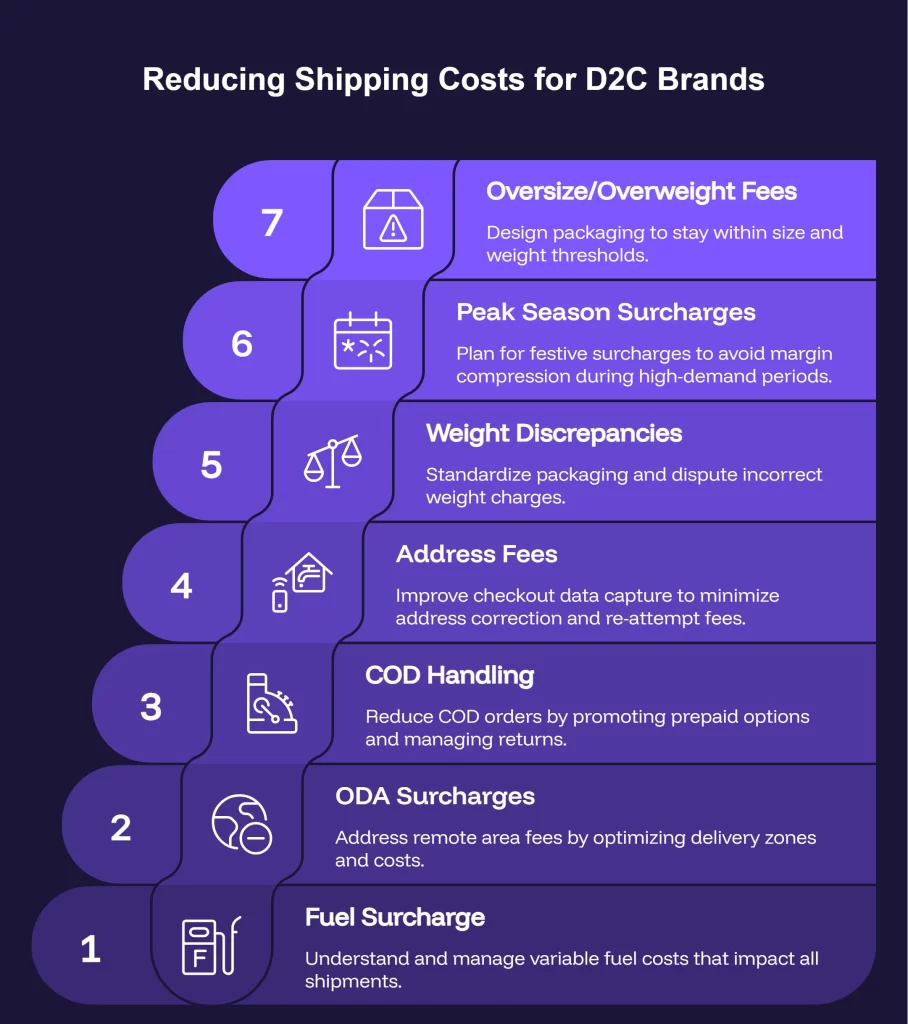
Not all surcharges are equal. Some are small and occasional; others compound across your entire shipment volume. Here are the ones that do the most damage to D2C margins in India, roughly in order of impact.
Fuel Surcharge
The fuel surcharge is the single most pervasive hidden shipping surcharge, because it applies to virtually every shipment you send. It is a variable percentage layered onto the base rate to offset the courier’s changing fuel costs. In India this typically ranges from 10 to 20 percent, and it is revised frequently, sometimes monthly, in response to petrol and diesel prices.
Here is why it hurts: it is a percentage, not a flat fee, so it scales with your volume and with any base-rate increases. Most founders don’t even realise they are paying 6 to 15 percent extra every month purely because fuel prices moved. If you modelled your shipping cost at a fixed rate and never revisited it, the fuel surcharge alone can quietly account for a meaningful chunk of the gap between your expected and actual shipping spend.
ODA and Remote Area Surcharges
ODA stands for Out of Delivery Area. When a shipment is destined for a pincode outside the courier’s standard serviceable zones, typically remote, rural, or low-density areas, the carrier adds an ODA or remote area surcharge to cover the extra cost of reaching that location. In India this commonly adds ₹20 to ₹80 or more per shipment, and for genuinely far-flung pincodes it can be higher still.
The trap with ODA charges is that they correlate with growth. As your brand expands beyond metros into tier-2 and tier-3 markets, exactly the expansion you want, a larger share of your orders start attracting remote-area fees. A marketing win becomes a margin problem, and because these charges are pincode-specific, they never show up in an averaged rate comparison. Understanding your pincode-level serviceability and cost profile is the only way to see them coming.
COD Handling Charges
Cash on Delivery remains dominant in Indian ecommerce, and couriers charge for the privilege of collecting cash. COD handling fees typically run ₹20 to ₹50 per order or 1 to 2 percent of the order value, whichever is higher. That is the visible cost.
The hidden cost of COD is far larger and lives adjacent to the handling fee. Prepaid orders in India see RTO rates of around 2 to 8 percent, while COD orders return at 25 to 40 percent. Every returned COD order means you pay forward logistics, reverse logistics, repackaging, and the cost of capital locked in inventory, often ₹180 to ₹350 per returned order, with zero revenue to show for it. So while the COD handling charge is the surcharge on the invoice, the true COD tax is the RTO cascade behind it. Shifting even a fraction of COD volume to prepaid is one of the highest-leverage margin moves a D2C brand can make, and there are proven tactics to convert COD orders to prepaid at checkout.
Address Correction and Re-Attempt Fees
When an address is incomplete, misspelled, or missing a unit number, the courier applies an address correction fee. When the first delivery attempt fails and the parcel has to be re-attempted, a re-attempt charge follows. Individually these look trivial. Across thousands of orders with imperfect checkout data, they add up into a line item that surprises brands every month.
What makes these especially frustrating is that they are largely preventable. A large share of address correction and re-attempt fees trace back to poor address capture at checkout and to failed delivery attempts, including fake delivery attempts couriers mark as failed, that could have been avoided with better customer communication. These are surcharges you are paying for a problem you can fix upstream.
Weight Discrepancy and Volumetric Weight Charges
Couriers bill on the higher of actual weight or volumetric weight, where volumetric weight is calculated from the parcel’s dimensions. If your declared weight is lower than what the courier’s re-weigh reports, you get hit with a weight discrepancy charge, the difference in freight plus, often, a penalty.
Weight discrepancies are one of the most disputed hidden shipping surcharges precisely because they are so easy to get wrong and so tedious to contest. A slightly oversized box, a rounding difference, or an inaccurate courier re-weigh can each trigger a charge. Multiplied across your catalogue and volume, unmanaged weight discrepancies become a persistent leak. Standardising packaging and systematically disputing incorrect courier weight discrepancies recovers money most brands simply write off; it is one of the most recoverable categories of overbilling.
Peak Season and Festive Surcharges
During high-demand windows, the festive season, major sale events, and end-of-year peaks, couriers impose temporary surcharges to manage surge volume. These festive surcharges can appear quickly and fluctuate, which means the exact period when you are shipping your highest volume is also when your per-shipment surcharge load is heaviest. If your festive-season shipping strategy and free-shipping thresholds were set using off-peak rates, the margin compression during your biggest sales window can be severe.
Oversize, Overweight, and Additional Handling Surcharges
Packages that exceed certain size or weight thresholds attract oversize or overweight surcharges. Separately, and at lower thresholds, additional handling surcharges apply to parcels that need extra attention because of shape, packaging, or fragility. Because the additional handling threshold is lower, it catches a wider range of shipments than founders expect. Brands shipping anything bulky, irregular, or awkwardly packaged should assume these fees are in play and design packaging to stay under the thresholds.
The Real Math: How Surcharges Compound Into Margin Loss
Individually, most of these fees look small. The damage comes from how they stack. Walk through a representative COD order for an Indian D2C brand.
Suppose your base forward freight for a 500-gram parcel to a nearby zone is ₹60. That is the number on your rate card and the number in your pricing model. Now layer the reality:
Add a fuel surcharge at 15 percent, and the freight becomes roughly ₹69. Add a COD handling charge of ₹35. If the destination is an ODA pincode, add ₹40. If the address needed correction or a re-attempt, add another ₹30. Already the ₹60 base rate has become roughly ₹174, nearly triple, before you have accounted for anything going wrong.
Now introduce RTO. COD orders return at 25 to 40 percent. When this order comes back undelivered, you pay forward freight and surcharges again on the reverse leg, plus repackaging and the opportunity cost of tied-up inventory, commonly ₹180 to ₹350 in total per returned order. Spread across a cohort, even a 25 percent RTO rate means a quarter of your shipments generate cost with no revenue, and that cost is loaded with the very surcharges you underestimated.
This is why logistics typically consumes 10 to 15 percent of revenue for a mid-size Indian D2C brand, and why brands that never audit their surcharges routinely find their real shipping cost running well above what their pricing assumed. The base rate told you shipping was affordable. The surcharges decided whether the order was actually profitable.
The strategic point is this: you cannot fix what you cannot see. As long as surcharges remain aggregated in a monthly invoice total, you will keep pricing off the base rate and keep absorbing the gap. The fix begins with making the hidden visible.
How to Audit Your Courier Bill for Hidden Shipping Surcharges
Auditing is the highest-ROI activity most D2C ops teams are not doing. The goal is to reconcile what you were billed against what you agreed to, line by line, and to catch overbilling before it becomes a permanent leak. Here is a practical framework.
Start with your rate card annexure, not the headline rate. The surcharges are almost always disclosed in the fine print, fuel surcharge formula, ODA fee schedule, COD charges, weight slabs, and penalty terms. Extract every surcharge and its trigger into a single reference sheet. You cannot verify a bill against a contract you have not fully read.
Reconcile invoices at the shipment level, not the summary level. A monthly total tells you nothing. You need to match each shipment’s charges against expected charges for that shipment’s weight, zone, and payment mode. This is where overbilling hides: a fuel surcharge applied at the wrong percentage, an ODA fee on a pincode that is not actually remote, or a COD charge on a prepaid order.
Interrogate every weight discrepancy. Pull the courier’s re-weigh data and compare it against your declared dimensions and weight. Systematically dispute discrepancies that do not hold up. This is tedious manually, which is exactly why so much money is left on the table here, but it is also one of the most recoverable categories.
Track ODA and remote-area fees by pincode. Build a view of which pincodes are generating remote-area surcharges and how often. This tells you where your true cost-to-serve is highest and informs both pricing and courier allocation decisions.
Separate preventable surcharges from structural ones. Address correction and re-attempt fees are preventable through better checkout data and proactive delivery communication. Fuel and ODA are structural. Sorting surcharges into these two buckets tells you what to fix upstream versus what to negotiate or route around.
Reconcile continuously, not annually. Surcharges change monthly. A once-a-year audit means eleven months of undetected drift. The brands that keep shipping margins tight treat reconciliation as an ongoing operational discipline, ideally automated, so that overbilling is flagged the moment it appears rather than discovered a year later.
Manual reconciliation across thousands of shipments is where this framework usually breaks down; it is simply too much data to check by hand, which is why automated freight reconciliation exists and why the money most brands lose to surcharges is money they never had the bandwidth to chase.
How to Reduce and Prevent Hidden Shipping Surcharges
Auditing recovers money you have already lost. Prevention stops the leak. The two work together, and most of the highest-impact moves are within your control.
Validate addresses at checkout. A large share of address correction and re-attempt fees originate from incomplete or inaccurate address capture. Enforcing address validation and pincode checks at checkout cuts these fees at the source and, as a bonus, reduces failed deliveries and the NDR cascade that follows.
Standardise and right-size your packaging. Oversize, additional-handling, and volumetric weight charges all trace back to packaging. Using standard box sizes that stay under carrier thresholds, and packing to minimise volumetric weight, directly reduces the surcharges you attract. This is a one-time operational fix with recurring returns.
Shift COD orders to prepaid. Because the true cost of COD is the RTO cascade, every order you convert from COD to prepaid eliminates the COD handling fee, the RTO risk, and the remittance float simultaneously. Even a modest shift in COD-to-prepaid mix meaningfully improves blended shipping margins. Incentivising prepaid at checkout is one of the most effective margin levers available.
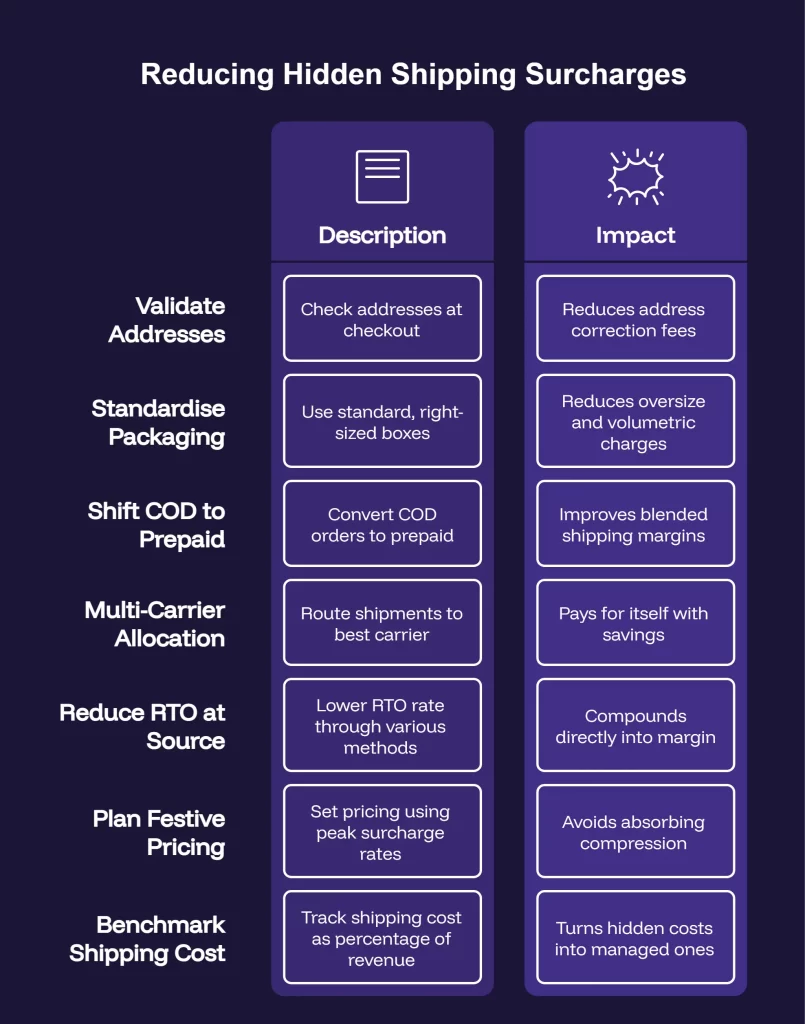
Use multi-carrier allocation to route around expensive lanes. No single courier is cheapest or best on every lane. Intelligent, data-driven multi-carrier shipping lets you route each shipment to the carrier with the best cost and performance profile for that specific pincode and weight, including steering around carriers whose ODA footprint or surcharge structure is punishing on particular lanes. This is where a multi-carrier setup pays for itself.
Reduce RTO at the source. Since RTO is the largest hidden cost sitting behind COD, anything that lowers your RTO rate, smart courier allocation, address verification, order confirmation flows, and risk scoring at checkout, compounds directly into margin. Reducing RTO is not a shipping tactic; it is a profitability strategy.
Plan festive and peak pricing against peak rates. Set your sale-season free-shipping thresholds and pricing using peak surcharge rates, not off-peak ones. If you know festive surcharges are coming, price for them in advance rather than absorbing the compression.
Benchmark your shipping cost as a percentage of revenue. If logistics is running well above the 10 to 15 percent range typical for mid-size D2C, treat it as a signal to audit. Tracking your core D2C shipping metrics, cost per order, RTO percentage, surcharge load, and blended shipping margin, turns hidden costs into managed ones.
Why This Is an Operations and Data Problem, Not a Negotiation Problem
Most brands respond to rising shipping costs by trying to negotiate a lower base rate. That helps, but it misses the point. The base rate was never the problem. The problem is the 30 to 40 percent of cost sitting in surcharges that you cannot see, cannot attribute, and therefore cannot manage.
Solving hidden shipping surcharges is fundamentally a data and operations challenge. It requires shipment-level visibility into what you are actually being billed, the ability to reconcile that against your contract automatically, the intelligence to allocate each order to the right carrier, and the upstream controls, address validation, packaging standards, prepaid conversion, that prevent avoidable fees from ever being charged. A platform that unifies multi-carrier allocation, automated reconciliation, and post-purchase controls turns surcharges from an invisible tax into a line item you actively manage. That is the difference between hoping your shipping is profitable and knowing that it is.
Conclusion: Make the Hidden Visible
Hidden shipping surcharges are killing D2C margins not because they are unusually large, but because they are unusually invisible. Fuel surcharges scale silently with volume. ODA fees grow as you expand into new markets. COD handling charges mask a far larger RTO cost behind them. Address, re-attempt, weight-discrepancy, and festive surcharges each look trivial in isolation and devastating in aggregate. Together they routinely turn a rate card that looked profitable into an invoice that is not.
The brands that win on shipping economics are not the ones with the lowest base rate. They are the ones that make the hidden visible, that audit every invoice at the shipment level, prevent the avoidable fees upstream, route intelligently across carriers, and treat shipping cost as a number to be managed continuously rather than accepted monthly. Your margins are being spent one surcharge at a time. The only question is whether you can see it happening.
Start by pulling your last three courier invoices and reconciling them, line by line, against your rate card. What you find in that gap is the money that has been quietly leaving your business, and the first step toward getting it back.
See Exactly Where Your Shipping Margin Is Leaking
Metaport gives you shipment-level visibility into every surcharge you are billed, fuel, ODA, COD, weight discrepancies, and more, with automated reconciliation, multi-carrier allocation, and RTO controls built in. Stop pricing off a base rate that was never the real cost.
Book a free demo and we will walk through your own invoices to show you exactly how much of your margin is disappearing into hidden shipping surcharges, and how to get it back.
Frequently Asked Questions
What are hidden shipping surcharges?
Hidden shipping surcharges are additional fees carriers add on top of the base freight rate, such as fuel, ODA, COD handling, address correction, and re-attempt charges. Because they are billed after the shipment and buried in invoice line items, they often go unnoticed and can add 30 to 40 percent to your total shipping cost.
What is a fuel surcharge and how is it calculated?
A fuel surcharge is a variable fee couriers add to offset changing fuel prices. In India it typically ranges from 10 to 20 percent of the base rate and is revised frequently, so the same shipment can cost different amounts month to month.
What does ODA mean in shipping?
ODA stands for Out of Delivery Area. It is a surcharge applied when a shipment is delivered to a remote or low-density pincode outside a carrier’s standard serviceable zones, usually adding ₹20 to ₹80 or more per shipment.
How much do hidden surcharges add to total shipping cost?
Industry estimates put surcharges at 30 to 40 percent of total shipping cost, meaning the rate you quote at checkout is often only 60 to 70 percent of what the carrier eventually bills you.
What are COD handling charges in India?
COD handling charges are fees couriers add for collecting cash on delivery, typically ₹20 to ₹50 per order or 1 to 2 percent of order value, whichever is higher. COD orders also carry far higher RTO rates (25 to 40 percent) than prepaid orders, adding further hidden cost.
How can D2C brands reduce shipping surcharges?
Validate addresses at checkout, standardise packaging, audit carrier invoices against the rate card, use multi-carrier allocation to route around expensive lanes, shift COD orders to prepaid, and reduce RTO at the source.
How do I audit my courier bill for hidden fees?
Reconcile every carrier invoice line item against your agreed rate card. Check for fuel surcharge percentage changes, ODA and remote-area fees, weight discrepancy or volumetric re-weighs, address correction and re-attempt charges, and COD fees. Automated freight reconciliation flags overbilling that manual checks miss.
What percentage of revenue should shipping cost for a D2C brand?
For most mid-size Indian D2C brands, logistics runs roughly 10 to 15 percent of revenue. If hidden surcharges push you well above that, it usually signals unaudited fuel, ODA, or RTO costs eating into your margin.

Kapil Pathak is a Senior Digital Marketing Executive with over six years of experience in the logistics and supply chain industry. He specializes in SEO, SEM, and multi-channel campaign management. He has a strong track record of building strategies that boost brand visibility and generate qualified leads. His work focuses on driving growth for D2C and B2B technology companies through data-driven digital marketing initiatives.