Picture this. You ship 5,000 orders in a month. Your packaging team measures every parcel carefully. Yet at month-end, your courier invoice is ₹47,000 higher than expected. Why? Weight discrepancy charges.
If you run a D2C brand in India, this story probably sounds familiar. Courier weight discrepancy disputes are one of the most common (and most ignored) sources of margin leakage in e-commerce shipping. Most brands pay these charges quietly. A few fight back. Even fewer win consistently.

This guide is for the brands that want to win.
Over the next few sections, we will break down what weight discrepancy actually means, why it happens, how to file a dispute that couriers cannot easily reject, and how to prevent these charges in the first place. We will also cover the SLA windows for major Indian carriers like Shiprocket, Delhivery, Bluedart, DTDC, and Xpressbees, so you know exactly how much time you have to act.
Ready? Let us get into it.
What Is Weight Discrepancy in Courier Shipping?
Weight discrepancy is the gap between the weight you declared at booking and the weight the courier records after they pick up your shipment. If the courier’s measurement is higher, they charge you extra. That extra charge shows up on your next invoice, often weeks later.
Sounds simple. The reality is messier.
Couriers bill you using something called chargeable weight. Chargeable weight is the higher of two numbers: your parcel’s actual weight (what a weighing scale shows) or its volumetric weight (a weight calculated from the parcel’s dimensions). So even if your parcel weighs only 500 grams, you could be charged for 2 kg if the box is large and bulky.
When the courier’s chargeable weight differs from yours, that gap is a weight discrepancy. And in India’s e-commerce shipping world, these gaps cost D2C brands anywhere from 2 to 4 percent of total shipping spend every single month.
That is real money. For a brand spending ₹10 lakh a month on shipping, that is ₹20,000 to ₹40,000 quietly slipping away.
The trouble is that most brands accept the courier’s word as final. They should not. Couriers are often wrong, and you have every right to dispute the charges if you have the evidence to back you up.
How Volumetric Weight Is Calculated (5000 vs 6000 Divisor)
To win a discrepancy dispute, you first need to understand the math. Most disputes go in the courier’s favour because brands cannot prove their volumetric weight calculation.
Here is the formula used across India:
Volumetric Weight (in kg) = (Length x Breadth x Height in cm) / Volumetric Divisor
The volumetric divisor varies by carrier and shipping mode:
- 5000 is the standard for air shipments and most express couriers
- 6000 is sometimes used for surface or road shipments
- Some international carriers use 4000 or 5000 depending on the lane
Let us walk through a quick example.
Say you ship a parcel measuring 30 cm x 25 cm x 20 cm. The actual weight on the scale is 800 grams.
Volumetric weight = (30 x 25 x 20) / 5000 = 3 kg
Chargeable weight = higher of 800 grams or 3 kg = 3 kg
So even though your scale showed less than 1 kg, the courier bills you for 3 kg. That is not a mistake. That is how chargeable weight works.
The problem starts when the courier claims your dimensions were larger than what you recorded. If they reweigh and remeasure your parcel at their hub, and their dimensions come out at 32 cm x 28 cm x 22 cm, the new volumetric weight becomes 3.94 kg. You get billed for nearly 4 kg instead of 3 kg. That is your discrepancy.
The fix? Capture dimensions accurately at your end, and prove it with evidence. We will get to that part shortly.
4 Types of Weight Discrepancy Disputes Every D2C Brand Faces
Not all weight discrepancies are the same. Knowing the type helps you build the right defence.
1. Volumetric vs Dead Weight Disputes
This is the most common case. The courier reweighs your parcel and bills you on a higher volumetric weight than you declared. Often the actual weight matches, but the dimensions get inflated by 1 or 2 cm on each side, which adds significantly to the chargeable weight.
2. Reweighing Inflation
Here, the actual weight itself shoots up. Maybe the courier’s scale was uncalibrated, or maybe a packaging error caused an unexpected weight gain. Either way, your declared 500 grams becomes their billed 750 grams.
3. Dimension Mismatch
The courier records dimensions that do not match your packaging spec. This is especially common with non-cuboid parcels like bottles, tubes, or irregular shapes, where edge measurement gets fuzzy and open to interpretation.
4. Multi-Piece Miscounts
When you ship a multi-box order, sometimes the courier counts boxes wrong or sums up weights incorrectly. Each missed piece can show up as a separate discrepancy line on the invoice.
Recognising the type matters because the evidence required is different for each. A dimension dispute needs photos of the parcel with a measuring tape. A reweighing dispute needs your own calibrated scale reading with a timestamp. Treating them all the same is exactly why so many disputes get rejected.
How to File a Weight Discrepancy Dispute: Step-by-Step
Here is the playbook most brands wish they had earlier. Follow these steps, and your win rate on disputes can climb from under 30 percent to over 70 percent.
Step 1: Catch the Discrepancy Quickly
Most courier portals show weight discrepancies under a section labelled “Reconciliation,” “Weight Disputes,” or “Invoice Adjustments.” Check this dashboard at least twice a week. If you wait for the monthly invoice, you will miss disputes that have already crossed their claim window.
Step 2: Pull Your Original Evidence
For every disputed AWB, gather:
- The packaging photo with dimensions visible
- The weight check photo on a calibrated scale
- The shipping label with the original declared values
- Your order’s product weight and dimension data from your OMS
Without this evidence, your dispute is dead before it starts.
Step 3: Match the Numbers
Compare your declared weight against the courier’s billed weight. Calculate the difference in chargeable weight, then the difference in cost. If the gap is below ₹5 per AWB, it may not be worth disputing individually, but track it in aggregate. Small leaks add up.
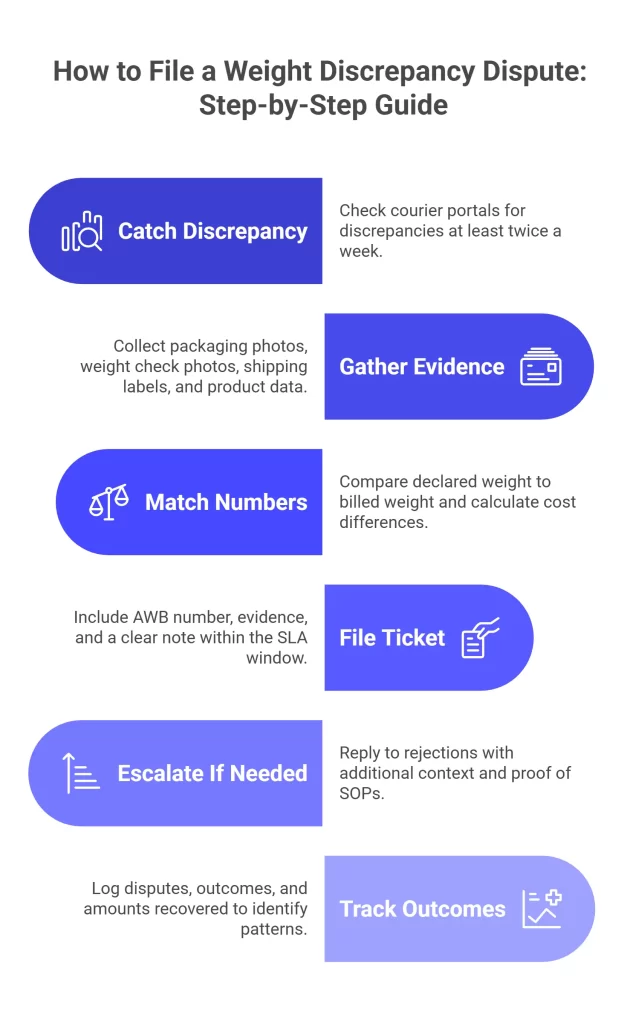
Step 4: File the Ticket Within the SLA Window
Every carrier has a strict claim window. Miss it, and you forfeit the right to dispute. We will cover specific carrier SLAs in the next section.
When filing, include the AWB number, your evidence files (zip them together if possible), and a short, clear note. Something like: “Disputing volumetric weight charge. Parcel dimensions verified at 30x25x20 cm. Evidence attached. Requesting refund of ₹54.”
Step 5: Escalate If Needed
If your first dispute is rejected, do not give up. Carriers have escalation matrices. Most aggregators have a second-level review team. Reply to the rejection with additional context: a video of the packaging, a third-party scale calibration certificate, or proof of your packaging SOP.
Step 6: Track Outcomes and Patterns
Maintain a simple spreadsheet (or better, use a freight reconciliation tool) to log every dispute, its outcome, and the amount recovered. After 2 to 3 months, patterns will emerge. You will see which couriers reject disputes most often, which parcel sizes get flagged, and where your packaging SOP needs tightening.
Evidence Checklist: What Couriers Actually Accept
Couriers reject most disputes on a technicality. Knowing what they accept upfront saves hours of back-and-forth.
Here is the evidence stack that wins:
- Pre-pickup parcel photo: Top view and side view, with a measuring tape clearly visible along each axis. The image should be timestamped, ideally by the camera or a packaging app.
- Weight verification photo: The parcel on a calibrated weighing scale, with the digital reading visible. The shipping label should be in the same frame so the AWB can be cross-checked.
- Calibration proof: Your weighing scale’s calibration certificate, dated within the last 12 months. If you do not have one, get your scale calibrated by a certified vendor. The cost is usually under ₹2,000 and the certificate stays valid for a year.
- Shipping label copy: The label generated at booking, showing your declared weight and dimensions.
- Order metadata: A screenshot or export from your OMS showing the order’s expected weight and dimensions based on the product master.
- Packaging SOP document: A short written document explaining how your team measures and weighs parcels. This adds credibility, especially in escalations.
A pro tip: invest in a simple barcode scanner plus weighing scale combo. Many Indian D2C brands now use packaging stations that auto-capture weight and dimensions at the moment of label generation. This creates a tamper-proof evidence trail and makes disputes much easier to win. If you have been thinking about automating your dispatch workflow, this is one of the highest-ROI additions you can make.
How Weight Discrepancy Disputes Work Across Shiprocket, Delhivery, Bluedart, and Others
Each carrier has different rules, claim windows, and evidence requirements. Here is a quick comparison based on observed practices in the Indian market.
⚠️ SLA windows last verified: May 2026. Carriers update their dispute policies periodically, and what is true today may shift in 3 to 6 months. Always confirm the current window on the carrier’s portal or with your account manager before filing. The figures below reflect standard B2B account terms in mid-2026.
Shiprocket Weight Discrepancy
Shiprocket pools shipments across multiple courier partners. Their weight discrepancy window is typically 7 to 15 days from the discrepancy being raised in your panel. To dispute, go to the “Weight Reconciliation” tab, select the AWB, and upload your evidence (photo plus dimensions). Shiprocket’s review usually takes 7 to 21 days.
Delhivery Weight Discrepancy
Delhivery has its own reweighing process at hubs. Their dispute window is around 7 days from invoice generation. They prefer evidence in a specific format, often a single image with both scale and tape measure visible. If you ship heavy volumes with Delhivery, having a dedicated KAM makes the dispute process noticeably smoother.
Bluedart Weight Discrepancy
Bluedart’s disputes are usually handled through their account manager or a dedicated dispute portal for B2B accounts. Their SLA window is typically 15 days from invoice receipt. They tend to be stricter on evidence quality but quicker on refunds when approved.
DTDC Weight Dispute
DTDC’s process is more manual. Disputes often go through email or franchise channels. The window is around 7 to 10 days. Recovery rates are lower compared to aggregators, so airtight evidence matters more here.
Xpressbees Weight Discrepancy
Xpressbees offers a dispute portal for direct B2B clients. The claim window is typically 10 days. Their reweighing process is automated at sortation hubs, so evidence with exact dimensions is critical.
Ekart Logistics Weight Discrepancy
Ekart, being a captive carrier for Flipkart and select D2C brands, has a more rigid dispute structure. Windows are usually 7 days with limited room for escalation. Build a strong evidence trail before you ship if Ekart is a major partner.
Ecom Express Weight Discrepancy
Ecom Express follows a similar 10 to 15 day window. They are known to accept video evidence in addition to photos, which can help in dimension disputes where a still image is not enough.
The takeaway? Build one master evidence template that satisfies the strictest carrier in your mix. That way, every dispute you file is automatically dispute-ready for all your partners. This is also a strong reason brands are moving towards the BYOC model, where you can hold direct carrier contracts and negotiate the dispute terms upfront.
What If a Carrier Refuses a Valid Dispute? Your Recourse Options
Even with airtight evidence, some disputes get rejected. Sometimes the rejection is procedural. Sometimes it is the carrier banking on you giving up. Here is what to do when that happens.
1. Use the Escalation Matrix
Every aggregator and direct carrier has an internal escalation chain: first-line support, second-line review, account manager, and a senior commercial contact. Many disputes rejected at the first level get reversed at the second. Always climb the matrix before walking away.
2. Apply Contract Leverage
Your shipping contract gives you rights. Most carrier agreements have clauses on reweighing standards, dispute resolution, and refund timelines. If a carrier is breaching these clauses, raise it formally in writing through your account manager. Document each breach, since this becomes your strongest card during contract renewal negotiations.
3. Use Volume as Negotiation Power
If a carrier consistently rejects valid disputes, route fewer orders through them. Carriers track share-of-wallet closely. A sustained 20 to 30 percent drop in volume usually gets their sales team’s attention, and they often become willing to revisit older disputes to win the business back.
4. Legal Recourse Under Indian Law
For larger disputes (typically above ₹50,000 in aggregate), legal escalation becomes a real option. The Consumer Protection Act 2019 does not directly cover B2B transactions, but the Indian Contract Act 1872 does. A carrier’s failure to honour the agreed dispute clauses can be treated as a breach of contract and taken to civil court or commercial court (under the Commercial Courts Act 2015 for claims above ₹3 lakh). Litigation is slow and expensive, so reserve it for cases where the recoverable amount clearly justifies the cost and effort. A formal legal notice from a lawyer often resolves disputes without ever reaching court.
5. Industry Bodies and Collective Action
For systemic issues, industry groups like the Federation of Indian E-Commerce (FICCI) and seller collectives have lobbied carriers and aggregators on fairness in dispute handling. Joining these forums gives you a collective voice that individual brands rarely have on their own. India does not yet have a dedicated logistics ombudsman, but pressure from collective bodies has nudged several aggregators to improve their dispute SLAs.
6. The Nuclear Option: Switch Carriers
If a carrier consistently overcharges and refuses valid disputes, the cleanest fix is to stop using them. Document the rejection rate and the aggregate dispute losses, then route volume to a more reliable partner. This is also one of the strongest arguments for the BYOC (Bring Your Own Carrier Platform): direct contracts give you cleaner dispute clauses and faster recourse than aggregator-level disputes.
How to Prevent Weight Discrepancy Charges Before They Happen
Winning disputes is good. Preventing them is better. Every dispute costs you time, and not every dispute wins. The smart play is to reduce the number of disputes that hit your invoice in the first place.
Here is what high-performing D2C ops teams do.
Standardise Your Packaging
Use a small set of pre-measured box sizes. When your packaging team picks the right box for each SKU, your dimensions become consistent and predictable. This is one of the simplest wins, yet most brands skip it. Five to seven standard box sizes will cover 90 percent of your SKUs.
Capture Weight and Dimensions at Label Generation
Modern packing stations integrate a weighing scale with the order management system. The moment a parcel is sealed, weight and dimensions get logged into the system, along with a photo. No manual entry, no guesswork.
Train Your Packaging Team
Most weight inflation happens because of small operational errors. Loose tape adds bulk. Oversized boxes inflate volumetric weight. Add a 15-minute weekly review session for your packing team to discuss errors caught in the last week. This habit alone can cut your discrepancy rate by half within a quarter.
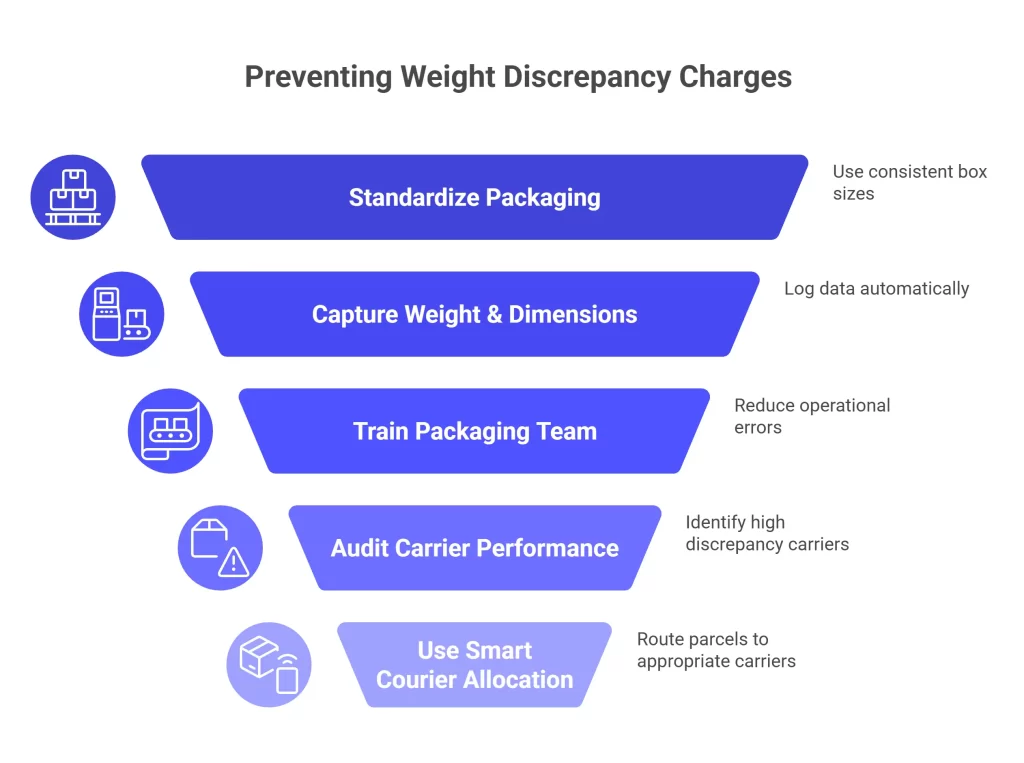
Audit Carrier Performance Monthly
Not all carriers are equal. Some have higher discrepancy rates than others. Run a monthly audit: total shipments per carrier vs total discrepancy amount per carrier. Drop or renegotiate with carriers that consistently overcharge.
Use Smart Courier Allocation
If a particular carrier shows a pattern of inflating weights on small parcels, route your small parcels to a different carrier. AI-powered courier allocation tools (like the ones discussed in our smart courier allocation guide) can do this routing automatically based on past performance data.
Run a Quarterly Freight Reconciliation Audit
A full freight audit, comparing every line item across invoices against your booking data, often surfaces patterns of overcharging. Many brands recover 1 to 3 percent of their annual shipping spend through these audits alone. Our deep dive on this is in the hidden cost of manual freight reconciliation guide.
Manual vs Automated Weight Reconciliation
Here is where most D2C brands hit a wall. Manual weight reconciliation does not scale.
If you ship 1,000 orders a month, you can probably manage discrepancies in a spreadsheet. At 10,000 orders, you cannot. By the time your ops team finishes reviewing one week’s discrepancies, the next week’s batch has already overflowed.
The Manual Approach
A typical manual workflow looks like this:
- Download invoice from each carrier
- Match against your shipment data
- Identify weight discrepancies one by one
- Pull evidence for each AWB
- File disputes individually through each portal
- Track responses across multiple email threads and dashboards
This takes 15 to 25 hours per week for a mid-sized brand. And human error means 20 to 30 percent of valid disputes never get filed in time. That is money you have already lost without even knowing it.
The Automated Approach
Automated weight reconciliation tools do four things well:
- Auto-pull invoices from every carrier and aggregator into one place
- Match each AWB against your booking data and flag discrepancies
- Auto-attach pre-captured evidence (photos, weight scans) to each dispute
- File disputes through carrier APIs (or generate pre-filled forms for portals without APIs)
Brands using automated reconciliation typically see dispute win rates jump from 30 percent to 70 to 80 percent. More importantly, they recover money faster, often within 2 to 4 weeks instead of 2 to 3 months.
Choosing the Right Tool
Metaport is one of several reconciliation options available to Indian D2C brands. Others include reconciliation modules built into shipping aggregators, standalone freight audit platforms, and in-house spreadsheet-plus-API workflows that larger brands build internally. The right choice depends on three things: your monthly shipping volume, the number of carriers you work with directly, and how tightly you want shipping, OMS, and finance data integrated. Any system beats no system. The point is to stop letting valid disputes slip past the SLA window.
If you want to understand whether automation fits your scale, our logistics aggregator vs SaaS platform guide covers the trade-offs in detail.
The Real Cost of Doing Nothing
Let us put numbers to this.
A D2C brand shipping 8,000 orders a month at an average shipping cost of ₹85 per order spends about ₹6.8 lakh on shipping every month. At a 3 percent leakage rate from weight discrepancies, that is ₹20,400 leaving the business every month. Annualised, that is nearly ₹2.5 lakh.
For a brand with thinner margins (say 12 percent contribution margin), that ₹2.5 lakh leakage is the equivalent of about 24 orders worth of profit per day. Every day. Going to the courier instead of your bank account.
Now scale up. A brand at 50,000 orders a month is leaking ₹12 to ₹15 lakh annually. That is enough to fund a small marketing campaign, a new product launch, or two full-time hires.
The cost of doing nothing is not zero. It is significant, and it compounds quietly month over month.
Building a Long-Term Weight Discrepancy Strategy
Solving weight discrepancy is not a one-time project. It is an ongoing operational discipline. Here is what a mature approach looks like, broken down month by month.
Month 1: Audit current discrepancy levels. Calculate exact ₹ leakage. Identify your worst-performing carriers and parcel categories.
Month 2: Standardise packaging. Roll out evidence capture at packing stations. Train your ops team.
Month 3: Implement automated reconciliation, either through a tool or a structured spreadsheet workflow. Set weekly dispute filing targets.
Month 4 onwards: Review monthly. Renegotiate with consistently overcharging carriers. Use the data in your contract reviews.
This is also where a unified shipping platform like Metaport’s multi-carrier shipping engine earns its keep. By keeping every shipment, weight check, and dispute in one workflow, you turn a chronic margin leak into a predictable cost line.
Frequently Asked Questions
1. What is weight discrepancy in courier shipping?
Weight discrepancy is the gap between the weight you declare at booking and the weight the courier records after pickup. If their chargeable weight is higher, they bill the extra amount on your next invoice.
2. How is volumetric weight calculated for couriers in India?
Volumetric weight = (Length x Breadth x Height in cm) divided by 5000 for air or express shipments, or 6000 for surface mode. Your chargeable weight is the higher of this number or the parcel’s actual weight on a scale.
3. What is the time limit to raise a weight discrepancy claim?
Windows vary by carrier: Shiprocket 7 to 15 days, Delhivery around 7 days, Bluedart up to 15 days, DTDC and Xpressbees 7 to 10 days. Miss it and you lose the right to dispute, so check your reconciliation dashboard at least twice a week.
4. What proof is required to dispute courier weight charges?
You need a pre-pickup parcel photo with a measuring tape, a weight check image on a calibrated scale showing the AWB, the shipping label, OMS dimension data, and a scale calibration certificate. Without this evidence stack, most disputes get rejected on technical grounds.
5. Can automation really improve my weight discrepancy win rate?
Yes, significantly. Manual filing wins only 25 to 35 percent of disputes due to missed SLA windows and weak evidence. Automated reconciliation tools push win rates to 70 to 80 percent and cut recovery time from months to 2 to 4 weeks.
Wrapping Up
Weight discrepancy disputes are not glamorous. They are not the kind of work that wins awards or makes for great LinkedIn posts. But they are quietly one of the highest-ROI activities your ops or finance team can run.
A brand that takes weight discrepancy seriously can save 2 to 4 percent on shipping costs. For most D2C businesses in India, that is the difference between a profitable quarter and a flat one. The math is in your favour. The tools exist. The evidence playbook is now in your hands.
Start small. Pick last month’s invoices. Audit them. File the disputes that are still in window. Track what you recover. Then build the operational muscle to make this a monthly habit.
And when your spreadsheet workflow starts to crack, look at automation. The brands that win at scale are the ones who treat freight reconciliation as a system, not a chore.
Ready to plug the leak? Metaport’s reconciliation engine captures weight evidence at every parcel, flags discrepancies the moment they hit your invoice, and files disputes automatically across all your carriers. Book a 20-minute demo to see how much you could be recovering every month.
Frequently Asked Questions
Weight discrepancy is the gap between the weight you declare at booking and the weight the courier records after pickup. If their chargeable weight is higher, they bill the extra amount on your next invoice.
Volumetric weight = (Length x Breadth x Height in cm) divided by 5000 for air or express shipments, or 6000 for surface mode. Your chargeable weight is the higher of this number or the parcel’s actual weight on a scale.
Windows vary by carrier: Shiprocket 7 to 15 days, Delhivery around 7 days, Bluedart up to 15 days, DTDC and Xpressbees 7 to 10 days. Miss it and you lose the right to dispute, so check your reconciliation dashboard at least twice a week.
You need a pre-pickup parcel photo with a measuring tape, a weight check image on a calibrated scale showing the AWB, the shipping label, OMS dimension data, and a scale calibration certificate. Without this evidence stack, most disputes get rejected on technical grounds.
Yes, significantly. Manual filing wins only 25 to 35 percent of disputes due to missed SLA windows and weak evidence. Automated reconciliation tools push win rates to 70 to 80 percent and cut recovery time from months to 2 to 4 weeks.
Wrapping Up
Weight discrepancy disputes are not glamorous. They are not the kind of work that wins awards or makes for great LinkedIn posts. But they are quietly one of the highest-ROI activities your ops or finance team can run.
A brand that takes weight discrepancy seriously can save 2 to 4 percent on shipping costs. For most D2C businesses in India, that is the difference between a profitable quarter and a flat one. The math is in your favour. The tools exist. The evidence playbook is now in your hands.
Start small. Pick last month’s invoices. Audit them. File the disputes that are still in window. Track what you recover. Then build the operational muscle to make this a monthly habit.
And when your spreadsheet workflow starts to crack, look at automation. The brands that win at scale are the ones who treat freight reconciliation as a system, not a chore.
Ready to plug the leak? Metaport’s reconciliation engine captures weight evidence at every parcel, flags discrepancies the moment they hit your invoice, and files disputes automatically across all your carriers. Book a 30-minute demo to see how much you could be recovering every month.

Kapil Pathak is a Senior Digital Marketing Executive with over six years of experience in the logistics and supply chain industry. He specializes in SEO, SEM, and multi-channel campaign management. He has a strong track record of building strategies that boost brand visibility and generate qualified leads. His work focuses on driving growth for D2C and B2B technology companies through data-driven digital marketing initiatives.