If you’re running a D2C brand in India, Cash on Delivery is probably both your biggest growth lever and your biggest margin leak, at the same time.
COD opens your brand to customers who don’t trust online payments yet. That’s a massive market. But it also brings RTO rates 3 to 5 times higher than prepaid, remittance delays that strangle your cash flow, and reverse logistics costs that quietly eat your contribution margin every single month.
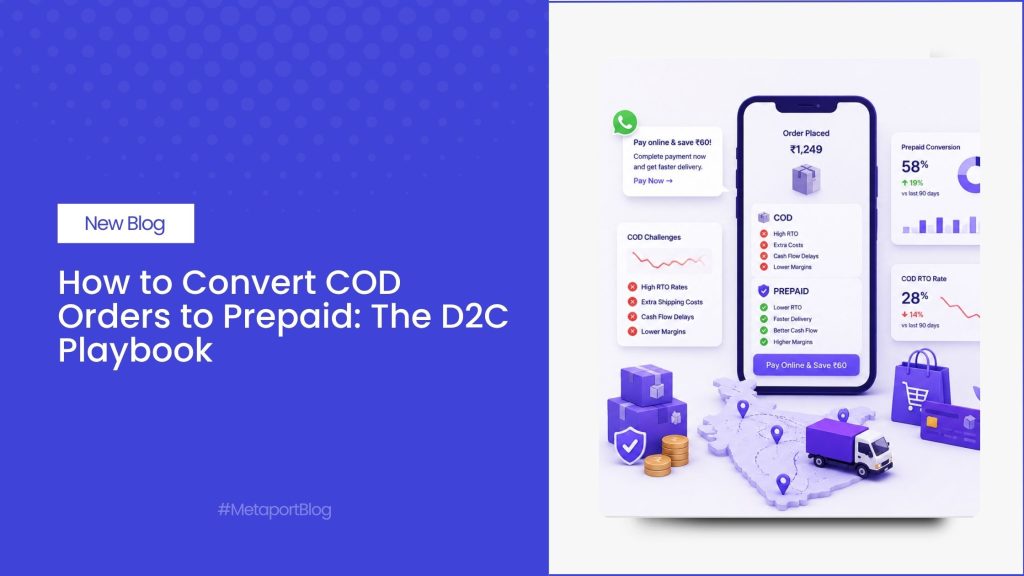
Most D2C founders treat COD as an unchangeable reality of Indian eCommerce. The brands that actually scale, from ₹50 lakh to ₹10 crore without bleeding out, are the ones that actively work to convert COD buyers into prepaid customers.
This is your complete playbook for doing exactly that.
Why COD Is Killing Your Margins (The Real Numbers)
COD accounts for 50 to 60 percent of Indian eCommerce transactions. In fashion and accessories, it runs higher, sometimes 70 percent. In Tier 2 and Tier 3 cities, it’s often the default payment method.
Here’s what that actually costs you per order:
| Cost Component | Prepaid | COD (Delivered) | COD (RTO) |
|---|---|---|---|
| Forward shipping | ₹80 | ₹80 | ₹80 |
| Reverse shipping | – | – | ₹70 |
| COD handling fee | – | ₹25–40 | ₹25–40 |
| Repackaging / QC | – | – | ₹30–50 |
| Working capital blocked | Minimal | 7–10 days | 15–25 days |
| Extra cost vs prepaid | Base | +₹25–40 | +₹200–250 |
For a brand shipping 8,000 orders a month with 55% COD and a 28% COD RTO rate, close to the Indian D2C average, that’s roughly 1,230 failed COD orders per month. At ₹220 average RTO cost, you’re burning ₹2.7 lakh every month before you’ve paid for ads, team, or product.
Annualised: ₹32 lakh.
Every percentage point you shift from COD to prepaid directly reduces your RTO exposure, frees working capital, and improves contribution margin. This isn’t a nice-to-have. It’s a core growth lever.
Why Indian Customers Choose COD
Before you can convert COD buyers, you need to understand what’s actually driving the choice. “Trust issues” is the surface-level answer. The reality is more specific:
- Product quality anxiety – The product might not match the photos. COD lets them inspect before paying.
- Return policy skepticism – Bad past experiences with slow refunds or rejected returns make COD feel like the safer option.
- Payment security concerns – Saving a card or entering UPI details on an unfamiliar checkout still feels risky for a large segment of Indian shoppers.
- Digital payment friction – OTP timeouts, UPI app failures, bank server issues at checkout. These real problems have trained some customers to default to COD to avoid the frustration.
- Low purchase intent – Some COD orders are impulse buys with no real commitment to accept delivery. Zero upfront cost makes this easy.
Knowing which of these drives your customers’ COD behaviour tells you which conversion strategy will actually move the number.
8 Strategies to Convert COD Orders to Prepaid
1. Put the Prepaid Discount on the Product Page, Not Just at Checkout
The most direct lever is also the most commonly misplaced one. Most brands bury the prepaid incentive at checkout, after the customer has already mentally committed to COD.
Put it on the product page itself. “Pay now and save ₹50 + get priority dispatch” next to the Add to Cart button is far more effective than a payment-stage prompt.
The discount doesn’t need to be large. ₹30 to ₹75 on an ₹800 to ₹1,500 order is typically sufficient. What matters more is placement and framing; specific discount plus a non-monetary benefit consistently outperforms a generic percentage discount.
Brands that do this correctly see prepaid conversion rates improve 8 to 15 percentage points within 60 days.
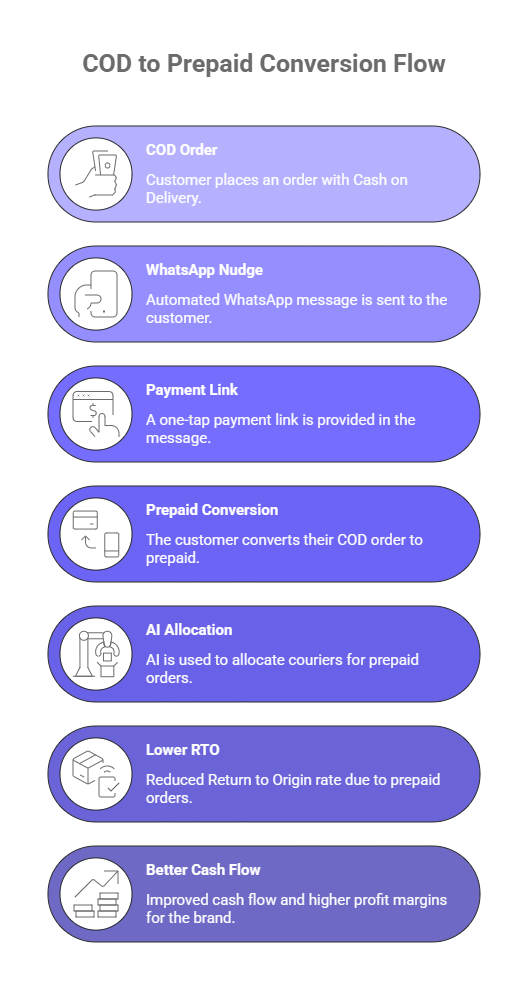
2. Send a WhatsApp Nudge Right After a COD Order Is Placed
This is currently the highest-ROI tactic available to Indian D2C brands, and still underused.
When a customer places a COD order, you have a 15 to 30 minute window where purchase intent is at its peak. A WhatsApp message in that window, offering a time-limited prepaid incentive with a one-tap payment link, can convert 10 to 20 percent of those COD orders before the item is even dispatched.
What works:
- Acknowledge the order with the customer’s name and product
- Offer a specific, time-bound incentive (“save ₹60, valid for the next 2 hours”)
- Include a one-tap payment link that requires no extra steps
This also filters low-intent orders. Customers who placed an impulsive COD order with no real intention to accept delivery will either convert to prepaid or cancel; both outcomes are better than a paid-for RTO.
At any meaningful volume, this needs to be fully automated via WhatsApp Business API, triggered the moment a COD order is confirmed. Manual outreach doesn’t scale past 200 orders a day.
3. Offer Exclusive Perks, Not Just Discounts
Price-sensitive customers respond to discounts. But a significant portion of Indian shoppers responds better to perks that feel like an upgrade.
Test these prepaid-exclusive benefits with your customer base:
- Priority dispatch – “Prepaid orders ship same day. COD ships next business day.” Easy to implement, genuinely compelling for delivery-speed-conscious buyers.
- Free gift – A small branded product or sample added to prepaid orders. The perceived value often exceeds an equivalent cash discount in the customer’s mind.
- Extended return window – “Prepaid gets 15-day returns. COD gets 7 days.” This directly addresses the return anxiety that drives many customers to COD in the first place.
- Loyalty point acceleration – “Earn 2x points on prepaid orders.” Particularly effective for repeat buyers already enrolled in your loyalty program.
Test one perk at a time before scaling. What works for a skincare brand won’t necessarily work for a fashion brand.
4. Reduce Friction on the Prepaid Path
Checkout friction is a silent COD driver that most brands underestimate. A customer who genuinely wanted to pay online but hit a UPI timeout or an expired OTP has now defaulted to COD, not by preference, but by failure.
High-impact changes that don’t require rebuilding your checkout:
- Save payment methods – One-tap checkout for returning customers eliminates the re-entry friction that pushes hesitant shoppers to COD.
- Show all payment options upfront – UPI, cards, netbanking, BNPL, all visible immediately, not buried in a scroll.
- Add BNPL for high-value orders – Platforms like Simpl, LazyPay, and ZestMoney convert customers who chose COD not because of distrust, but because they didn’t want to pay the full amount upfront. This is especially effective for orders above ₹1,500.
- Make COD slightly more effortful – An OTP confirmation before COD is finalised filters low-intent orders and makes the frictionless prepaid path comparatively more appealing. It’s not about blocking COD; it’s about nudging the preference.
5. Use Instalment Options for High-Value Orders
COD rates spike on orders above ₹1,500. The higher the value, the greater the perceived risk in prepaying.
For high-value COD orders, no-cost EMIs consistently outperform discounts at driving prepaid conversion. A ₹2,500 order split into three monthly instalments of ₹834 removes the financial hesitation without you discounting the product. The customer pays full price, just not all at once.
6. Build Trust Before the Purchase Decision
Some COD selection happens well before checkout, in the customer’s head, the first time they encounter your brand. Trust signals that build confidence earlier in the journey reduce COD selection downstream.
Key elements to add or sharpen:
- Photo reviews – Generic star ratings are weak trust signals. Customer photos showing the actual product address the “what if it looks different from the listing” concern directly.
- Visible return policy – One sentence on the product page: “Not happy? Return within 15 days for a full refund.” That above the Add to Cart button does more for prepaid conversion than most discount experiments.
- Specific estimated delivery dates – “Arriving by Thursday, May 29” builds far more confidence than “5 to 7 business days.” Customers who trust a delivery promise are more comfortable paying upfront. This is where an AI-powered EDD Delivery Predictor earns its keep; it shows a pin code-level delivery date on your product page before the customer even reaches checkout.
7. Verify High-Risk COD Orders Before Dispatch
Not all COD orders carry the same risk. A repeat metro customer placing an ₹800 order is very different from a first-time buyer in a historically high-RTO pin code placing a ₹2,000 COD order.
For your high-risk segment, an automated IVR or WhatsApp verification call before dispatch confirms purchase intent, and creates a natural opening to offer prepaid conversion:
“Hi, we’re calling to confirm your order. Would you like ₹50 off by switching to online payment?”
Brands that implement risk-tiered COD verification typically see 8 to 12 percent of high-risk orders either convert to prepaid or cancel before dispatch. Either outcome protects your margins.
8. Build a Loyalty Program That Rewards Prepaid Behaviour
The most durable COD-to-prepaid strategy is one that compounds over time.
When customers see that their prepaid orders are building toward a tangible reward, a free product, exclusive discount, or early access to new launches, the calculus shifts. Prepaid stops being “paying upfront” and becomes “investing in rewards.”
Practical mechanics that work:
- Award 2x points for prepaid orders vs COD orders
- Show COD customers how close they are to the next tier: “You’re 120 points from Gold. Switch to prepaid to get there 2x faster.”
- Make prepaid tier benefits clearly visible on the account dashboard
For repeat buyers, loyalty-driven conversion consistently outperforms discounts because it creates a lasting habit, not just a one-time switch.
Realistic Prepaid Targets by Brand Stage
Setting targets without knowing your starting point is guesswork. Here’s what’s actually achievable across brand stages:
| Brand Stage | Typical Starting Prepaid % | Achievable in 12 Months | Primary Levers |
|---|---|---|---|
| Early-stage (< ₹50L) | 25–35% | 40–50% | Product page discount, checkout fix |
| Growth (₹50L–₹2Cr) | 35–45% | 50–60% | WhatsApp nudge, BNPL, trust signals |
| Scaling (₹2Cr–₹10Cr) | 40–55% | 60–70% | Full automation, loyalty, risk verification |
| Established (₹10Cr+) | 50–65% | 70–80% | AI personalisation, brand trust equity |
Category matters significantly. Health, beauty, and personal care brands convert COD to prepaid more easily than fashion, where fit and quality uncertainty keeps COD rates structurally higher. Geography matters too; metro customers shift faster than Tier 3.
Even a move from 40% to 55% prepaid cuts your RTO-exposed order volume by 27 percent. At meaningful scale, that’s the difference between a profitable operation and one that’s constantly plugging holes.
Common Mistakes D2C Founders Make
Blocking COD without building trust first. Restricting COD in high-RTO pin codes sounds clean, but it usually just blocks the sale. Customers don’t switch to prepaid; they go to a competitor. Build trust and offer incentives first; restrict COD only as a last resort for genuinely unserviceable zones.
Setting the prepaid discount too low. A ₹10 discount on a ₹1,200 order is noise, not a conversion lever. If you’re running a prepaid incentive, make it meaningful enough to actually influence the decision.
Showing the incentive only at checkout. By the time a customer reaches checkout, many have already decided on COD. The conversion opportunity is on the product page, in the cart, and in the post-order WhatsApp message, not just at the payment step.
Treating all COD orders the same. Verification calls belong on high-risk orders. Loyalty acceleration works on repeat buyers. BNPL is for high-value orders. Segmented approaches consistently outperform blanket ones.
Metrics to Track Weekly
Once you start running conversion experiments, pull these numbers every week:
- Overall prepaid percentage, your baseline and primary success metric
- Prepaid % by acquisition channel, tells you which channels bring higher-intent buyers
- COD RTO rate vs prepaid RTO rate, quantifies exactly how much more COD orders fail
- WhatsApp COD-to-prepaid conversion rate, measures whether your nudge message is working
- High-risk COD cancellation rate post-verification, higher cancellation is actually a good sign
- Contribution margin by payment type, the number that makes the full business case undeniable
The Tech Stack That Makes This Scale
These strategies work at 50 orders a day without much infrastructure. At 500 orders a day, you need automation doing the heavy lifting.
What the best-performing Indian D2C brands are running:
- Unified order management – all channels (Shopify, Amazon, Flipkart) syncing into one dashboard in real time, no manual CSV exports
- WhatsApp Business API – automated post-order COD nudges with personalised content and expiring payment links, firing without any manual intervention
- Pre-shipping validation – address verification, pin code serviceability checks, and COD fraud screening before dispatch catches problems before they become RTOs
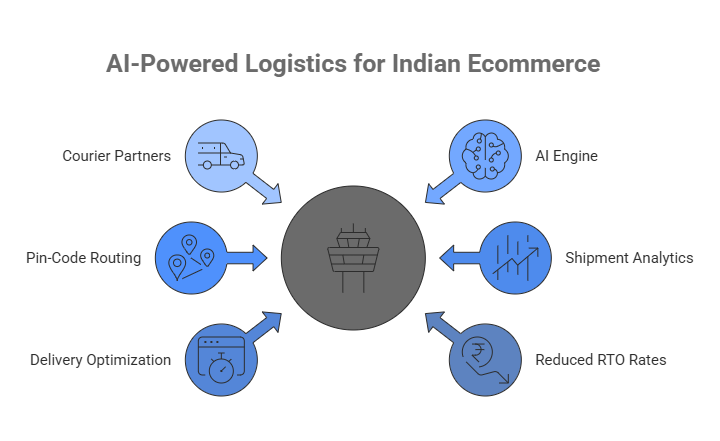
- AI-powered courier allocation – every COD order is routed to the carrier with the highest delivery success rate for that specific pin code, reducing fake attempts and first-attempt failures before they hit your NDR queue
- NDR automation – when a COD delivery fails, automated WhatsApp and SMS workflows trigger instantly, scheduling reattempts and capturing updated delivery information before the order slips into RTO
- COD reconciliation and analytics – real-time visibility into every rupee collected by every courier, with automatic discrepancy flagging and no end-of-month spreadsheet scramble
Platforms that connect all of this into a single workflow, rather than requiring you to stitch together five separate tools, are what separate the brands that scale cleanly from the ones that plateau at ₹2 crore.
Your 90-Day Roadmap
Days 1–30: Establish your baseline and run quick wins
- Pull current prepaid %, COD RTO rate, and cost per RTO; this is your before state without which nothing is measurable
- Add a visible prepaid discount to the product page, not just checkout
- Set up COD verification for your highest-risk segment: first-time buyers in Tier 2 and Tier 3 cities placing orders above ₹1,500
Days 31–60: Automate the post-order nudge
- Build your WhatsApp COD-to-prepaid flow, a single message with a specific incentive and a one-tap payment link
- A/B test timing (15 min vs 30 min post-order) and incentive type (discount vs free shipping upgrade vs gift)
- Add AI-powered estimated delivery dates to your product pages; measure whether delivery transparency shifts prepaid selection at checkout
Days 61–90: Layer in loyalty and reduce checkout friction
- Restructure or launch a loyalty program that explicitly rewards prepaid behaviour
- Audit your checkout for payment friction: fix UPI handling, enable saved payment methods, add BNPL for high-value orders
- Review your 90-day data. Which tactics moved the needle? Which categories or pin codes still resist prepaid? Use the answers to set your 6-month targets.
The Bottom Line
Converting COD to prepaid isn’t a single tactic. It’s a compounding system: trust signals that build pre-purchase confidence, frictionless checkout that removes the payment barrier, automated post-order nudges that catch high-intent customers before dispatch, and a loyalty architecture that makes prepaid the natural default for repeat buyers.
Every percentage point you shift cascades into lower RTO rates, faster remittance, healthier cash flow, and stronger contribution margins. The math isn’t marginal. At scale, it’s the difference between a business that compounds and one that’s constantly absorbing losses it doesn’t fully see.
Ready to build the infrastructure that makes prepaid the default for your customers? Explore how Metaport’s platform, from smart dispatch allocation to NDR automation to real-time COD reconciliation, gives your brand the tools to make it happen.
Frequently Asked Questions
Under 40% signals significant room for improvement. 40 to 55% is typical for growing D2C brands. Above 60% is strong, and above 70% is excellent for most categories outside fashion, where COD rates remain structurally higher due to fit and quality uncertainty.
In isolation, yes. But the math reverses once you factor in savings on COD handling fees, reduced RTO rates, lower reverse logistics costs, and faster cash realisation. Most brands find a 3 to 5% prepaid discount more than pays for itself through RTO reduction alone, before accounting for the cash flow benefit.
Brands using automated post-order WhatsApp nudges report 10 to 20 percent conversion rates on COD orders that receive the message. The keys are timing (within 30 minutes of order placement), personalisation (include actual order details and a specific payment link), and a clear, time-bound incentive.
Only as a last resort. Blocking COD typically reduces sales without meaningfully improving your prepaid rate; customers who defaulted to COD usually just don’t purchase at all rather than switching to prepaid. Build trust and run verification workflows first.
Every COD order that ships should go to the carrier with the highest delivery success rate for that specific pin code. Smart dispatch allocation does this automatically, routing each order based on real historical performance, reducing fake delivery attempts and improving first-attempt delivery rates directly. Learn more in our guide on why AI courier allocation is crucial for eCommerce brands.

Kapil Pathak is a Senior Digital Marketing Executive with over six years of experience in the logistics and supply chain industry. He specializes in SEO, SEM, and multi-channel campaign management. He has a strong track record of building strategies that boost brand visibility and generate qualified leads. His work focuses on driving growth for D2C and B2B technology companies through data-driven digital marketing initiatives.