For most Indian D2C brands, the festive season is the single biggest revenue window of the year, and festive season shipping is where that revenue is either captured or quietly lost. Between the Great Indian Festival, Big Billion Days, Diwali, and the global BFCM wave, order volumes can jump three to five times in a matter of days. The brands that win are not always the ones with the loudest campaigns; they are the ones whose parcels actually arrive on time, in full, and without a flood of “where is my order” messages.
This guide is a practical, India-first playbook for festive season shipping and last-mile delivery in 2026. It walks through what to do before the peak, during the rush, and after the dust settles, covering demand forecasting, carrier capacity, smart courier allocation, delivery promises, RTO control, tracking, and returns. Whether you ship a few hundred orders a day or tens of thousands, the goal is the same: protect your margins and your customer experience when everything is moving at maximum speed.
The stakes are high because festive demand compresses a quarter of sales into a few weeks, and the logistics network is under its heaviest strain of the year at exactly that moment. Couriers hit capacity limits, delivery SLAs slip, return-to-origin rates climb, and customer patience runs thin. A deliberate festive season shipping strategy turns that chaos into a competitive advantage.
Why Festive Season Shipping Breaks Unprepared D2C Brands
Understanding what goes wrong is the first step to preventing it. Festive peaks expose every weak point in a shipping operation at once, and the failures compound.
The most obvious problem is volume. A surge that multiplies daily orders strains your packing stations, your team, and above all your courier partners. Carriers allocate finite pickup and delivery capacity across thousands of sellers, so during peak weeks your shipments compete for space on the same vehicles as everyone else’s. Brands that depend on a single courier are the most exposed, because when that one partner saturates, there is no fallback.
The second problem is delivery promises. Shoppers buy during festive sales partly because they expect their order before the festival or the gifting occasion. When estimated delivery dates are vague or overly optimistic, the gap between expectation and reality becomes complaints, cancellations, and refused deliveries. Festive shoppers are also more likely to order on cash on delivery, which raises the risk of refusals and return to origin.
The third problem is visibility. With more parcels in transit and more first-time buyers, “where is my order” queries spike. If customers cannot self-serve tracking, your support team drowns, response times balloon, and trust erodes during the exact window when you want repeat purchases. Add the post-festive returns wave, and an unprepared brand finds its margins eroded from every direction at once. A strong festive season shipping plan addresses each of these failure points deliberately rather than reactively.
The Festive Season Shipping Timeline: Before, During, and After
The most reliable way to think about festive season shipping is as three distinct phases, each with its own priorities. Trying to fix capacity or delivery promises in the middle of the rush is too late; the winning work happens in the weeks beforehand.
The pre-peak phase, roughly four to eight weeks out, is for forecasting, carrier onboarding, capacity commitments, inventory positioning, and stress-testing your systems. The peak phase is for disciplined execution: automated dispatch, smart allocation, proactive tracking, and real-time monitoring. The post-peak phase is for handling the returns surge, reconciling shipping costs, and capturing lessons for next year. The strategies below are organised so you can map each one to the right phase.
Strategy 1: Forecast Demand and Lock In Carrier Capacity Early
Everything in festive season shipping starts with a realistic demand forecast. Look at last year’s festive numbers, your recent growth rate, planned marketing spend, and the specific sale events you will participate in. Translate that into expected daily and peak-day order volumes, broken down by destination zone and by prepaid versus cash on delivery.
Armed with that forecast, have capacity conversations with your courier partners well before the rush. Carriers prioritise sellers who communicate volumes in advance, so share your projections and confirm pickup slots, daily shipment caps, and serviceable pincodes. This is also the moment to expand your carrier mix. Relying on one courier during the festive peak is the most common and most damaging mistake a D2C brand can make, because a single point of failure becomes a single point of catastrophe when that partner saturates.
Position inventory closer to demand where you can, using multiple pickup locations or fulfilment hubs so that more orders ship within zone and reach customers faster. Shorter shipping zones mean lower costs, faster delivery, and fewer failed attempts, all of which matter more during the festive season than at any other time of year.
Strategy 2: Go Multi-Carrier with Smart Courier Allocation
A single courier cannot reliably carry a D2C brand through the festive peak. A multi-carrier shipping setup spreads risk across several partners so that when one hits capacity or slows down in a region, others absorb the load. During festive weeks, the ability to reroute volume in real time is the difference between deliveries that flow and a backlog that snowballs.
Multi-carrier only delivers its full value when paired with intelligent allocation. Manually deciding which courier handles which order does not scale to festive volumes. Instead, smart courier allocation automatically assigns every shipment to the best carrier based on destination pincode, weight, delivery SLA, cost, and each courier’s recent performance and capacity. This keeps parcels moving on the fastest, most reliable, most cost-effective path without human bottlenecks.
Allocation logic is also one of your strongest levers for reducing failed deliveries. By routing orders to the courier with the best track record for a given zone or pincode, smart allocation directly lowers RTO, which is especially valuable when festive volumes magnify every percentage point of return to origin into a serious cost. Set your allocation rules before the peak, test them on live orders, and let automation carry the load when volume spikes.
Strategy 3: Set Accurate Delivery Promises with Smart EDDs
Festive shoppers buy on the promise of timely delivery, so the estimated delivery date you show is part of the product. An accurate, realistic estimated delivery date on the product and checkout pages does two things at once: it lifts conversion by giving hesitant buyers confidence, and it protects you from the disappointment that drives cancellations and refused parcels.
During the festive season, resist the temptation to display aggressively short delivery windows you cannot keep. Carrier networks are slower under peak load, so build that reality into your EDDs. A delivery date that is honest and slightly conservative beats an optimistic one that you miss, because a missed festive delivery often means a returned order and a lost customer. Communicate any festive cutoff dates clearly too, so shoppers know the last day to order for guaranteed delivery before the key festival.
Accurate delivery promises also reduce support load. When customers see a credible date up front and the parcel arrives within it, they have no reason to raise a “where is my order” ticket, freeing your team to focus on genuine exceptions during the busiest period of the year.
Strategy 4: Attack RTO Before It Happens
Return to origin is the silent margin killer of the festive season, and festive volumes amplify it. Every RTO means you paid forward shipping, return shipping, and handling for an order that earned nothing. Understanding what drives NDR and RTO is essential, because the fixes are mostly preventive and need to be in place before the peak begins.
Address quality is the first line of defence. Incomplete or incorrect addresses cause a large share of failed deliveries, so validate and enrich address data at checkout and flag suspicious or incomplete entries before dispatch. Cash on delivery is the second big driver, since COD orders are far more likely to be refused than prepaid ones. Nudging shoppers to convert COD orders to prepaid with small incentives, partial advance payment, or trust-building at checkout meaningfully reduces festive RTO.
The third lever is active NDR management. When a delivery fails on the first attempt, a fast, automated response that confirms the address or intent with the customer and triggers a reattempt prevents that shipment from sliding into RTO. During festive weeks, when first-attempt failures rise, an automated NDR workflow that resolves exceptions within hours rather than days protects both revenue and customer experience.
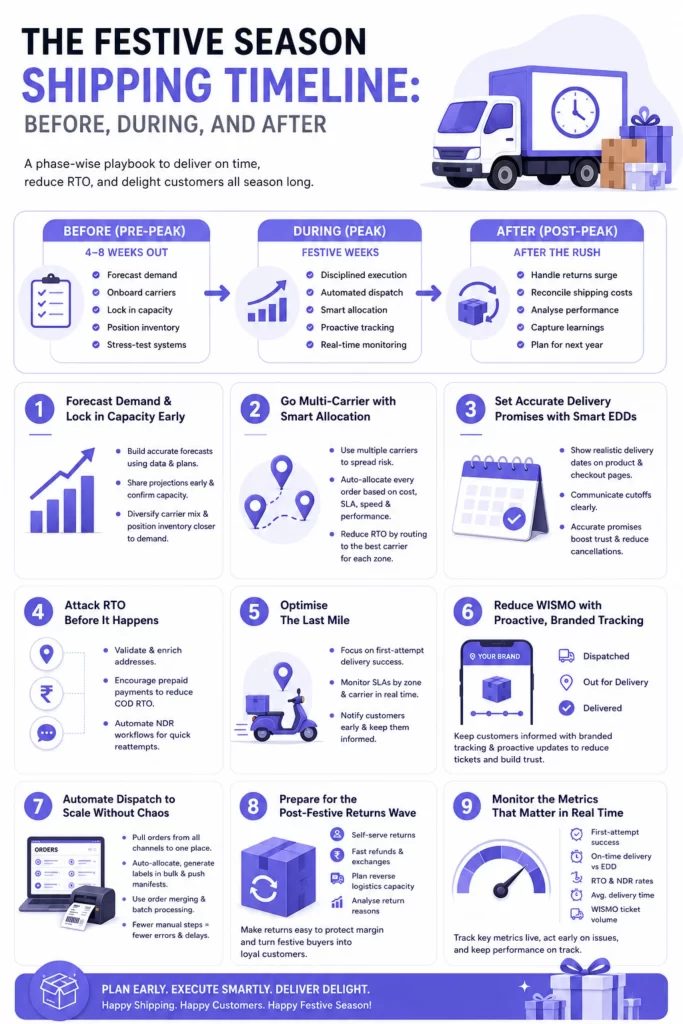
Strategy 5: Optimise the Last Mile
The last mile is where festive promises are kept or broken, and it is the most congested, most expensive segment of the journey. Optimising it during peak season is about maximising first-attempt delivery success, because every reattempt adds cost, delay, and RTO risk.
Several of the strategies above feed directly into last-mile performance. Smart allocation routes parcels to the courier most likely to deliver successfully in a given area. Accurate addresses and confirmed customer intent reduce wasted attempts. Clear delivery windows and pre-delivery notifications mean customers are expecting the parcel and available to receive it. Together these lift first-attempt success, which is the single most important last-mile metric during the festive season.
Watch your delivery SLAs by zone and courier in real time so you can spot a partner slowing down in a particular region and shift volume before a local backlog forms. The brands that manage the last mile actively during peak, rather than hoping their couriers cope, are the ones whose customers receive orders on time and come back after the festive season ends.
Strategy 6: Reduce WISMO with Proactive, Branded Tracking
Festive peaks bring a surge of “where is my order” queries, driven by higher volumes and a large share of first-time, anxious buyers. If every one of those becomes a support ticket, your team cannot cope and your costs climb. The answer is proactive visibility through branded tracking pages that keep customers informed automatically.
A branded tracking experience gives shoppers a self-serve, real-time view of their order on a page that carries your brand rather than the courier’s. Combined with proactive notifications at each milestone, dispatched, out for delivery, delivered, it answers the “where is my order” question before the customer has to ask. That deflects a large share of tickets, keeps your support team focused on real exceptions, and turns a routine logistics touchpoint into a branded engagement opportunity during your highest-traffic season.
Proactive tracking also softens the impact of the delays that are inevitable during peak load. A customer who can see exactly where their parcel is, and who receives a timely heads-up when something slips, is far more patient than one left in the dark. Transparency buys goodwill precisely when the network is under the most strain.
Strategy 7: Automate Dispatch to Scale Without Chaos
Manual shipping processes that work fine at normal volumes collapse under festive load. Hand-keying orders, manually choosing couriers, and printing labels one by one cannot keep pace when volumes multiply, and every manual step is a chance for error and delay. Automating the ecommerce dispatch workflow is what lets a brand scale its shipping throughput without scaling its headcount or its mistakes.
An automated dispatch flow pulls orders from every sales channel into one place, applies your allocation rules, generates carrier-compliant labels in bulk, and pushes manifests to couriers automatically. Order merging and batch processing let your team handle far more shipments per hour, clearing the daily queue before pickup cutoffs instead of racing against them. Removing manual touchpoints also removes a major source of festive errors such as wrong labels and misrouted parcels.
The time to implement and test automation is during the pre-peak phase, not in the middle of the rush. Configure your rules, run them on live orders in the weeks before the sale, and refine them so that when volume spikes, the system simply absorbs it. Automation is the backbone that holds every other festive season shipping strategy together at scale.
Strategy 8: Prepare for the Post-Festive Returns Wave
The festive rush is followed by a returns surge, and a brand that plans only for outbound shipping gets caught flat-footed when parcels start coming back. Gifting mismatches, impulse purchases, and sizing issues all drive higher festive return rates, so returns readiness is part of any complete festive season shipping plan.
A streamlined, automated returns process protects both margin and customer loyalty during this window. Offering a self-serve, automated returns experience lets customers initiate returns without burdening your team, applies your eligibility rules consistently, and gets refunds or exchanges moving quickly. Fast, painless returns are a powerful driver of repeat purchase, so handling them well after the festive season is how you convert one-time festive buyers into loyal customers.
Plan reverse logistics capacity with your couriers the same way you planned outbound capacity, and watch return reasons closely. The data from festive returns, why items came back, which SKUs, which regions, feeds directly into better product, sizing, and shipping decisions for the next peak.
Strategy 9: Monitor the Metrics That Matter in Real Time
You cannot manage a festive peak on instinct alone. Tracking the right D2C shipping metrics in real time lets you catch problems while you can still act on them, rather than discovering them in a post-mortem.
The metrics that matter most during the festive season are first-attempt delivery success, on-time delivery rate against promised EDDs, RTO and NDR rates by courier and zone, average delivery time, and “where is my order” ticket volume. Watching these live tells you instantly when a courier is slipping in a region, when RTO is creeping up, or when a particular pincode cluster is underperforming, so you can reallocate volume or intervene before the problem scales.
Set baselines from your normal operations and from last year’s festive period, and define the thresholds that should trigger action. A daily peak-season review of these numbers, with a clear owner empowered to shift volume between carriers, keeps your festive season shipping under control when everything is moving fast.
Your Festive Season Shipping Checklist
Use this condensed festive season shipping checklist as a readiness gate in the weeks before your peak sale:
- Demand forecast built by zone, with prepaid and COD split
- Carrier capacity confirmed with every courier partner
- Multi-carrier setup live, with no single point of failure
- Smart courier allocation rules configured and tested on live orders
- Accurate EDDs displayed on product and checkout pages
- Festive order cutoff dates communicated to customers
- Address validation active at checkout
- COD-to-prepaid nudges in place
- Automated NDR workflow ready for fast first-attempt recovery
- Branded tracking and proactive notifications switched on
- Dispatch automation configured, with bulk labels and manifests
- Returns process automated and reverse-logistics capacity planned
- Real-time shipping dashboard live, with thresholds and an owner
- Support team briefed and staffed for peak ticket volume
Common Festive Shipping Mistakes to Avoid
Even experienced brands repeat a handful of avoidable mistakes each festive season. The most damaging is depending on a single courier, which turns any capacity crunch into a brand-wide crisis. Close behind is making delivery promises the network cannot keep, which converts eager buyers into refused parcels and RTO.
Other frequent errors include leaving shipping processes manual and hoping the team can simply work harder, ignoring address quality until parcels fail, treating COD as harmless when it inflates festive RTO, and forgetting to plan for returns until the wave hits. Underinvesting in proactive tracking is another, because the “where is my order” flood it creates can swamp support during your busiest week. Every one of these is preventable with the strategies above, and avoiding them is largely a matter of doing the pre-peak work rather than reacting once the rush begins.
Frequently Asked Questions
Start four to eight weeks early. Forecast demand by zone, confirm capacity with multiple courier partners, set up multi-carrier shipping with smart allocation, display accurate EDDs, automate dispatch, and switch on branded tracking and automated returns. The brands that prepare before the peak, rather than reacting during it, are the ones that keep deliveries flowing.
Automate the dispatch workflow so orders from every channel flow into one system that allocates couriers, generates labels in bulk, and pushes manifests automatically. Combine that with a multi-carrier setup so volume can be spread and rerouted in real time. Automation lets you scale throughput without scaling errors or headcount.
Tackle RTO before it happens: validate addresses at checkout, convert COD orders to prepaid with incentives, route shipments using smart courier allocation based on courier performance by zone, and run an automated NDR workflow that recovers failed first attempts quickly. These preventive steps matter most when festive volumes magnify every point of RTO.
The last mile is where the delivery promise is kept, and it is the most congested and expensive segment during peak season. Maximising first-attempt delivery success through smart allocation, accurate addresses, and pre-delivery notifications directly protects cost, speed, and customer experience when the network is under maximum strain.
Give customers proactive, self-serve visibility through branded tracking pages and automated milestone notifications. When shoppers can see exactly where their order is and receive timely updates, most never need to raise a ticket, which keeps your support team focused on genuine exceptions during the busiest weeks.
Conclusion
Festive season shipping rewards preparation and punishes improvisation. The brands that thrive during the 2026 peak will be the ones that forecast demand early, spread risk across multiple carriers, automate allocation and dispatch, make honest delivery promises, attack RTO at its source, keep customers informed with proactive tracking, and plan for returns before the wave arrives. None of these are last-minute fixes; they are decisions made in the weeks before the rush that pay off when order volumes hit their peak.
Treat this festive season shipping playbook as a checklist you work through ahead of time, and revisit it after the peak with the data you gathered so each year is smoother than the last. Get the logistics right, and the festive season becomes your biggest growth moment instead of your biggest operational risk.
Metaport helps D2C brands turn festive peaks into smooth, profitable seasons with multi-carrier shipping, AI-driven courier allocation, accurate delivery dates, branded tracking, NDR and RTO control, and automated returns in one platform. Talk to our team to get your shipping stack festive-ready for 2026.
Related reading: Why AI Courier Allocation Is Crucial for Ecommerce Brands, Reduce RTO with Smart Courier Allocation, Branded Tracking Pages to Cut WISMO Tickets, and Returns Automation for D2C.

Kapil Pathak is a Senior Digital Marketing Executive with over six years of experience in the logistics and supply chain industry. He specializes in SEO, SEM, and multi-channel campaign management. He has a strong track record of building strategies that boost brand visibility and generate qualified leads. His work focuses on driving growth for D2C and B2B technology companies through data-driven digital marketing initiatives.