A return is not just a parcel coming back. It is a fork in the road. Down one path, you have paid freight twice, blocked a unit of inventory, burned a support agent’s afternoon, refunded the customer, and lost them anyway. Down the other, you have recovered the sale, kept the customer, and learned exactly which courier, pincode, or product caused the problem so it happens less often next time.
Which path a return takes is rarely decided by the courier or the customer. It is decided by how much of your reverse logistics is automated and how much is still being firefought by hand. For most Indian D2C brands, returns are the single largest operational cost nobody is measuring properly, and the single biggest retention lever nobody is pulling. This guide breaks down what a return actually costs, where returns automation changes the math, and how to turn your returns process from a margin drain into a reason customers come back.
The real cost of a return, and why most brands under-count it
Ask a seller what a return costs and they will quote you the reverse freight. That is usually less than half the true number.
Reverse logistics in India typically runs 1.5 to 2 times the cost of forward shipping per return once every component is counted. The full stack looks like this:
The forward freight you already paid to send the order out. The reverse freight to bring it back, which is often charged at the same rate as forward, sometimes higher because reverse pickups are dispersed and irregular. Inspection and grading labour, the time to open, photograph, test, and classify each returned unit. Restocking, repackaging, relabelling, and restoring the item to sellable condition. Holding cost, every day the unit sits un-inspected is a day of capital locked in inventory you have already paid for. Refund and payment-gateway fees, which you rarely recover. And the cost almost no one prices in: the lost customer lifetime value when a slow or painful return means they never buy again.
For a product priced under ₹500, a single avoidable return can wipe out the entire margin and then some. At scale, in high-return categories, this is the difference between a profitable brand and one that is growing revenue while quietly losing money on every cohort.
The first move is simply to measure the full number. Track cost per return as forward freight plus reverse freight plus handling, and watch it as a percentage of net fulfilled revenue. Once you can see it, you can manage it. (If reconciling these charges across couriers sounds like a nightmare, it usually is when it is manual, see our breakdown of the hidden cost of manual freight reconciliation.)
RTO, customer returns, and exchanges: three problems, three playbooks
The most common reporting mistake is lumping every reverse shipment into one bucket called “returns.” It hides the insight you need to fix each one, because the three types have completely different causes, costs, and solutions.
| Type | Who initiates | Main causes | Revenue recoverable | Primary lever |
|---|---|---|---|---|
| RTO (Return to Origin) | Courier, after failed delivery | Fake NDR, wrong address, COD refusal, customer unavailable | Zero, no sale completed | NDR action, address validation, COD-to-prepaid, smart allocation |
| Customer return | Customer, after delivery | Wrong size, quality issue, changed mind | Partial, item may be re-listable | Better listings, sizing guides, fast QC and refund |
| Exchange | Customer, after delivery | Size or colour swap, replacement | Full, sale is retained | One-click exchange, free exchange shipping, store credit |
RTO is the most expensive because you pay both forward and reverse freight and recover nothing. Customer returns are partially recoverable if you process them fast. Exchanges are the one type you actively want to encourage, because they keep the revenue and the customer. Treat them as one number and you will optimise none of them.
If RTO is your biggest line, start upstream, most of it is preventable before dispatch. Our guides on what NDR and RTO actually mean, reducing RTO with smart courier allocation, and handling fake delivery attempts cover the source-level fixes in depth.
Why returns hurt D2C margins more in India
The same return that costs a US brand a few dollars of friction costs an Indian D2C brand disproportionately more, for structural reasons.
COD still dominates, especially in Tier 2 and Tier 3 cities, and COD invites impulse orders that get refused at the door, turning into RTO before anyone even opens the box. Delivery infrastructure gaps in smaller cities push up failed-delivery and fake-NDR rates. And a buying culture of “order to try,” particularly in fashion and footwear, means customers routinely order multiple sizes intending to send most of them back.
Return rates vary sharply by category, which is why blended averages are useless for planning:
| Category | Typical return rate |
|---|---|
| Fashion & apparel | 25–40% |
| Footwear | 20–35% |
| Electronics & accessories | 8–15% |
| Beauty | 5–10% |
The single highest-leverage structural fix is reducing COD dependence, because prepaid orders have a fraction of the RTO rate. Small UPI discounts, partial prepaid booking fees, and confirmation flows all move the needle, covered in our guide to converting COD orders to prepaid.
The returns automation stack: what to automate, in what order
Most reverse-logistics advice describes a manual process and then tells you to “use software.” That is backwards. Here is the returns automation stack in the order that delivers the most margin per unit of effort, so you can build it in stages rather than all at once.
1. Self-serve return and exchange portal. The foundation. Customers initiate returns themselves, choose a pickup slot, and see live status, instead of opening a support ticket. This alone removes a large chunk of “where is my refund” contacts, the reverse-logistics cousin of WISMO. The same logic that makes branded tracking pages cut WISMO tickets applies to returns: visibility kills the ticket.
2. Automated eligibility and approval rules. Your return policy enforced by logic, not by an agent reading dates off an order. Window checks, category rules (exchange-only for certain SKUs, warranty path for electronics), and fraud flags applied automatically and consistently.
3. Smart reverse-pickup courier allocation. Reverse pickups deserve the same intelligence as forward orders, routed by pincode serviceability, cost, and courier performance history rather than defaulting to whoever delivered it. This is the same engine described in reducing RTO with smart courier allocation and multi-carrier shipping, pointed at the return leg.
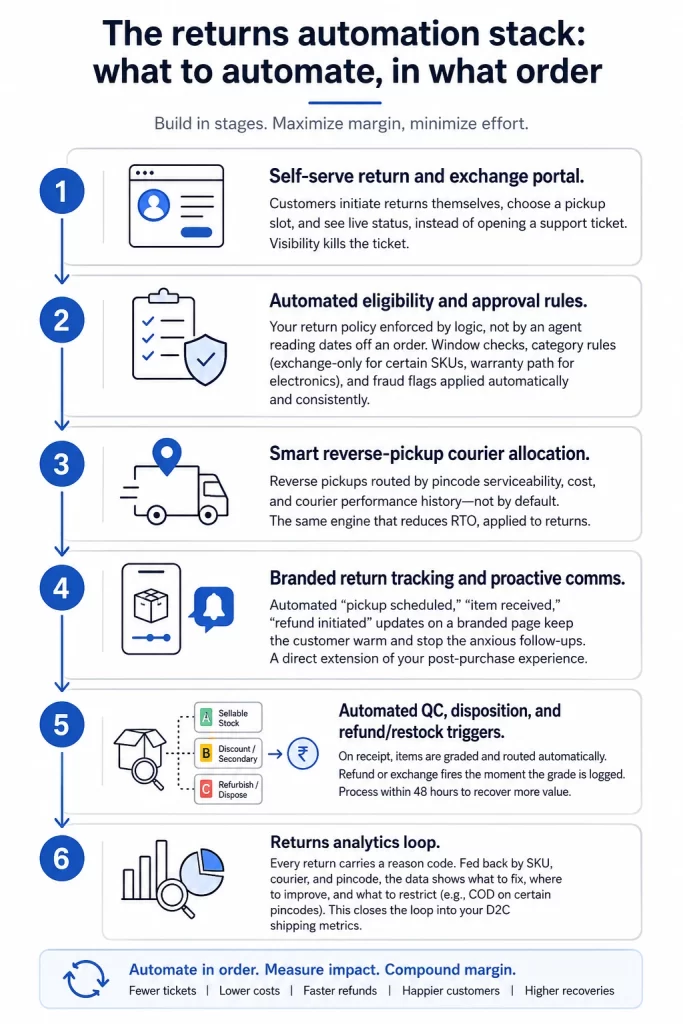
4. Branded return tracking and proactive comms. The refund wait is where trust is won or lost. Automated “pickup scheduled,” “item received,” “refund initiated” updates on a branded page keep the customer warm and stop the anxious follow-ups. It is a direct extension of your post-purchase customer experience.
5. Automated QC, disposition, and refund/restock triggers. On receipt, each item is graded and routed automatically: Grade A back to sellable stock, Grade B to a discount or secondary channel, Grade C to refurbishment or disposal, with the refund or exchange firing the moment the grade is logged. Speed here is money: brands that process returns within 48 hours recover materially more value than those taking a week.
6. Returns analytics loop. Every return carries a reason code. Fed back by SKU, courier, and pincode, that data tells you which products need better listings, which couriers to route away from on which routes, and which pincodes to restrict COD on. This closes the loop into your broader D2C shipping metrics.
The disposition flow
Once a returned unit arrives, every item should travel a single, automated decision path:
Received → QC graded →
- Grade A (unused, packaging intact) → restock as new
- Grade B (opened, functional) → relist at discount / secondary channel
- Grade C (damaged, defective) → refurbish, liquidate, or dispose
The goal is that no human decides this case by case. The grade determines the route, the route triggers the refund or exchange, and inventory updates in real time so good stock never sits invisible.
Exchange over refund: the retention play your competitors skip
Here is the move almost every reverse-logistics guide mentions in one line and then forgets: when a customer wants to return something, your goal is not to process the refund efficiently. It is to turn the return into an exchange.
A refund loses the sale and, often, the customer. An exchange keeps both. For a fashion brand where most returns are sizing issues, the customer does not dislike the product, they got the wrong size. The entire value of that order is recoverable if the swap is frictionless.
Make the exchange the path of least resistance: a one-click “swap size” option in the portal that is faster than requesting a refund; free exchange shipping where a refund return is not; instant exchange that dispatches the replacement before the original is even picked up; and store credit with a small bonus for customers who choose credit over cash back. Each of these tilts the decision toward keeping the revenue. Measured against customer lifetime value, a saved exchange is worth far more than the handful of rupees it costs to incentivise.
Reducing returns at the source
Processing returns well is good. Preventing them is better, and most prevention happens before the order ever ships.
Validate addresses and confirm COD intent before dispatch to cut RTO. Set accurate expectations at checkout, an AI-driven estimated delivery date reduces the “it took too long, I don’t want it anymore” cancellations that become RTO. Invest in listing accuracy: detailed size guides, multiple real photos, and honest descriptions remove the gap between expectation and delivery that drives most fashion and electronics returns. And use right-sized, protective packaging, because a product damaged in transit generates both a return and a replacement shipment.
Returns fraud and policy abuse
Automation that approves every return blindly is just faster leakage. As volumes grow, a minority of customers will exploit the policy, and you need controls built in.
The common patterns: wardrobing, where a garment is worn once for an event and returned; empty-box or swap returns, where the customer keeps the product and sends back a brick or a used unit; and serial returners whose return rate makes them unprofitable to serve. The defences are mostly automatable. Capture photo or OTP proof at pickup so the courier’s collection is documented. Photograph every item at the moment of QC receipt, which is also your only real evidence for a courier damage claim. Flag customers whose return rate crosses a threshold. And set category-specific policies, exchange-only or inspection-gated refunds for the highest-abuse categories, rather than one blanket policy that the worst actors exploit.
GST and compliance on returned goods
Returns have tax consequences that are easy to get wrong at scale. When goods come back, you generally need to issue a credit note to reverse the original GST invoice, adjust the GST on the COD amount for COD returns, and account for Input Tax Credit on returned inventory. Keep the documentation trail, return receipt, inspection report, credit note, for every return, because reconstructing it later is painful. This is general guidance, not tax advice; confirm the treatment for your business type and product category with a GST practitioner.
What “good” looks like, benchmark yourself
Use these as a scorecard. If you are off on more than one, that is where the margin is hiding.
| Metric | Healthy benchmark |
|---|---|
| RTO rate | Below 15% |
| Return processing time (receipt to disposition) | Under 48 hours |
| Refund turnaround (receipt to refund) | 24–48 hours |
| Returned inventory resold | 70–85% |
| Cost per return | Tracked as % of net fulfilled revenue |
| Reporting | RTO, customer returns, and exchanges tracked separately |
Two of the highest-impact actions on this list cost nothing: separate RTO from customer returns in your reporting, and record a reason code on every single return. Within a month you will have enough data to see exactly which couriers, pincodes, and products are driving the most avoidable cost, and fix them one by one.
How Metaport automates the full reverse cycle
Metaport’s returns automation runs the reverse leg with the same intelligence as the forward one: smart courier allocation for reverse pickups, branded return tracking that keeps customers informed through the refund window, automated disposition and refund triggers so good stock goes back on sale fast, and returns analytics that feed reason-code data back into your allocation and listings, all from one dashboard, no minimum volume.
If returns are quietly eroding your margins, the fastest win is to start measuring the true cost per return and separate your reverse-shipment types. The calculator below this article will give you your real number in a minute.
Cost Per Return Calculator
See what returns really cost your D2C brand, and what returns automation could save you. Numbers update live.
Your numbers
What returns cost you today
With returns automation
Adjust the levers to model your own assumptions.
Estimates only, based on the assumptions above. Actual results vary by category, courier mix, and order profile.
Frequently asked questions
Returns automation is the use of software to handle the reverse-logistics workflow, self-serve return and exchange requests, eligibility checks, reverse-pickup courier allocation, status tracking, QC-based disposition, and refund or restock triggers, without manual intervention at each step.
Typically 1.5 to 2 times the forward shipping cost per return once you include reverse freight, inspection labour, restocking, holding cost, and refund processing, not just the pickup charge most sellers quote.
RTO is a courier-initiated return after failed delivery, with zero recoverable revenue. A customer return is initiated after delivery and is partially recoverable. An exchange retains the full sale and is the outcome you want to encourage. They have different causes and need different fixes, so track them separately.
Make the exchange the easiest option: one-click size swaps in the portal, free exchange shipping, instant exchange that ships the replacement before pickup, and store credit with a small bonus. Most fashion returns are sizing issues where the customer still wants the product.
Yes. Reverse pickups should be routed by pincode serviceability, cost, and courier performance exactly like forward orders, rather than defaulting to whoever delivered the parcel.
Capture photo or OTP proof at pickup, photograph every item at QC receipt, flag customers above a return-rate threshold, and apply category-specific policies (exchange-only or inspection-gated refunds) to the highest-abuse categories.
You generally issue a credit note to reverse the original invoice, adjust COD GST, and account for Input Tax Credit on returned stock, keeping full documentation. Confirm specifics with a GST practitioner.
Aim for disposition within 48 hours of receipt and refunds within 24–48 hours. Slow processing both locks up inventory and loses customers.
A self-serve return/exchange portal, automated eligibility rules, smart reverse-pickup allocation, branded return tracking, automated QC-and-disposition with refund/restock triggers, and a returns analytics loop feeding reason codes back into operations.

Kapil Pathak is a Senior Digital Marketing Executive with over six years of experience in the logistics and supply chain industry. He specializes in SEO, SEM, and multi-channel campaign management. He has a strong track record of building strategies that boost brand visibility and generate qualified leads. His work focuses on driving growth for D2C and B2B technology companies through data-driven digital marketing initiatives.