If your courier invoice shows ₹80 for a shipment, does that mean the order actually cost your business ₹80 to ship?
Not necessarily.
Freight is only one line item. Packaging, COD charges, volumetric weight, RTO, GST, surcharges, delivery failures, and the operational time spent chasing exceptions all add up, and in India’s PIN-code-diverse, COD-heavy market, they add up faster than most brands expect.
A ₹799 order can look healthy on paper, but a high RTO rate in Tier 2/3 pincodes or a volumetric-weight mismatch can quietly erase the margin.
This guide breaks down shipping cost per order for Indian D2C brands: how to calculate the true cost, why the cheapest courier rate card rarely reflects the cheapest total cost, and practical ways to reduce logistics spend without hurting delivery performance.
What Is Shipping Cost Per Order?
Shipping cost per order is the average logistics cost incurred per shipment.
Shipping Cost Per Order = Total Shipping Costs ÷ Total Shipments
The hard part is defining “total shipping costs.” Counting only the courier’s base freight gives you the visible cost, not the true cost. A more complete number for an Indian D2C business includes freight, packaging, COD charges, GST, surcharges, expected RTO cost, and weight corrections.
Example: A brand spends ₹8,00,000 on shipping across 10,000 shipments → ₹80/order on the dashboard. But another ₹1,50,000 sits unaccounted for in packaging, RTO, and billing leakage → the effective cost is really ₹95/order.
That ₹15 gap is what shapes your pricing, free-shipping thresholds, and courier strategy.
Why the Courier Rate Card Isn’t Your True Cost
A rate card tells you what a carrier charges based on origin, destination, service type, and weight slab. It doesn’t capture everything your business absorbs around that shipment, especially in India, where COD still drives a large share of D2C volume and serviceability varies sharply by pincode.
A typical COD order needs packaging, gets billed on actual or dimensional weight (whichever is higher), carries a COD fee, and, if the customer isn’t reachable, can turn into an NDR and eventually an RTO. GST at 18% typically applies on the freight component too, and is often overlooked in quick mental math.
Treat the rate card as a starting point, not the answer.
What Goes Into the True Cost of Shipping
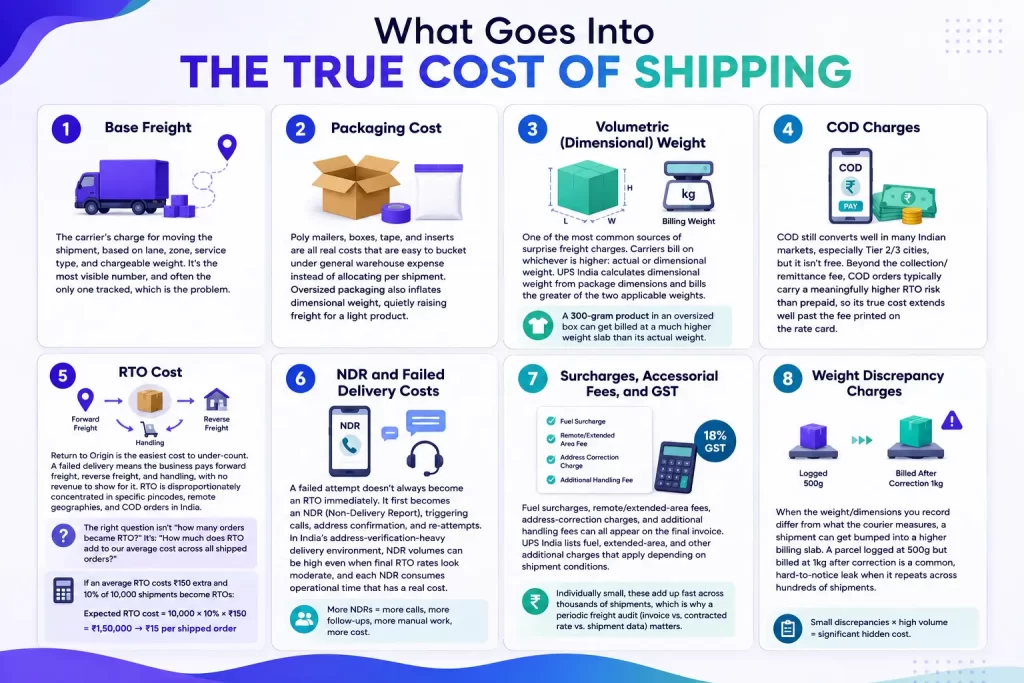
1. Base Freight
The carrier’s charge for moving the shipment, based on lane, zone, service type, and chargeable weight. It’s the most visible number, and often the only one tracked, which is the problem.
2. Packaging Cost
Poly mailers, boxes, tape, and inserts are all real costs that are easy to bucket under general warehouse expense instead of allocating per shipment. Oversized packaging also inflates dimensional weight, quietly raising freight for a light product.
3. Volumetric (Dimensional) Weight
One of the most common sources of surprise freight charges. Carriers bill on whichever is higher: actual or dimensional weight. UPS India, for instance, calculates dimensional weight from package dimensions and bills the greater of the two applicable weights. (UPS)
A 300-gram product in an oversized box can get billed at a much higher weight slab than its actual weight, a frequent issue for apparel and lightweight D2C categories in India.
4. COD Charges
COD still converts well in many Indian markets, especially Tier 2/3 cities, but it isn’t free. Beyond the collection/remittance fee, COD orders typically carry a meaningfully higher RTO risk than prepaid, so its true cost extends well past the fee printed on the rate card.
5. RTO Cost
Return to Origin is the easiest cost to under-count. A failed delivery means the business pays forward freight, reverse freight, and handling, with no revenue to show for it. RTO is disproportionately concentrated in specific pincodes, remote geographies, and COD orders in the Indian context.
The right question isn’t “how many orders became RTO?” It’s:
“How much does RTO add to our average cost across all shipped orders?”
If an average RTO costs ₹150 extra and 10% of 10,000 shipments become RTOs:
Expected RTO cost = 10,000 × 10% × ₹150 = ₹1,50,000 → ₹15 per shipped order
6. NDR and Failed Delivery Costs
A failed attempt doesn’t always become an RTO immediately. It first becomes an NDR (Non-Delivery Report), triggering calls, address confirmation, and re-attempts. In India’s address-verification-heavy delivery environment, NDR volumes can be high even when final RTO rates look moderate, and each NDR consumes operational time that has a real cost.
7. Surcharges, Accessorial Fees, and GST
Fuel surcharges, remote/extended-area fees, address-correction charges, and additional handling fees can all appear on the final invoice. UPS India lists fuel, extended-area, and other additional charges that apply depending on shipment conditions. (UPS) On top of these, 18% GST typically applies to the freight and surcharge components, a cost that’s easy to leave out of a quick per-order estimate.
Individually small, these add up fast across thousands of shipments, which is why a periodic freight audit (invoice vs. contracted rate vs. shipment data) matters.
8. Weight Discrepancy Charges
When the weight/dimensions you record differ from what the courier measures, a shipment can get bumped into a higher billing slab. A parcel logged at 500g but billed at 1kg after correction is a common, hard-to-notice leak when it repeats across hundreds of shipments.
How to Calculate Shipping Cost Per Order
True Shipping Cost Per Order = Total Shipping-Related Costs ÷ Total Shipments
Collect: base freight, packaging, COD charges, GST, surcharges, weight/dimension corrections, expected RTO cost, and reverse logistics. Divide by total shipments.
Worked example, 10,000 orders/month:
| Cost Component | Monthly Cost |
|---|---|
| Freight | ₹7,00,000 |
| Packaging | ₹1,00,000 |
| COD charges | ₹50,000 |
| Surcharges, corrections & GST | ₹30,000 |
| Incremental RTO cost | ₹70,000 |
| Total | ₹9,50,000 |
₹9,50,000 ÷ 10,000 = ₹95 per order
The dashboard may show ₹70/shipment in freight. The true shipping cost per order is ₹95, a ₹25 gap worth investigating.
Why a Single Average Can Mislead You
A blended ₹95/order average can hide very different economics underneath. One courier might average ₹82 with high RTO and frequent weight corrections; another might average ₹90 but deliver more successfully with fewer disputes.
The useful question isn’t “which courier has the lowest rate card?” It’s “which courier gives the lowest true cost for the shipment profile we care about?”
Break your data down by:
- Courier and pincode/zone
- Actual vs. chargeable weight
- COD vs. prepaid
- Product category
- Delivery success, RTO rate, NDR rate
- Weight disputes and surcharges
Illustrative comparison: Courier A charges ₹72/shipment with a 14% RTO rate; Courier B charges ₹78 with a 7% RTO rate. At ₹150 incremental cost per RTO, per 100 shipments: Courier A carries ₹2,100 in expected RTO cost vs. Courier B’s ₹1,050. Courier A’s ₹6 freight saving is wiped out several times over by RTO exposure. This is why courier selection needs freight, delivery performance, exceptions, and billing accuracy considered together, not the rate card alone.
For a structured comparison approach, see Courier Performance Scorecard: How to Evaluate and Rank Courier Partners.
Multi-Courier Allocation: Matching, Not Just Adding Partners
Using multiple couriers only helps if shipments are routed intelligently. A carrier that performs well in Delhi-NCR may be weak in parts of the Northeast or interior Bihar; a courier with strong COD collection in metros may not have the best economics for prepaid shipments elsewhere.
A multi-courier strategy should weigh serviceability, freight rate, chargeable weight, delivery SLA, RTO rate, NDR performance, COD performance, and historical pincode-level data. This approach gets more valuable as volume (and data) grows.
See Multi-Courier Shipping for a broader look.
Freight Audit: Checking Whether You Were Billed Correctly
Even after optimizing courier allocation, one question remains: did the invoice match the contract?
Carrier invoices can differ from expectations due to weight, dimensions, zone classification, surcharges, or rate-card mismatches. Manual reconciliation (downloading invoices, cross-checking shipment records, raising disputes one by one) gets slow and error-prone as volume scales.
A structured freight audit compares shipment record, contracted rate, carrier invoice, and applicable charges before finalizing the true cost. Read more: The Hidden Cost of Manual Freight Reconciliation and How to Automate It.
You can’t optimize a cost you can’t see, and you can’t dispute a charge you can’t validate.
7 Ways to Reduce Shipping Cost Per Order
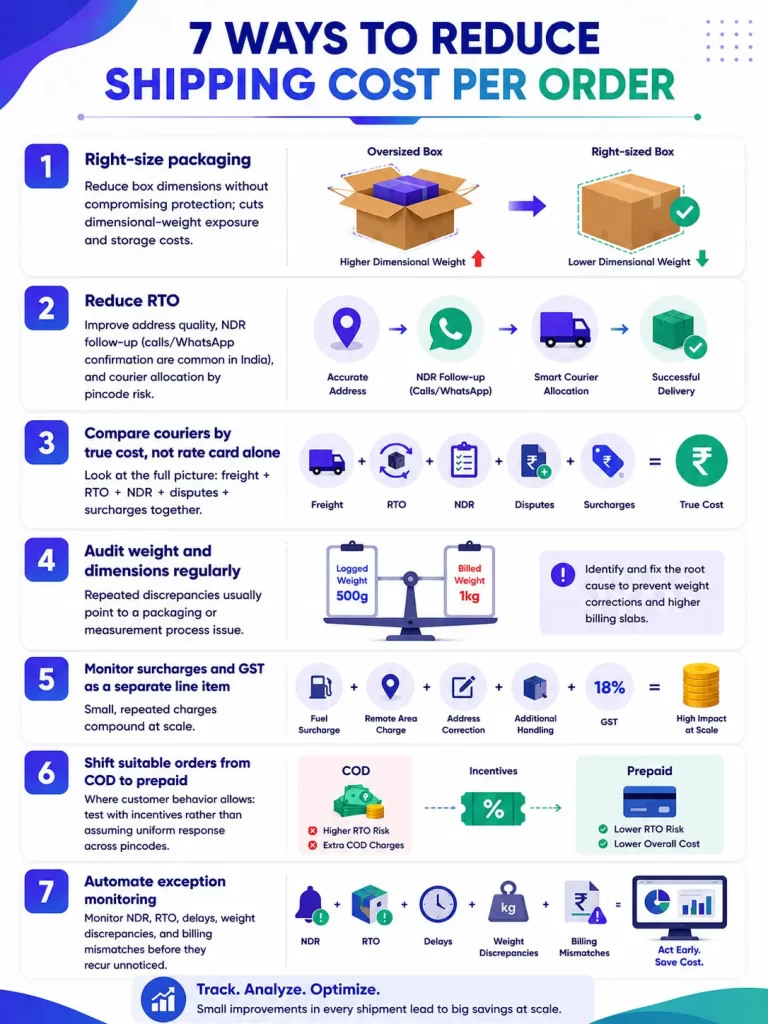
- Right-size packaging: reduce box dimensions without compromising protection; cuts dimensional-weight exposure and storage costs.
- Reduce RTO: improve address quality, NDR follow-up (calls/WhatsApp confirmation are common in India), and courier allocation by pincode risk.
- Compare couriers by true cost, not rate card alone: freight + RTO + NDR + disputes + surcharges together.
- Audit weight and dimensions regularly: repeated discrepancies usually point to a packaging or measurement process issue.
- Monitor surcharges and GST as a separate line item: small, repeated charges compound at scale.
- Shift suitable orders from COD to prepaid where customer behavior allows: test with incentives rather than assuming uniform response across pincodes.
- Automate exception monitoring for NDR, RTO, delays, weight discrepancies, and billing mismatches before they recur unnoticed.
Better KPIs Than a Single Blended Number
Pair shipping cost per order with metrics that explain why it moves:
- Shipping cost per delivered order vs. per shipped order
- RTO rate and first-attempt delivery rate
- NDR rate and average chargeable weight
- Weight discrepancy rate and surcharge per order
- COD share vs. prepaid share
- Courier-wise true cost by pincode
The shipped-vs-delivered distinction matters most: at ₹95/shipped order with a 10% RTO rate, the economics of orders that actually reach the customer look meaningfully different from the blended average. That’s the number finance, logistics, and growth teams should actually be aligned on.
When to Recalculate
Revisit the model whenever there’s a material shift in courier contracts, fuel/accessorial charges, packaging, product mix, COD share, RTO rate, delivery geography, or order volume. This includes seasonal spikes like festive-season surges, which can shift both cost and RTO patterns sharply. A monthly review is a reasonable baseline for a growing D2C brand; high-volume teams benefit from tighter, dashboard-driven monitoring.
How Metaport Helps Indian D2C Brands Control Shipping Costs
The first step in controlling logistics cost is visibility. Metaport connects shipping operations, courier performance, shipment exceptions, tracking, and freight data into one layer, including multi-courier shipping, real-time tracking, NDR management, and freight-related tools.
Instead of a flat “₹80 freight” view, a brand can ask:
- Which courier has the lowest true cost for this pincode?
- Which products are creating the most weight disputes?
- Where is RTO climbing, and in which zones?
- Which surcharges keep recurring?
- Do carrier invoices actually match contracted rates?
Final Thoughts
The number on your courier rate card is not your shipping cost per order. The real number includes freight, packaging, dimensional weight, COD, RTO, NDR, GST, surcharges, and weight corrections.
True Shipping Cost Per Order = Total Shipping-Related Costs ÷ Total Shipments
Then break it down by courier, pincode, product, weight, payment method, and delivery outcome. The goal isn’t the cheapest courier. It’s the lowest sustainable total cost at reliable delivery performance.
Explore Metaport’s logistics intelligence platform to bring scattered courier, invoice, and order data into one view.
Frequently Asked Questions
The average logistics cost per shipment. The basic formula is total shipping-related costs ÷ total shipments, but an accurate figure for Indian D2C brands should also factor in COD, RTO, GST, and surcharges, not just base freight.
Add freight, packaging, COD charges, GST, expected RTO cost, surcharges, and weight corrections, then divide by total shipments. Exact components vary by business model and courier contract.
Yes. Couriers bill on whichever is higher: actual or dimensional weight. So lightweight products in oversized packaging often get billed above their real weight. See Metaport’s Volumetric Weight Guide.
RTO adds forward freight, reverse freight, and handling costs without a completed sale. Multiply your RTO rate by the incremental cost per RTO to see its effective contribution to your average shipping cost.
Not necessarily. A lower base rate can be offset by higher RTO, NDR, weight disputes, or surcharges. Compare true courier economics (cost, delivery performance, and billing accuracy together) rather than the rate card alone.

Kapil Pathak is a Senior Digital Marketing Executive with over six years of experience in the logistics and supply chain industry. He specializes in SEO, SEM, and multi-channel campaign management. He has a strong track record of building strategies that boost brand visibility and generate qualified leads. His work focuses on driving growth for D2C and B2B technology companies through data-driven digital marketing initiatives.