Ever shipped a 700-gram cushion cover and got billed for 3 kilograms? You’re not alone, and no, the courier didn’t make a mistake. You just met volumetric weight, the pricing rule that decides what most ecommerce brands actually pay for shipping.
Here’s the formula couriers use, right up front: Volumetric Weight (kg) = Length × Breadth × Height (in cm) ÷ 5000

If that number is higher than what your parcel weighs on a scale, you pay for the higher number. Simple rule, expensive consequences.
In this guide, we’ll break down how to calculate volumetric weight, why couriers divide by 5000, how divisors differ across Delhivery, Blue Dart, DTDC and FedEx, and most importantly, eight practical ways to shrink your billed weight and claw back margin on every shipment.
What Is Volumetric Weight in Courier Shipping?
Volumetric weight (also called dimensional weight or DIM weight) is a way of charging for the space a parcel occupies, not just how heavy it is.
Think about it from the courier’s side. A truck or an aircraft has two limits: how much weight it can carry and how much space it has. A 1 kg guitar takes up as much room as twenty 1 kg jars of jam. If the courier charged both by weight alone, the guitar shipper would be getting free space at the jam shipper’s expense.
So couriers calculate two numbers for every parcel:
- Dead weight (actual weight): what the parcel weighs on a scale, box and all
- Volumetric weight: what the parcel “weighs” based on its dimensions
Whichever is higher becomes your chargeable weight (also called billed weight). That’s the number on your invoice, and it’s why lightweight but bulky products like footwear, toys, apparel and home decor almost always cost more to ship than their scale weight suggests.
The Volumetric Weight Formula (With a Worked Example)
Let’s make this concrete. The standard formula for domestic courier shipping in India is:
Volumetric Weight = (L × B × H in centimeters) ÷ 5000
Say you sell sneakers. The shoebox, inside your shipping carton, measures 35 × 25 × 15 cm. The shoes weigh 800 grams.
- Volumetric weight = (35 × 25 × 15) ÷ 5000 = 13,125 ÷ 5000 = 2.62 kg
- Dead weight = 0.8 kg
- Chargeable weight = higher of the two = 2.62 kg, usually rounded up to the next slab, so 3 kg
You thought you were shipping 800 grams. The courier billed you for 3 kg. At roughly ₹40 to 50 per additional 500-gram slab, that gap can quietly triple your shipping cost per order. Multiply that across 3,000 monthly orders and you’re leaking lakhs, which is exactly the kind of silent margin drain we covered in our guide to hidden shipping surcharges.
Why Do Couriers Divide by 5000?
The divisor (5000 for most Indian domestic couriers) represents an assumed density: it says one kilogram of cargo should occupy no more than 5,000 cubic centimeters of space. Pack denser than that and you’re billed on actual weight. Pack fluffier and volumetric weight kicks in.
The lower the divisor, the harsher the charge. A divisor of 4000 treats the same box as heavier than a divisor of 5000 does. That’s why knowing your courier’s divisor matters as much as knowing their rate card.
Volumetric Weight vs Dead Weight vs Chargeable Weight
These three terms confuse a lot of sellers, so here’s the clean breakdown:
| Term | What it means | Who determines it |
|---|---|---|
| Dead weight (actual weight) | Scale weight of the packed parcel | Your weighing scale |
| Volumetric weight | L × B × H ÷ divisor | Your box dimensions |
| Chargeable weight | Higher of the two, rounded up to the slab | The courier’s billing system |
The key insight: you control both inputs. Dead weight depends on your product and packaging material. Volumetric weight depends entirely on box dimensions. Since you’re billed on the higher of the two, the goal is to bring them as close together as possible. A parcel whose dead weight and volumetric weight match is a parcel with zero wasted spend.
Volumetric Weight Divisors by Courier: Delhivery, Blue Dart, DTDC, FedEx
Not every courier uses 5000, and this is where sellers get caught off guard. Here’s the general picture for Indian shipping:
| Courier | Typical divisor | Notes |
|---|---|---|
| Blue Dart | 5000 | Standard for air express |
| DTDC | 5000 | Most services |
| Delhivery | 5000 (surface), 4000 on some air services | Verify per your contract |
| FedEx / DHL (international) | 5000 | Some air cargo services use 6000 |
| Air freight (IATA standard) | 6000 | Bulk cargo, not parcel |
Two warnings here. First, divisors vary by service type: the same courier may use 5000 for surface and 4000 for air. Second, your specific rate agreement can override the published number. Always confirm the divisor in writing before signing a courier contract, because a 4000 divisor makes every bulky parcel 25% “heavier” than a 5000 divisor does.
If you ship through multiple carriers, these differences compound. The same box can be billed as 2.6 kg by one courier and 3.3 kg by another. This is one more reason multi-carrier shipping with intelligent allocation beats locking into a single courier: you can route bulky-light parcels to the carrier whose divisor and slab structure treats them best.
Which Products Get Hit Hardest?
Volumetric weight punishes anything light and bulky. If you sell in these categories, your billed weight almost certainly exceeds your dead weight:
- Footwear: rigid boxes full of air
- Apparel and winter wear: jackets and hoodies compress poorly in boxes
- Toys and stationery: irregular shapes forcing oversized cartons
- Home decor and kitchenware: fragile items with heavy void fill
- Bags and luggage: enormous volume, minimal weight
Run a simple audit: pull your last 100 shipments and compare invoiced weight against product weight. If billed weight averages more than 1.5x your dead weight, volumetric charges are eating your margin, and the fixes below will pay for themselves within a month.
How to Calculate Volumetric Weight Step by Step
Want to do this right for your own catalog? Follow this process:
- Measure the final shipping box, not the product. Include any bulge or padding, in centimeters.
- Multiply L × B × H. Measure the longest point on each side, since that’s what the courier’s scanner will capture.
- Divide by your courier’s divisor (confirm whether it’s 5000 or 4000 for your service).
- Compare with dead weight of the fully packed parcel.
- Take the higher number and round up to your courier’s weight slab (usually 0.5 kg increments).
That final figure is what you should expect on your invoice. Record it per SKU in your order management system. When the courier’s invoice shows something different, you have proof, and that matters more than most sellers realize (more on disputes below).
You can sanity-check your math against any public volumetric weight calculator, but for catalog-wide accuracy, SKU-level measurement is non-negotiable.
8 Ways to Reduce Volumetric Weight and Lower Your Billed Weight
Now the part that saves money. Each of these tactics attacks either the dimensions, the divisor, or the billing itself.
1. Right-size your packaging
The single biggest win. Every centimeter of empty box is space you’re paying to ship. Audit your top 20 SKUs and match each to the smallest box that still protects it. Brands that right-size typically cut billed weight by 20 to 40% on bulky-light SKUs.
2. Switch boxes for mailer bags where possible
Apparel, soft toys and non-fragile items don’t need corrugated boxes. Poly mailers and courier bags collapse around the product, slashing all three dimensions at once. A folded T-shirt in a mailer can bill at 0.5 kg; the same shirt in a box often bills at 1 kg or more.
3. Reduce void fill, not protection
Bubble wrap and crumpled paper exist to fill gaps that shouldn’t exist. Shrink the box first, then use minimal void fill. Your product-to-package ratio should be the metric, not “does it feel safe.”
4. Create SKU-level packaging rules
One-size-fits-all packaging is a volumetric weight machine. Define box assignments per SKU (or per SKU combination for multi-item orders) in your dispatch workflow so pickers never reach for an oversized carton out of convenience.
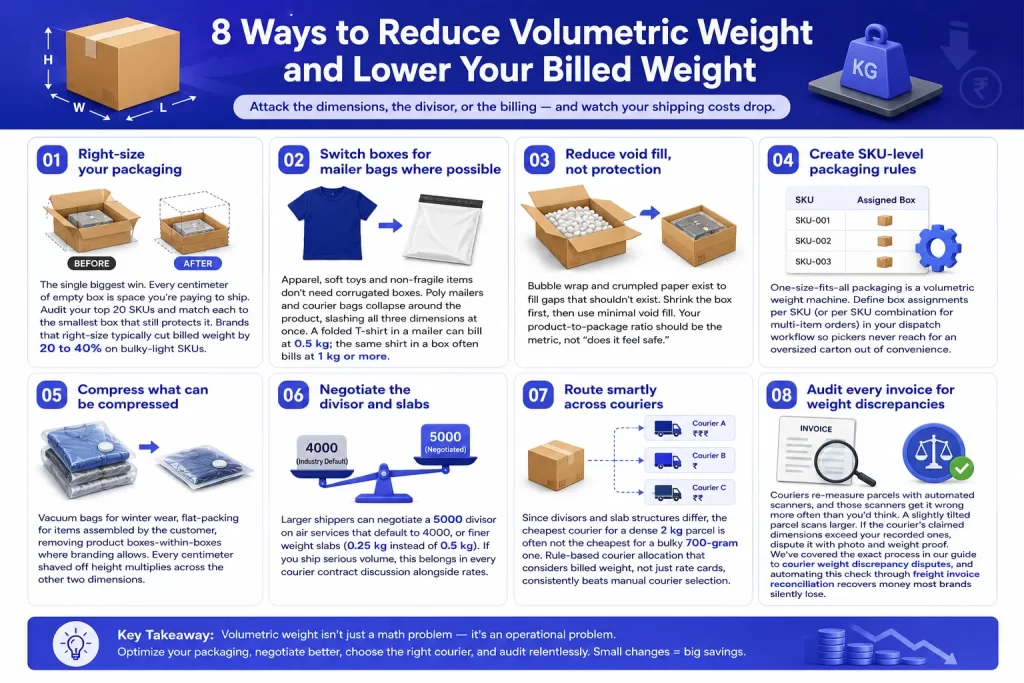
5. Compress what can be compressed
Vacuum bags for winter wear, flat-packing for items assembled by the customer, removing product boxes-within-boxes where branding allows. Every centimeter shaved off height multiplies across the other two dimensions.
6. Negotiate the divisor and slabs
Larger shippers can negotiate a 5000 divisor on air services that default to 4000, or finer weight slabs (0.25 kg instead of 0.5 kg). If you ship serious volume, this belongs in every courier contract discussion alongside rates.
7. Route smartly across couriers
Since divisors and slab structures differ, the cheapest courier for a dense 2 kg parcel is often not the cheapest for a bulky 700-gram one. Rule-based courier allocation that considers billed weight, not just rate cards, consistently beats manual courier selection.
8. Audit every invoice for weight discrepancies
Couriers re-measure parcels with automated scanners, and those scanners get it wrong more often than you’d think. A slightly tilted parcel scans larger. If the courier’s claimed dimensions exceed your recorded ones, dispute it with photo and weight proof. We’ve covered the exact process in our guide to courier weight discrepancy disputes, and automating this check through freight invoice reconciliation recovers money most brands silently lose.
Volumetric Weight for International Shipping
Shipping abroad? The same logic applies with different numbers. International express carriers like DHL, FedEx and UPS typically apply a 5000 divisor on parcels, while IATA’s air cargo standard uses 6000. Some US-domestic services calculate DIM weight in inches with divisors like 139.
The practical takeaway for Indian D2C brands going cross-border: international shipping rates per kg are 10 to 20x domestic rates, so every unnecessary centimeter costs proportionally more. Right-sizing isn’t optional at international rates; it’s the difference between profitable and loss-making cross-border orders.
What If the Courier Bills the Wrong Weight?
Here’s the uncomfortable truth: your chargeable weight is ultimately what the courier’s system says it is, unless you challenge it.
Weight discrepancies happen when the courier’s scanned dimensions or weight exceed what you declared. Sometimes you under-declared. Often, the scanner misread. Either way, the surcharge lands on your invoice weeks later, buried among hundreds of line items.
Protect yourself with three habits: record dimensions and weight per SKU with photos, reconcile every courier invoice against your declared data, and raise disputes within the courier’s window (usually 7 to 15 days). Brands that reconcile systematically recover 1 to 3% of their total freight spend, which drops directly to the bottom line. Track this alongside your other D2C shipping metrics so billed-vs-declared weight variance is always visible.
The Bottom Line
Volumetric weight isn’t a courier trick. It’s a fair pricing mechanism that becomes unfair only when you ignore it.
Quick recap: couriers bill the higher of dead weight and volumetric weight (L × B × H ÷ 5000 for most Indian couriers). Divisors vary by courier and service, bulky-light products suffer most, and your defense is right-sized packaging, SKU-level box rules, divisor-aware courier allocation, and disciplined invoice auditing.
Do the audit this week. Pull 100 invoices, compare billed weight to dead weight, and you’ll know within an hour how much margin is hiding in your boxes.
Want the courier allocation and invoice reconciliation parts handled automatically? Metaport routes every order to the courier with the best effective rate for its billed weight and flags weight discrepancies before you overpay. Book a demo and see your real shipping cost per order.
FAQs
Volumetric weight is a parcel’s weight calculated from its dimensions rather than a scale: length × breadth × height in centimeters divided by the courier’s divisor (usually 5000). Couriers bill the higher of volumetric weight and actual weight, so bulky but light parcels get charged for the space they occupy.
Dead weight is the physical scale weight of your packed parcel. Chargeable (billed) weight is what the courier actually invoices: the higher of dead weight and volumetric weight, rounded up to the nearest weight slab, typically 0.5 kg.
Yes. Volumetric weight, dimensional weight and DIM weight all describe the same concept. “Volumetric” is the common term in India, while US and international carriers like UPS and FedEx usually say “dimensional weight.”
Some Delhivery air services use a 4000 divisor instead of the standard 5000, which makes the same box calculate 25% heavier. Divisors vary by courier, service type and contract, so always confirm yours in writing before comparing rate cards.
Right-size boxes to your products, switch to mailer bags for non-fragile items, cut excess void fill, set SKU-level packaging rules, negotiate divisors in courier contracts, and audit invoices for weight discrepancies. Together these typically cut billed weight by 20 to 40% on bulky-light SKUs.

Kapil Pathak is a Senior Digital Marketing Executive with over six years of experience in the logistics and supply chain industry. He specializes in SEO, SEM, and multi-channel campaign management. He has a strong track record of building strategies that boost brand visibility and generate qualified leads. His work focuses on driving growth for D2C and B2B technology companies through data-driven digital marketing initiatives.