Here’s a question every D2C founder should be able to answer instantly: how much of your money is sitting with your courier right now?
If you run a COD-heavy store, the answer is probably “more than I’d like.” Your customer paid cash at the doorstep three days ago. Your bank account hasn’t seen a rupee of it yet. That gap between collection and payout is the COD remittance cycle, and for most Indian D2C brands, it’s the single biggest drag on cash flow that nobody talks about.
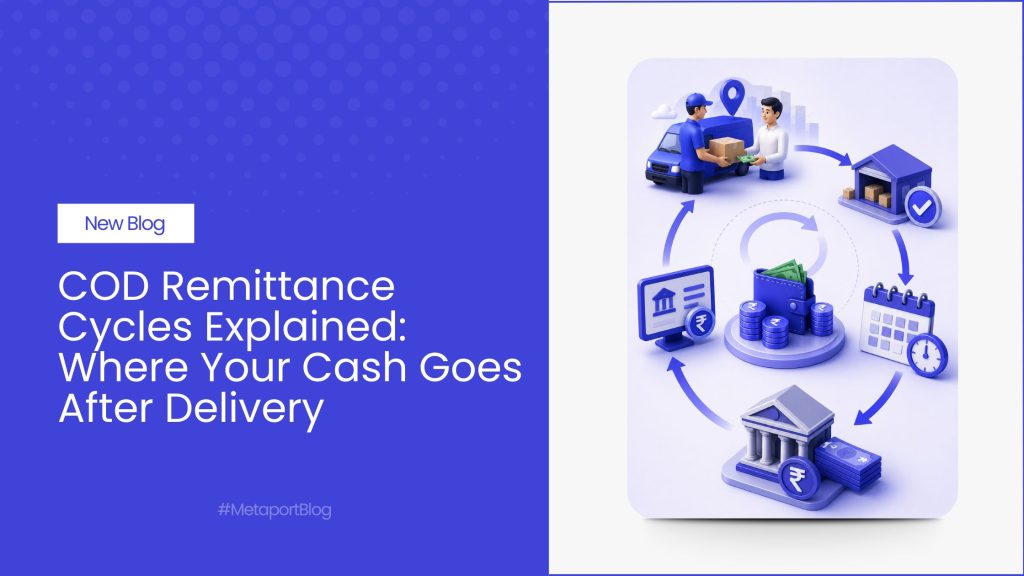
In this guide, we’ll explain what COD remittance means, how the cycle actually works behind the scenes, what D+1, D+2 and D+7 payouts really cost you, why remittances get delayed or come up short, and the practical steps to get your money moving faster.
What Is COD Remittance?
COD remittance is the process by which a courier company transfers the cash it collected from your customers on delivery back to you, the seller.
Simple in theory. In practice, that cash takes a long detour. The delivery agent collects it, deposits it at the local hub, the hub reports it upward, the courier’s finance team reconciles collections against deliveries, and only then does a batch payout land in your account, along with a settlement report you’ll need to verify line by line.
The time between delivery and payout is your remittance cycle. And since COD still drives the majority of Indian ecommerce orders, that cycle effectively decides how fast your revenue becomes usable money.
How COD Remittance Works: From Doorstep to Bank Account
Let’s walk through what happens to a single ₹1,499 COD payment:
- Collection. The delivery agent takes cash (or UPI-on-delivery) from your customer and marks the order delivered.
- Deposit. The agent deposits the day’s collections at the branch or hub. This alone can take 1 to 2 days in smaller towns.
- Reconciliation. The courier matches the cash collected against delivered orders, adjusting for RTOs, cancellations and disputes.
- Batch payout. On your scheduled remittance day, the courier transfers a lump sum covering a batch of orders, referenced by a UTR number.
- Settlement report. You receive an MIS report listing which orders that payment covers. Your job: verify it order by order.
Notice something? Your money changes hands four times before it reaches you. Every handoff adds delay, and every reconciliation step is a place where orders can silently go missing from your payout. More on that trap below.
D+1 vs D+2 vs D+7: Remittance Cycles Compared
Remittance schedules are written as “D plus days,” where D is the delivery date. Here’s what the common cycles look like in practice:
| Cycle | Money arrives | Typical for | Cash flow impact |
|---|---|---|---|
| D+7 to D+15 | 1 to 2 weeks after delivery | Direct courier contracts, standard plans | Heavy working capital lock-up |
| D+4 to D+5 | Twice a week | Most aggregator default plans | Moderate |
| D+2 | 2 days after delivery | Paid “early COD” plans | Light |
| D+1 / D+0 | Next day or same day | Premium instant COD plans | Minimal, but fees apply |
What Does D+2 Remittance Actually Mean?
D+2 means the COD amount for an order delivered on Monday reaches your bank by Wednesday. Sounds obvious, but two details matter. First, D counts from delivery, not from when you shipped. An order that spends six days in transit plus D+2 still means money arrives eight days after dispatch. Second, most couriers batch payouts on fixed days, so “D+2” in the contract often behaves like D+3 or D+4 in real life.
Always check the payout frequency alongside the cycle. A D+2 promise with weekly payouts is really a D+2 to D+8 range.
The Real Cost of Slow Remittance: Your COD Float
Let’s put numbers on the pain, because “cash flow problem” sounds abstract until you calculate your own float.
Say you do 3,000 COD orders a month at an average order value of ₹1,200. That’s ₹36 lakh of COD collections monthly. On a D+10 cycle, roughly ₹12 lakh of your money sits with couriers at any given moment.
That ₹12 lakh is your COD float, and it’s expensive in three ways:
- Inventory you can’t reorder. Your best-selling SKU goes out of stock while the cash to restock it rides around in a courier’s ledger.
- Ad spend you can’t recycle. D2C growth runs on reinvesting revenue into ads within days, not weeks.
- Borrowing you shouldn’t need. Many brands take working capital loans at 15 to 18% annually to cover a gap their own collected cash could fill.
Compare that to prepaid orders, where payment gateways settle in T+1 to T+2. The remittance gap is one more hidden cost of COD, on top of the fraud and RTO risks we covered in our COD fraud prevention guide. It’s also one more reason converting COD orders to prepaid pays off twice: lower risk and faster cash.
Early COD and Instant COD: Are the Fees Worth It?
Most aggregators now sell accelerated payouts. Shiprocket’s Early COD, for example, offers D+2 payouts for a fee, and instant COD plans go further, advancing a large share of your COD value the day after shipping.
Should you pay for speed? Do the math honestly:
- Early COD fees typically run 0.3 to 1% of order value depending on the plan and cycle.
- On ₹36 lakh monthly COD volume, a 0.5% fee is ₹18,000 per month, or ₹2.16 lakh a year.
- If that speed lets you avoid a working capital loan, or recycle ad spend one extra time per month, it usually pays for itself.
- If your margins are thin and your reorder cycles are long, D+4 at no fee may be the smarter deal.
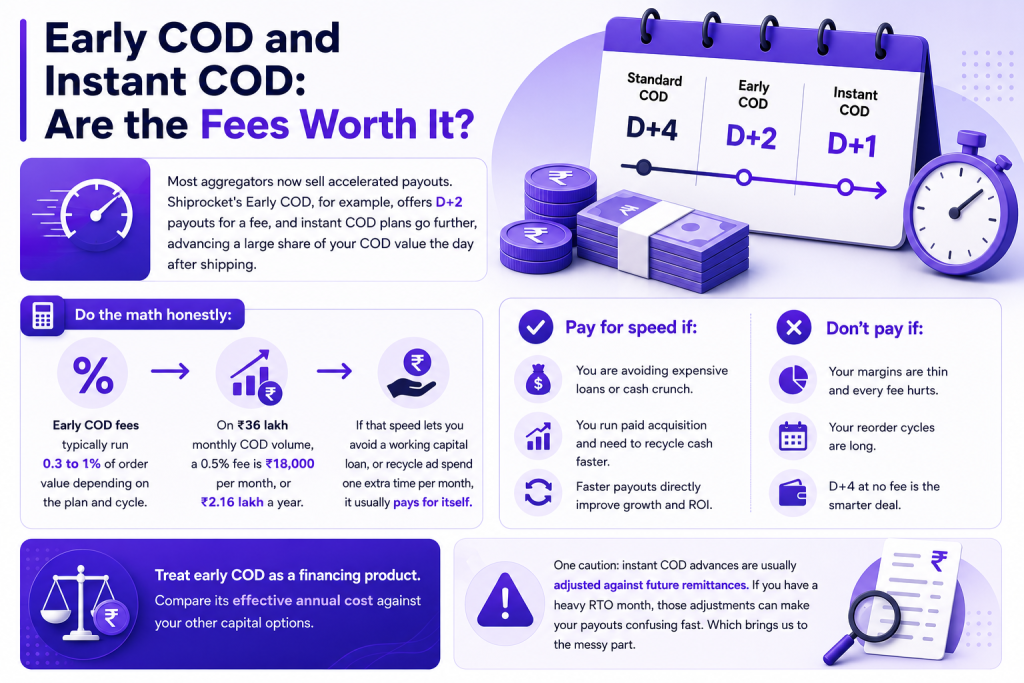
The right answer depends on what your idle cash costs you. A brand doing aggressive paid acquisition values D+1 money far more than a brand growing organically. Treat early COD as a financing product and compare its effective annual cost against your other capital options.
One caution: instant COD advances are usually adjusted against future remittances. If you have a heavy RTO month, those adjustments can make your payouts confusing fast. Which brings us to the messy part.
Why COD Remittances Get Delayed
If your payout didn’t arrive when expected, one of these is usually the culprit:
- Delivery not confirmed in the courier’s system. The parcel was delivered, but the status update lagged, so the order missed the remittance batch.
- Hub deposit delays. Cash from Tier 3 towns takes longer to physically reach a branch.
- Disputes and verification holds. Orders flagged for fake delivery or customer complaints get held back. (Sound familiar? See our guide on fake delivery attempts.)
- Bank holidays and batch schedules. A D+2 that lands on a long weekend becomes a D+5.
- KYC or account issues. Pending paperwork on your courier account silently freezes payouts.
An occasional delay is normal. A pattern of delays from one courier is a red flag worth escalating, and worth tracking on your courier performance scorecard right alongside delivery metrics.
The Remittance Traps Nobody Explains
Slow payouts are annoying. Wrong payouts are worse. These four traps quietly cost brands real money:
1. Short remittance
The settlement covers 480 orders when 500 were delivered. The missing 20 aren’t flagged anywhere; they’re simply absent. Unless you reconcile order by order, you’ll never notice. Across months, these missing orders add up to lakhs.
2. RTO and refund adjustments
Couriers net off RTO charges, reverse shipping fees and disputed amounts against your COD payout. The deduction logic lives buried in the settlement report. Some deductions are legitimate. Some are duplicate charges or wrong weight disputes you could have contested, as we detailed in our weight discrepancy guide.
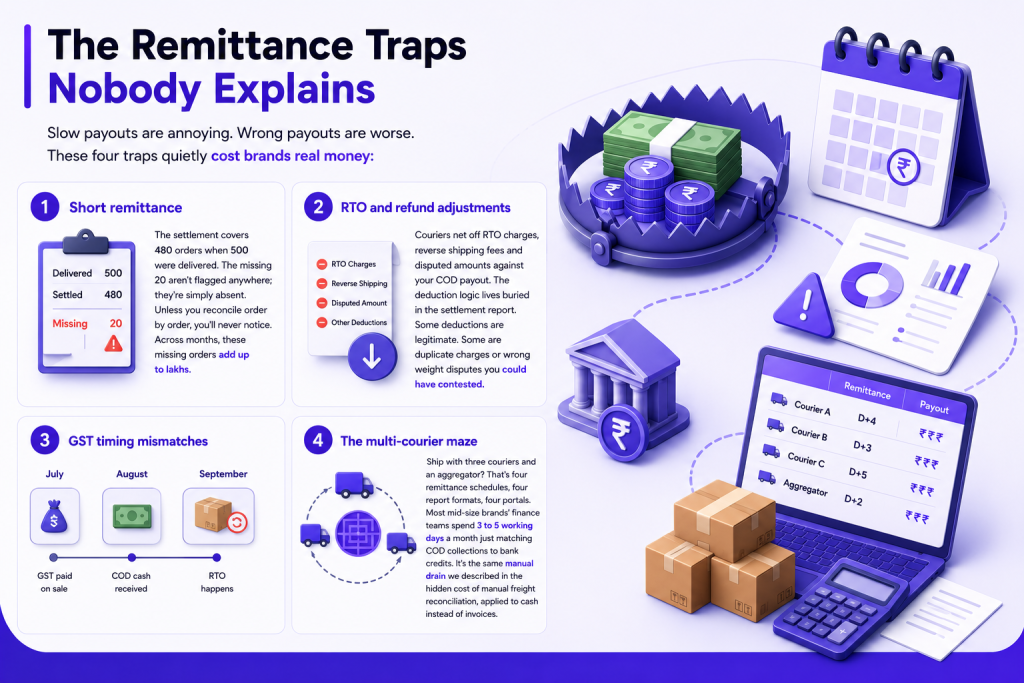
3. GST timing mismatches
You paid GST on the sale in July. The COD cash arrived in August. If an RTO comes back in September, your books now have a three-month spread on a single order. Finance teams without order-level reconciliation lose days untangling this every quarter.
4. The multi-courier maze
Ship with three couriers and an aggregator? That’s four remittance schedules, four report formats, four portals. Most mid-size brands’ finance teams spend 3 to 5 working days a month just matching COD collections to bank credits. It’s the same manual drain we described in the hidden cost of manual freight reconciliation, applied to cash instead of invoices.
How to Reconcile COD Remittance the Right Way
Here’s the discipline that separates brands who recover every rupee from brands who leak:
- Reconcile at the order level, not the batch level. A lump sum matching “roughly” what you expected is not reconciliation.
- Track three states per order: delivered, remitted, and pending. Any order delivered more than your cycle length ago but not remitted goes on an exception list.
- Verify every deduction. RTO charges, COD fees and adjustments should each map to a specific order and a contract rate.
- Raise claims within the window. Most couriers accept remittance disputes only for 15 to 30 days. After that, the money is gone.
- Automate it. At a few hundred orders a month, spreadsheets work. Beyond that, order-level auto-reconciliation across couriers is the only way this stays accurate, and it’s exactly what Metaport’s COD panel was built to do in seconds rather than days.
Track “COD pending remittance” as a standing number on your dashboard, right next to RTO rate and FADR. It belongs in your core D2C shipping metrics.
How to Speed Up Your COD Remittance
Beyond paying for early COD, you have more leverage than you think:
- Negotiate the cycle in your contract. Volume shippers can push D+7 defaults to D+3 or D+4 without paying premium fees. Ask.
- Split volume by remittance performance. If two couriers offer similar delivery rates, route more COD volume to the one that pays faster and cleaner.
- Push UPI-on-delivery. Digital doorstep payments cut the cash-handling chain, settle faster, and reduce short remittances.
- Convert more orders to prepaid. Every percentage point of COD share you shift to prepaid shrinks your float permanently.
- Fix your exception process. Chasing stuck remittances weekly (not quarterly) keeps the pending pile small and the disputes within claim windows.
The Bottom Line
COD remittance is where your revenue lives between the doorstep and your bank account. The cycle length (D+1 to D+15) decides how much of your money is floating with couriers, the settlement process decides how much of it silently leaks, and your reconciliation discipline decides whether you ever get the leaked part back.
Recap: know your cycle and payout frequency, calculate your COD float, treat early COD as a financing decision, reconcile at the order level, contest deductions inside the claim window, and track pending remittance as a first-class metric.
Want your COD reconciliation done in seconds instead of days? Metaport matches every courier remittance against orders automatically, flags short payments and wrong deductions, and shows your real-time COD float across all carriers in one panel. Book a demo and see where your cash is stuck today.
FAQs
COD remittance is the transfer of cash collected from customers at delivery back to the seller by the courier company. It follows a set cycle (like D+2 or D+7, counted from the delivery date) and arrives as batch payouts with a settlement report listing the covered orders.
D+2 means the COD amount is paid out two days after the order is delivered. Note that the count starts at delivery, not dispatch, and actual credit depends on the courier’s payout frequency, so a D+2 plan with twice-weekly payouts can behave like D+3 or D+4.
Standard cycles run 7 to 15 days with direct courier contracts, while most aggregators default to D+4 or D+5 with twice-weekly payouts. Paid early COD plans bring this down to D+2, D+1 or even same-day advances for a fee of roughly 0.3 to 1% of order value.
Couriers net off deductions before paying out: RTO and reverse shipping charges, COD handling fees, weight dispute adjustments and disputed orders. Short remittances also happen when delivered orders miss the batch. Order-level reconciliation is the only reliable way to catch both.
Match every payout to individual orders using the settlement report, track delivered-but-unremitted orders as exceptions, verify each deduction against your contract rates, and raise disputes within the 15 to 30 day claim window. At scale, automated reconciliation software replaces the 3 to 5 days a month finance teams spend doing this manually.

Kapil Pathak is a Senior Digital Marketing Executive with over six years of experience in the logistics and supply chain industry. He specializes in SEO, SEM, and multi-channel campaign management. He has a strong track record of building strategies that boost brand visibility and generate qualified leads. His work focuses on driving growth for D2C and B2B technology companies through data-driven digital marketing initiatives.