You launch a campaign for Indore, Nashik, and Guwahati. Orders pour in, and the team celebrates. Two weeks later, the dashboard tells a different story. Parcels are bouncing back, COD cash is stuck, and the shipping bill looks heavier than the sales report.
Sound familiar? You are not alone. Tier 2 and Tier 3 shipping in India is where much of the next growth sits for D2C brands. It is also where many RTO (return to origin) losses begin.
The good news is that most of these losses are fixable. They come from a handful of causes, and each one has a practical answer.
In this guide, we will cover:
- Why smaller cities matter so much for growth
- Why RTO runs higher outside the metros
- A step-by-step plan to cut RTO without turning customers away
- How to manage costs, surcharges, and courier choice
- A simple test-and-scale framework you can start this month
- Five FAQs at the end
Let’s start with the why.
Why Tier 2 and Tier 3 Cities Matter for D2C Growth
Metro customers are expensive to win. Ad costs are high, competition is crowded, and loyalty is thin. Smaller cities look different. Many shoppers there are buying online more often, and fewer brands are speaking to them directly.
Think of it like a busy highway versus a growing town road. The highway has more traffic, but the town road has fewer rivals and more room to build.
For most D2C brands, the opportunity looks like this:
- Lower ad competition: Cost per acquisition can be easier to manage outside the top cities.
- Strong demand for brands: Shoppers in smaller towns want products they cannot find in local shops.
- Festive and seasonal spikes: Smaller cities often drive a large share of festive volume.
- Room for repeat orders: Once trust is built, repeat purchases tend to follow.
But there is a catch. Demand does not help if half your parcels come back. That is why shipping strategy has to grow along with your ad strategy.
Why RTO Runs Higher in Smaller Cities
Before fixing RTO, you need to know where it comes from. Let’s look at the data first.
In ClickPost’s data for October and November 2025, covering 35.8 million orders, Tier 3 orders returned at almost twice the metro rate. The figures were 12.0% against 6.6%. That is one provider’s data set, so treat it as a direction rather than a rule. Still, it matches what most sellers see in their own numbers.
So what is behind the gap?
COD dominates smaller markets
Industry players report that COD can make up well over half of orders in smaller cities. Some put it at 60 to 80%. Cash on delivery lowers the barrier to buy, but it also lowers the barrier to refuse.
A prepaid customer has already committed. A COD customer can say “not today” at the door.
Addresses are less precise
In a metro, an address usually has a building name, a lane, and a clear pincode. In smaller towns, you may see “near the old temple” or “behind the bus stand.” Delivery agents may know the area, but a new rider will not.
Incomplete addresses lead to failed attempts. Failed attempts lead to RTO.
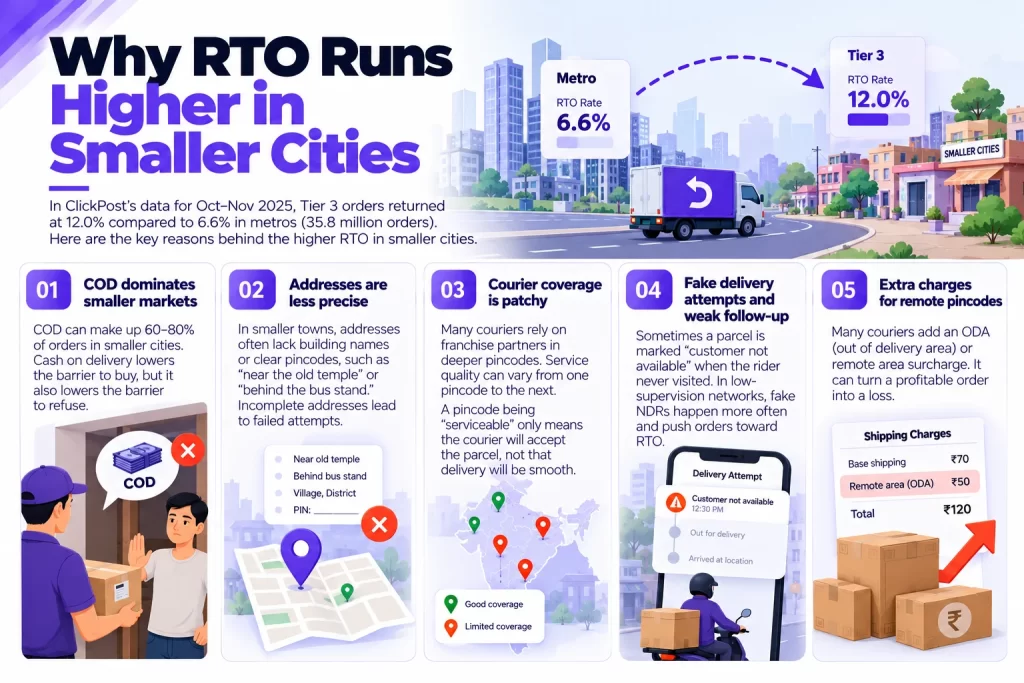
Courier coverage is patchy
A courier that is excellent in Mumbai may be average in a small town in Bihar. Many couriers rely on franchise partners in deeper pincodes. Service quality can change from one pincode to the next.
A pincode being “serviceable” only means a courier will accept the parcel. It does not mean the courier will deliver well.
Fake delivery attempts and weak follow-up
Sometimes a parcel is marked “customer not available” when the rider never visited. This is often called a fake NDR or fake attempt. In low-supervision networks it happens more often, and it quietly pushes orders toward RTO. We cover this in more depth in our guide to handling fake delivery attempts, and the broader picture in our guide to NDR management.
Extra charges for remote pincodes
Many couriers add an ODA (out of delivery area) or remote area surcharge. It can turn a profitable order into a loss. Our post on hidden shipping surcharges explains how these charges sneak into your invoice.
Put these five issues together and you can see why the same shipping setup that works in Delhi struggles in a Tier 3 town.
What One RTO Really Costs You
Let’s make this concrete. The numbers below are an illustration, not a benchmark. Swap in your own.
Say you ship 1,000 orders a month to Tier 3 pincodes.
- RTO rate: 14%, so 140 parcels come back
- Forward shipping: ₹70 per parcel
- Return shipping: ₹70 per parcel
- Packaging and handling lost: about ₹20 per parcel
Each RTO costs around ₹160. Across 140 parcels, that is ₹22,400 gone every month, before you count the ad spend that won the order.
Now imagine you bring RTO down to 9%. That is 50 fewer returns, and about ₹8,000 saved on every 1,000 orders. The saving grows with volume, and the stock you recover can sell again.
So what actually works? Here is a seven-step plan.
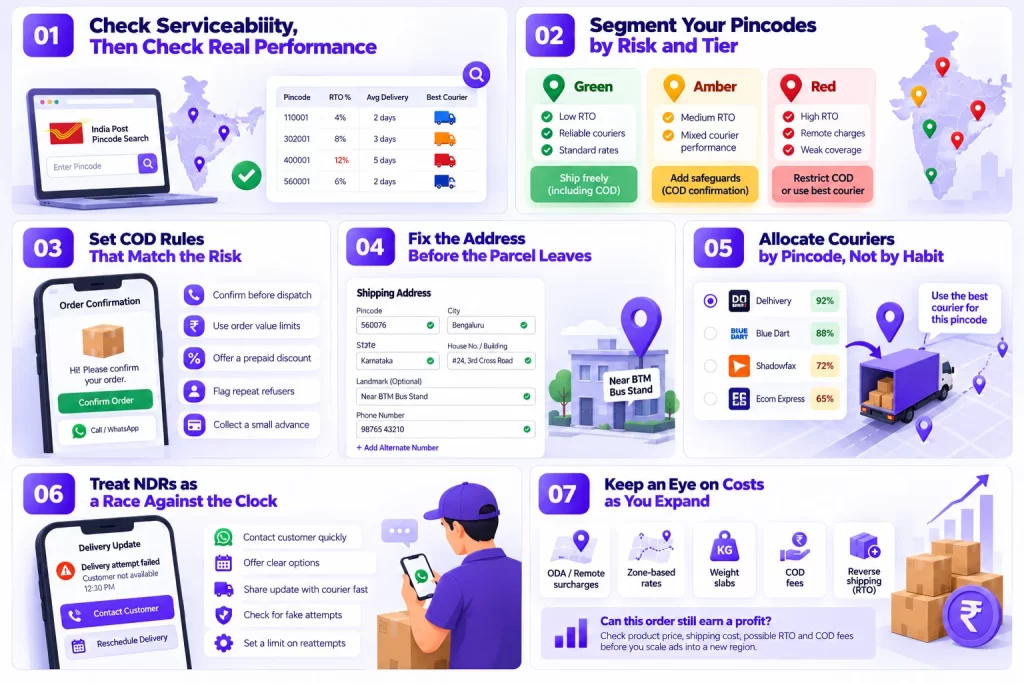
Step 1: Check Serviceability, Then Check Real Performance
Start with the basics. Confirm that your couriers cover the pincodes where your orders are coming from. India Post’s pincode search is a handy reference for verifying that a pincode and its area details are valid.
But do not stop at serviceability. Pull your past data and ask:
- Which pincodes have the highest RTO rate?
- Which couriers deliver best in each region?
- Where do delays or failed attempts cluster?
- Which pincodes trigger ODA charges?
A simple spreadsheet works to begin with. List the top 50 pincodes by order volume and add RTO rate, average delivery time, and courier used. Patterns appear quickly.
If your platform already shows pincode-wise courier performance, even better. If not, this is the first thing to fix.
Step 2: Segment Your Pincodes by Risk and Tier
Not every small city behaves the same way. A fast-growing Tier 2 city with strong courier hubs is very different from a remote Tier 3 pincode with one local franchise.
Instead of treating “Tier 2/3” as a single block, split your pincodes into three groups:
- Green: Low RTO, reliable couriers, standard rates. Ship freely, including COD.
- Amber: Medium RTO or mixed courier performance. Add safeguards such as COD confirmation or a prepaid nudge.
- Red: High RTO, remote charges, or weak coverage. Restrict COD, use your best courier, or limit ads there for now.
This works like a traffic signal. You are not banning anyone. You are matching your caution to the road ahead.
If you want to understand how couriers group pincodes by distance and cost, read our explainer on courier zones in India. It helps you read your rate card with more confidence.
Review the segments every month. Pincodes move between groups as courier networks improve or slip.
Step 3: Set COD Rules That Match the Risk
COD is not the enemy. Many customers in smaller cities will not buy without it. The goal is to make COD safer, not to remove it.
Here are rules that work for many D2C brands:
- Confirm before dispatch. Send an automated call, SMS, or WhatsApp to verify the order. If the customer does not confirm, hold the parcel.
- Use order value limits. Allow COD on lower-value orders in red pincodes, and ask for prepaid on high-value ones.
- Offer a small prepaid discount. Even a modest incentive moves a share of buyers to pay online.
- Flag repeat refusers. If a phone number or address has refused before, treat the next order with care.
- Collect a small advance. A token payment on COD orders signals real intent.
We break down the conversion tactics in our post on converting COD orders to prepaid. For the risk side, including patterns that point to bad orders, see our guide to COD fraud detection and prevention.
One caution: do not apply the same strict rules to every pincode. Blocking COD everywhere will cut RTO, but it will also cut sales. Use your pincode segments to decide where to be firm and where to stay open.
Step 4: Fix the Address Before the Parcel Leaves
A bad address is the cheapest problem to solve and the most expensive one to ignore. Once the parcel is in transit, you are paying to discover the mistake.
Here is how to catch issues early:
- Validate at checkout. Check that the pincode matches the city and state.
- Ask for a landmark. In smaller towns, a nearby landmark often matters more than a house number.
- Add a second phone number. One more contact gives riders another way to reach the buyer.
- Flag odd entries. Very short addresses, random characters, and mismatched pincodes deserve a quick check.
- Confirm by message. A simple “Is this address correct?” message can prevent a failed delivery.
If your store collects addresses in a free-text box, expect trouble. A structured form with pincode auto-fill reduces errors right away.
Want the full playbook? Our guide to address validation for ecommerce in India covers tools and checks in detail.
Step 5: Allocate Couriers by Pincode, Not by Habit
Many brands pick one courier for everything because it is simple. It is also costly. No single courier is the best everywhere.
Picture a cricket captain who bowls the same bowler in every over, no matter the pitch or the batter. It rarely ends well. A smart captain rotates bowlers based on conditions.
Courier allocation works the same way. Route each order to the courier with the strongest record for that pincode, then weigh cost and speed.
A good allocation rule might look like this:
- Check each courier’s delivery success rate for the destination pincode.
- Check recent RTO and NDR patterns for that courier in that area.
- Compare cost, including any remote area surcharge.
- Apply separate rules for COD and prepaid orders.
- Keep a backup courier ready for when the first choice slips.
Doing this by hand across thousands of pincodes is not realistic. That is where automation helps. Read how smart courier allocation reduces RTO for a deeper look at how brands set this up.
Also consider whether you should bring your own courier contracts. Local and regional couriers often perform well in specific states. With a bring-your-own-courier setup, you can add them next to national names and let performance data decide who gets which parcel.
Step 6: Treat NDRs as a Race Against the Clock
When a delivery fails, a non-delivery report (NDR) is raised. What happens in the next 24 to 48 hours often decides whether the order is delivered or returned.
In smaller cities, a fast response matters even more. Here is a simple routine:
- Contact the customer right away. Use WhatsApp, SMS, and a call. Many buyers reply quickly to a message that is easy to answer.
- Offer clear options. Let them confirm the address, pick a new time, or update the phone number in one tap.
- Share the update with the courier fast. A slow handoff wastes the attempt window.
- Check for fake attempts. If the courier marked “customer unavailable” but the customer says no one came, escalate with proof.
- Set a limit on attempts. Decide how many reattempts you will pay for before accepting an RTO.
Your first-attempt success rate is the best early signal of how this is going. Our post on first attempt delivery rate and RTO explains how to track it and why it moves RTO so strongly.
A small tip: write NDR messages in the customer’s language where you can. A short Hindi or regional message often gets a better response than a stiff English one.
Step 7: Keep an Eye on Costs as You Expand
Cutting RTO is only half the story. You also need each delivered order to make money.
Watch these cost drivers in smaller cities:
- ODA or remote surcharges: These can add a fixed amount per parcel or per kilogram.
- Zone-based rates: Distance from your warehouse changes the base price.
- Weight slabs: Heavier or bulkier parcels cost more, and disputes are common.
- COD fees: Most couriers charge a percentage or a flat fee on COD.
- Reverse shipping: Every RTO is paid for twice, forward and back.
Before you scale ads into a new region, ask a simple question: Can this order still earn a profit after shipping, a possible RTO, and COD fees? If the answer is “barely,” adjust your pricing, free shipping threshold, or product mix for that area.
Also think about where your stock sits. Shipping everything from one warehouse in the north to the far south adds days and cost. Even a second, smaller stocking point can improve delivery time and lower zone charges.
A Simple Test-and-Scale Framework
Do you need to do all seven steps at once? No. Start small and build.
Here is a four-week plan:
- Week 1: Measure. Pull RTO, NDR, and delivery time by pincode. Mark pincodes green, amber, or red.
- Week 2: Protect. Add COD confirmation for amber pincodes and stricter rules for red ones. Turn on address checks.
- Week 3: Route. Assign couriers by pincode performance. Test one new regional courier in a problem area.
- Week 4: Review. Compare RTO, first-attempt delivery, and cost per delivered order against your Week 1 numbers.
Then repeat. Each cycle teaches you something new, and the gains stack up.
When you test, change one thing at a time where possible. If you change courier, COD rules, and messaging all at once, you will not know which one worked.
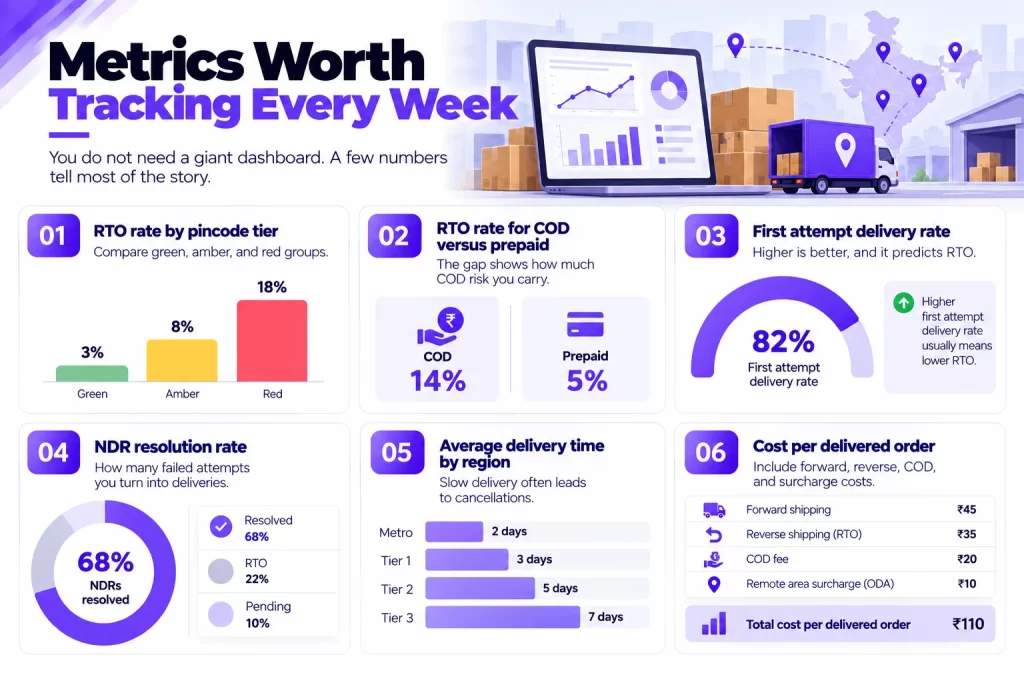
Metrics Worth Tracking Every Week
You do not need a giant dashboard. A few numbers tell most of the story:
- RTO rate by pincode tier: Compare green, amber, and red groups.
- RTO rate for COD versus prepaid: The gap shows how much COD risk you carry.
- First attempt delivery rate: Higher is better, and it predicts RTO.
- NDR resolution rate: How many failed attempts you turn into deliveries.
- Average delivery time by region: Slow delivery often leads to cancellations.
- Cost per delivered order: Include forward, reverse, COD, and surcharge costs.
To judge which courier deserves more volume, build a simple scorecard. Our guide to a courier performance scorecard shows how to do it.
Common Mistakes to Avoid
Even good teams trip on these. Watch for them:
- Treating all small cities alike. A Tier 2 hub and a remote Tier 3 pincode need different rules.
- Blocking COD too broadly. You will lower RTO and lose sales together.
- Trusting “serviceable” as proof of quality. Always check real delivery data.
- Ignoring NDRs for a day. Late follow-up is a common reason parcels return.
- Never reviewing the data. Courier performance shifts, so last quarter’s choice may be wrong today.
- Chasing the lowest rate. A cheap courier with high RTO costs more in the end.
If any of these sound familiar, do not worry. Each one is easy to fix once you spot it.
Conclusion: Grow Into Smaller Cities With Eyes Open
Smaller cities offer real growth, but they punish guesswork. The brands that win there do a few things well.
Let’s recap:
- RTO runs higher in Tier 2 and Tier 3 markets because of COD, unclear addresses, patchy coverage, fake attempts, and remote charges.
- Segment your pincodes into green, amber, and red groups instead of treating them as one block.
- Make COD safer with confirmation, limits, and prepaid nudges.
- Validate addresses before dispatch.
- Allocate couriers by pincode performance, not habit.
- Respond to NDRs fast, and watch for fake attempts.
- Track cost per delivered order, not just shipping rates.
You do not need to fix everything this week. Pick one pincode group, run the four-week plan, and let the numbers guide the next move.
Ready to cut RTO and reach more customers? Metaport helps D2C brands allocate couriers by pincode, manage NDRs, and track performance across every region. Talk to our team and see how it works for your pincodes.
Frequently Asked Questions
Several things add up. COD orders are more common, and COD buyers can refuse at the door. Addresses are often less precise, courier coverage varies by pincode, and fake delivery attempts are more likely in low-supervision networks. Remote area charges also push brands to cut corners. Fixing addresses, COD rules, and courier choice usually brings the biggest gains.
There is no single best courier. Performance changes by pincode, product type, and season. A courier that does well in one state may struggle in another. The smart approach is to track delivery success and RTO by pincode, then route each order to the courier with the best record for that location. A regional courier can also outperform national names in specific areas.
ODA stands for out of delivery area. Couriers charge extra to deliver to remote or hard-to-reach pincodes. You cannot always avoid it, but you can reduce its impact. Compare ODA rules across couriers, add the charge to your cost calculation, adjust your free shipping threshold for those areas, and consider a courier with a stronger local network.
In most cases, yes, because many customers there prefer it. But offer it with guardrails. Use order confirmation, set value limits in high-risk pincodes, and give a small discount for prepaid payment. Review COD RTO by pincode, and tighten rules only where the data shows a problem.
You can check serviceability on your courier or shipping platform, and verify pincode details through India Post’s pincode search. But serviceability only tells you a courier accepts parcels there. It does not tell you how well they deliver. Always compare real delivery rate, NDR patterns, and RTO history for each courier before you choose.

Kapil Pathak is a Senior Digital Marketing Executive with over six years of experience in the logistics and supply chain industry. He specializes in SEO, SEM, and multi-channel campaign management. He has a strong track record of building strategies that boost brand visibility and generate qualified leads. His work focuses on driving growth for D2C and B2B technology companies through data-driven digital marketing initiatives.