You pack two identical 500g parcels. One goes across town. The other goes to Guwahati. The second one costs you almost double to ship.
Why? It comes down to courier zones in India.
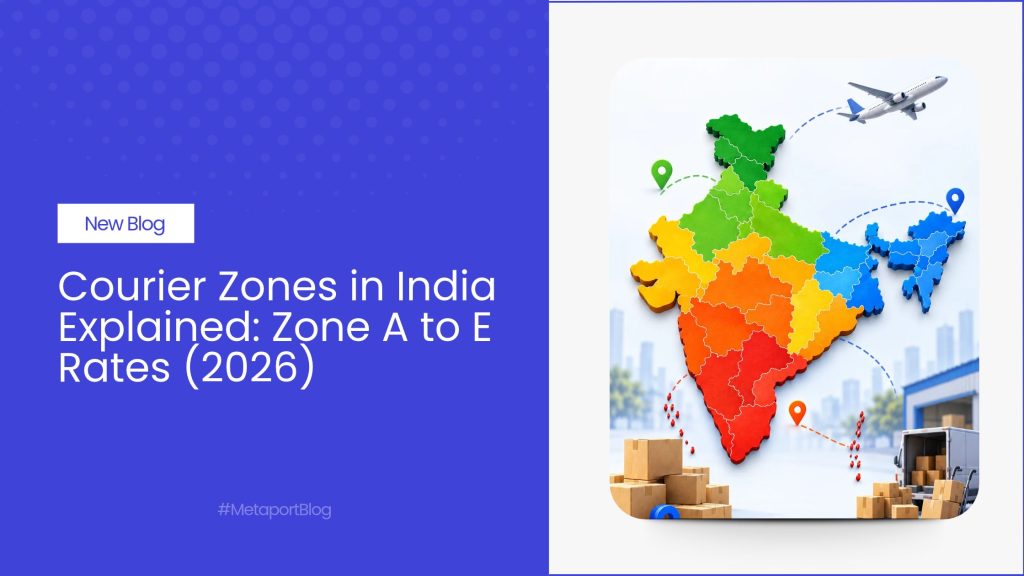
Every courier company and shipping aggregator sorts deliveries into zones, usually labelled A to E. The zone decides your base rate, your delivery time and, in many cases, whether that order makes you any money at all.
Yet most first-time sellers only notice zones when the monthly invoice lands. By then, the margin is already gone.
This guide fixes that. Here is what you will learn:
- What Zone A, B, C, D and E actually mean (and why couriers disagree on Zone B)
- Indicative courier charges per 500g for each zone in 2026
- How volumetric weight quietly raises your bill, with a worked example
- How COD, RTO, fuel surcharge and GST stack on top of the base rate
- Practical ways to push more of your orders into cheaper zones
Let’s start with the basics.
What Are Courier Zones in India?
A courier zone is a pricing band based on how far your parcel travels and how hard the destination is to reach. The zone is set by two things: your pickup (origin) pincode and the customer’s (destination) pincode.
Think of it like auto-rickshaw fares. A short ride inside your area is cheap. A long ride to the airport costs more. A trip up a hill road with no return passengers costs the most.
Couriers work the same way. Here is the standard Zone A to E structure most Indian shipping platforms use.
Zone A to E at a glance
| Zone | Also called | What it covers | Example route | Typical surface delivery time |
|---|---|---|---|---|
| Zone A | Local / within city | Pickup and delivery in the same city | Andheri to Bandra, Mumbai | 1 to 2 days |
| Zone B | Regional / within state | Same state, or within roughly 500 km | Pune to Nagpur | 2 to 3 days |
| Zone C | Metro to metro | Both ends are major metro cities | Delhi to Bengaluru | 2 to 4 days |
| Zone D | Rest of India / national | Everything else, excluding special zones | Jaipur to Coimbatore | 4 to 6 days |
| Zone E | Special zone | North-East states, J&K and other hard-to-reach areas | Kolkata to Imphal | 6 to 10 days |
Delivery times are typical surface ranges. Air (express) mode cuts them by a day or more.
A quick note on Zone C
Zone C trips people up. Delhi to Chennai is a longer distance than Delhi to Lucknow. Yet Delhi to Chennai is often cheaper.
Why? Metro-to-metro lanes carry huge daily volumes. Couriers run full trucks and flights on them every day, so the cost per parcel drops. High volume beats long distance here.
Metro cities list for courier
Most couriers treat these as metros for Zone C: Delhi NCR, Mumbai, Kolkata, Chennai, Bengaluru, Hyderabad, Pune and Ahmedabad. Some aggregators add a few more, so always check your own platform’s list.
How Are Courier Zones Decided in India?
The short answer: by pincode pairs, not by kilometres alone. When you book a shipment, the platform checks your origin pincode against the destination pincode. Then it drops the order into a zone based on the courier’s own map.
That last part matters. There is no government standard for shipping zones in India. Each courier builds its zone map around its own network, hubs and costs.
Why Zone B means different things on different platforms
This is the biggest source of confusion online. Two definitions are common:
- Within state: Shiprocket and several aggregators call any intra-state delivery Zone B. Mumbai to Nagpur (about 800 km) counts as Zone B.
- Within ~500 km: Delhivery defines Zone B as regional deliveries within 500 km. That can include a cross-border route like Delhi to Jaipur.
So the same Mumbai to Nagpur parcel could be Zone B on one platform and Zone D on another. Neither is wrong. They just draw the map differently.
Some couriers use a Zone F
Not every rate card stops at E. Delhivery’s rate card, for example, splits special zones in two:
- Zone E: Jammu, Himachal Pradesh and most North-East states
- Zone F: Kashmir, Manipur, Ladakh, and the Andaman & Nicobar Islands
If your aggregator shows a Zone F, it is simply the most remote, most expensive tier.
Do Delhivery, DTDC and Blue Dart use zones?
Yes, all of them do. The labels just vary:
- Delhivery: A to F zones, plus a destination city surcharge for 11 large city groups
- DTDC: Local, within zone, metro, rest of India and special destinations
- Blue Dart: Region and distance-based tariff bands, with extra charges for ODA (out of delivery area) pincodes
- Ekart and Xpressbees: Mostly reached through aggregators, which map them onto the A to E format
- India Post Speed Post: Distance slabs instead of letters (local, up to 200 km, 201 to 1,000 km, 1,001 to 2,000 km, and above 2,000 km)
Are courier zones the same across all aggregators?
Mostly, but not exactly. Shiprocket, NimbusPost, Shipyaari, Shipmozo and iThink Logistics all show A to E zones. Underneath, though, each one maps zones per courier partner.
If you sell on marketplaces, the platform usually handles this for you. Our guide on how to sell on Meesho covers how marketplace shipping works. Running your own D2C store is different. There, the zone math lands on you, which is one reason picking the right stack matters. See our list of the best e-commerce platforms in India for options that plug into Indian shipping aggregators.
Courier Charges Per 500g by Zone (2026 Rates)
Here is the number everyone searches for. These are indicative 2026 ranges for a prepaid, surface-mode, B2C parcel on popular aggregators. They are based on published aggregator ranges and third-party rate guides, not a single courier’s official card.
| Zone | First 500g (₹) | Each additional 500g (₹) | Rough cost of a 1 kg parcel (₹) |
|---|---|---|---|
| Zone A (within city) | 28 to 40 | 25 to 35 | 55 to 75 |
| Zone B (regional) | 32 to 48 | 28 to 42 | 60 to 90 |
| Zone C (metro to metro) | 40 to 60 | 35 to 55 | 75 to 115 |
| Zone D (rest of India) | 45 to 70 | 40 to 65 | 85 to 135 |
| Zone E (special zone) | 60 to 95 | 55 to 85 | 115 to 180 |
Base freight only. Fuel surcharge, COD fee and 18% GST are extra. Air or express mode usually costs 1.5x to 2x these figures. Live rates change by courier, volume tier and month, so check your own rate calculator before quoting customers.
What the table tells you
- Zone E costs roughly double Zone A for the same weight.
- The jump from Zone C to Zone D is often bigger than it looks, because Zone D also takes longer. Longer transit means more cancelled and refused COD orders.
- Every extra 500g adds nearly a full slab. A 510g parcel is billed as 1 kg.
Cheapest courier for Zone E and the North-East
There is no single winner. In practice:
- Delhivery and India Post have the deepest North-East reach.
- Aggregators let you compare several couriers on the same pincode in seconds.
- For very low-value orders to Zone E, India Post Speed Post is often the cheapest prepaid option.
Always check pin code serviceability first. A cheap rate is useless if the courier cannot deliver to that pincode.
Volumetric Weight: The Hidden Cost Inside Every Zone
Here is something many new sellers miss. Couriers don’t always charge you for what your parcel weighs. They charge for the applicable weight (also called chargeable weight), which is the higher of two numbers:
- Dead weight: What the parcel actually weighs on a scale
- Volumetric weight: How much space it takes up in the truck or plane
Why? A big box of pillows weighs very little but fills a van. The courier still has to pay for that space.
The volumetric weight formula
Most Indian couriers use this formula for surface and express parcels:
Volumetric Weight Formula
Example: 30 × 25 × 10 cm box = 7,500 ÷ 5,000 = 1.5 kg
Couriers bill the higher of dead weight and volumetric weight.
Some air shipments use a divisor of 4,000 instead, which makes the result even higher. Check your rate card to be sure.
Now trim the box to 28 x 22 x 9 cm. Volumetric weight drops to about 1.1 kg. You are now billed on the 1.2 kg dead weight, which rounds to 1.5 kg anyway. But on a lighter product, that smaller box could save a full slab.
Tip: Weight discrepancy disputes are one of the top complaints sellers raise. Photograph every packed box on a scale with a tape measure in view. It is the fastest way to win a dispute when the courier re-weighs your parcel.
Beyond the Base Rate: COD, RTO, Fuel Surcharge and GST
The zone rate is only your starting point. Four add-ons decide what you finally pay.
COD charges (and are they zone-wise?)
Cash on delivery comes with a handling fee. Across most aggregators in 2026, it sits around:
- ₹30 to ₹50 flat per order, or 1.5% to 2.5% of order value, whichever is higher
Here is the part few pages explain. The COD fee itself rarely changes by zone. A ₹799 COD order costs about the same in fees whether it goes to Zone A or Zone E.
What changes by zone is the risk. Longer transit to Zone D and Zone E means more time for the buyer to change their mind. That leads to more refusals, and refusals lead to RTO.
RTO charges zone-wise
RTO (return to origin) happens when a parcel can’t be delivered and comes back to you. Most couriers charge RTO at roughly the same rate as the forward shipment, in the same zone.
So a failed Zone E order costs you twice: once to send it, once to get it back. And you still have no sale. If RTO is hurting you, a strong NDR (non-delivery report) process helps you rescue orders before they turn around.
Fuel surcharge
Most couriers add a fuel surcharge of about 10% to 20% of the base freight. It moves with diesel and jet fuel prices, so it can change month to month. Always check whether the rate you see already includes it.
GST on courier charges
Courier and shipping services attract 18% GST in India. It applies on the freight, the fuel surcharge and the COD fee together. If you are GST-registered, you can usually claim this as input tax credit, so keep every invoice in order. A good GST billing software makes matching these courier invoices far less painful.
Other charges to watch
- ODA charges: Out of delivery area pincodes can add ₹30 to ₹100 per parcel
- Destination city surcharge: Some couriers add a fee for busy metro deliveries
- Reverse pickup charges: Customer returns are often priced higher than forward shipping
Worked Example: The Same Parcel in Zone A vs Zone E
Let’s put it all together. We’ll ship the 1.5 kg (applicable weight) parcel from earlier. It is a ₹799 COD order. We’ll use mid-range rates from the table above and a 12% fuel surcharge.
| Cost line | Zone A (₹) | Zone E (₹) |
|---|---|---|
| Base freight (3 slabs of 500g) | 94.00 | 218.00 |
| Fuel surcharge (12%) | 11.28 | 26.16 |
| COD fee (₹40 or 2%, higher) | 40.00 | 40.00 |
| GST (18%) | 26.15 | 51.15 |
| Total if delivered | 171.43 | 335.31 |
| Total lost if RTO (forward + return freight with fuel and GST) | 248.46 | 576.22 |
The margin-leak callout
Read that last row again. One failed Zone E COD order wipes out about ₹576. That is more than 70% of the order value, gone.
If your gross margin on a ₹799 product is 40% (about ₹320), a single Zone E RTO cancels the profit from nearly two successful orders.
So is Zone E always a bad idea? Not at all. North-East and J&K customers are loyal and often underserved. The fix is to price and filter smartly, not to stop shipping there.
How to Reduce Shipping Costs Across Courier Zones
You can’t change where your customers live. But you can change how much each zone costs you. Here are the moves that work best for Indian D2C sellers.
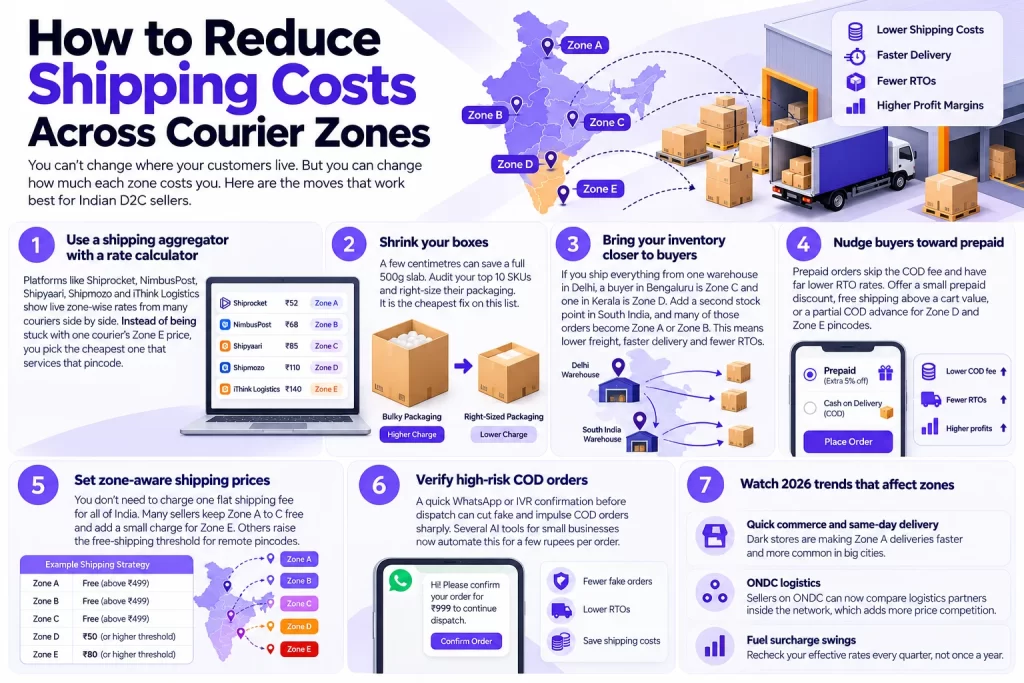
1. Use a shipping aggregator with a rate calculator
Platforms like Shiprocket, NimbusPost, Shipyaari, Shipmozo and iThink Logistics show live zone-wise rates from many couriers side by side. Instead of being stuck with one courier’s Zone E price, you pick the cheapest one that services that pincode.
2. Shrink your boxes
As the volumetric example showed, a few centimetres can save a full 500g slab. Audit your top 10 SKUs and right-size their packaging. It is the cheapest fix on this list.
3. Bring your inventory closer to buyers
This is the big one. If you ship everything from one warehouse in Delhi, a buyer in Bengaluru is Zone C and one in Kerala is Zone D.
Now add a second stock point in South India. Suddenly, many of those orders become Zone A or Zone B. That means lower freight, faster delivery and fewer RTOs.
Multi-warehouse (or distributed inventory) setups used to be only for big brands. Today, shared fulfilment centres and warehouse management software make it possible for small sellers too. As you add locations and staff, tools like payroll software help keep the back office simple.
4. Nudge buyers toward prepaid
Prepaid orders skip the COD fee and have far lower RTO rates. Offer a small prepaid discount, free shipping above a cart value, or a partial COD advance for Zone D and Zone E pincodes.
5. Set zone-aware shipping prices
You don’t need to charge one flat shipping fee for all of India. Many sellers keep Zone A to C free and add a small charge for Zone E. Others raise the free-shipping threshold for remote pincodes.
6. Verify high-risk COD orders
A quick WhatsApp or IVR confirmation before dispatch can cut fake and impulse COD orders sharply. Several AI tools for small businesses now automate this for a few rupees per order.
7. Watch 2026 trends that affect zones
- Quick commerce and same-day delivery: Dark stores are making Zone A deliveries faster and more common in big cities.
- ONDC logistics: Sellers on ONDC can now compare logistics partners inside the network, which adds more price competition.
- Fuel surcharge swings: Recheck your effective rates every quarter, not once a year.
Conclusion: Make Courier Zones Work for You
Courier zones in India are not just labels on a rate card. They decide your shipping cost, your delivery speed and, often, your profit on each order.
Here is a quick recap:
- Zone A to E runs from same-city (cheapest) to special zones like the North-East and J&K (most expensive).
- Zone B and Zone C are defined differently by different couriers, so always check your own platform’s map.
- Indicative 2026 courier charges per 500g range from about ₹28 in Zone A to ₹95 in Zone E, before add-ons.
- Volumetric weight, fuel surcharge, COD fees and 18% GST can push the final bill far above the base rate.
- A single Zone E RTO can cost more than 70% of a mid-priced order’s value.
The good news? Most of these costs are within your control. Right-size your boxes, compare couriers on every pincode, push prepaid, and move stock closer to your buyers.
Your next step: pull last month’s shipping invoice and sort your orders by zone. You’ll quickly see where your margin is leaking. Then pick the right tools to plug it. Our guides to the best marketing software for small businesses in India and the best SEO tools for small businesses can help you grow prepaid demand in your cheapest zones.
Frequently Asked Questions
They are pricing bands based on origin and destination pincodes. Zone A is within the same city, Zone B is regional or within the state, Zone C is metro to metro, Zone D is the rest of India, and Zone E covers special zones like the North-East and J&K. Rates rise from A to E.
Multiply the box’s length, breadth and height in centimetres, then divide by 5,000. The courier bills you on the higher of this volumetric weight and the dead weight. This is called the applicable or chargeable weight, and it is rounded up to the next 500g weight slab.
In 2026, most aggregators charge about ₹30 to ₹50 per order or 1.5% to 2.5% of order value, whichever is higher. The fee itself rarely changes by zone. However, RTO risk is much higher in Zone D and Zone E, which raises the real cost of COD in those areas.
These special zones have tougher terrain, fewer courier hubs, lower parcel volumes and longer transit times. Some pincodes also count as ODA (out of delivery area) and attract extra charges. Some couriers, like Delhivery, split the most remote areas into a separate Zone F.
No single courier is cheapest everywhere. Delhivery, Xpressbees, Ekart, DTDC and Blue Dart each win on different lanes and weight slabs. The easiest way to find the lowest rate is a shipping aggregator’s rate calculator, which compares several couriers for your exact pincode pair, weight and payment mode.

Kapil Pathak is a Senior Digital Marketing Executive with over six years of experience in the logistics and supply chain industry. He specializes in SEO, SEM, and multi-channel campaign management. He has a strong track record of building strategies that boost brand visibility and generate qualified leads. His work focuses on driving growth for D2C and B2B technology companies through data-driven digital marketing initiatives.