Most D2C brands in India never negotiate their courier rates. They sign up on an aggregator, accept the rate card on screen, and move on.
That works at 50 orders a day. At 500, it quietly eats your margin. A difference of even ₹5 to ₹8 per shipment adds up to lakhs a year, before you count COD fees, RTO charges and weight disputes.
The good news: courier rates are far more flexible than the rate card suggests. Couriers want predictable volume, clean data and low returns. If you can show them that, you have leverage.
This guide walks through what drives your rate, when it makes sense to move from an aggregator to direct contracts, the data you need before the call, and a step-by-step negotiation playbook. You’ll also see a worked example of what a better deal is worth in rupees, the contract clauses that matter more than the headline per-kg price, and the best times of year to ask.
What actually decides your courier rate
Before you negotiate, understand what the courier is pricing. Your rate is a bet on how profitable your parcels will be for them.
| Factor | Why it matters to the courier | What you can do |
|---|---|---|
| Monthly volume | Fixed costs spread over more parcels | Commit to a realistic monthly band, not a dream number |
| Zone mix | Metro to metro is cheap; North East and J&K are expensive | Share your actual zone split, not an average |
| Weight slabs | Most parcels fall in the first 0.5 kg slab | Fix packaging so parcels stay in the lowest slab |
| COD share | Cash handling and remittance cost money | Push prepaid to lower your COD percentage |
| RTO rate | Returns cost them a full extra trip | Show RTO trends and what you’re doing to cut them |
| Pickup density | One pickup point with 300 parcels beats 10 small ones | Consolidate pickups where you can |
A brand with 2,000 orders a month, 30% COD and a 12% RTO rate is a very different customer from one with the same volume, 60% COD and 25% RTO. The second brand will always get a worse rate, no matter how well it negotiates.
If weight is your biggest cost lever, start with our guide on volumetric weight.
Aggregator rates vs direct contracts: when to switch
Aggregators pool volume from thousands of sellers and pass on a share of their discount. For a new brand, that’s a real advantage. You get access to many couriers on day one with no contract to sign.
The catch is that you’re priced as part of a crowd. Your low RTO or high prepaid share doesn’t earn you anything, because the rate card is built for the average seller. You also give up control over terms like remittance cycles and dispute windows.
Direct contracts start to make sense when a few things line up:
- Your monthly volume is steady and growing, not spiky
- Your RTO and COD numbers are better than the category average
- You ship heavily into a few zones where one or two couriers are strong
- You have the tools to manage several courier accounts without extra headcount
You don’t have to choose one or the other overnight. Many brands keep an aggregator for long-tail pincodes and move their core zones to direct contracts. Our guide on logistics aggregators vs SaaS platforms covers this trade-off in more depth.
Data to gather before courier rate negotiation
Couriers respect numbers. Walk in with three to six months of shipping data and the conversation changes from “what’s your best price?” to “here’s why we deserve a better one.”
Pull these from your shipping panel or OMS:
- Monthly shipments, with the trend over the last six months
- Zone-wise split (within city, within state, metro, rest of India, special zones)
- Weight distribution across slabs (0.5 kg, 1 kg, 2 kg and above)
- COD vs prepaid share
- RTO rate, overall and by zone
- Current effective cost per shipment, including every surcharge, not just the base rate
- Weight dispute history: how many were raised and how many you won
- Courier-wise performance: delivery TAT, first attempt delivery rate, loss and damage
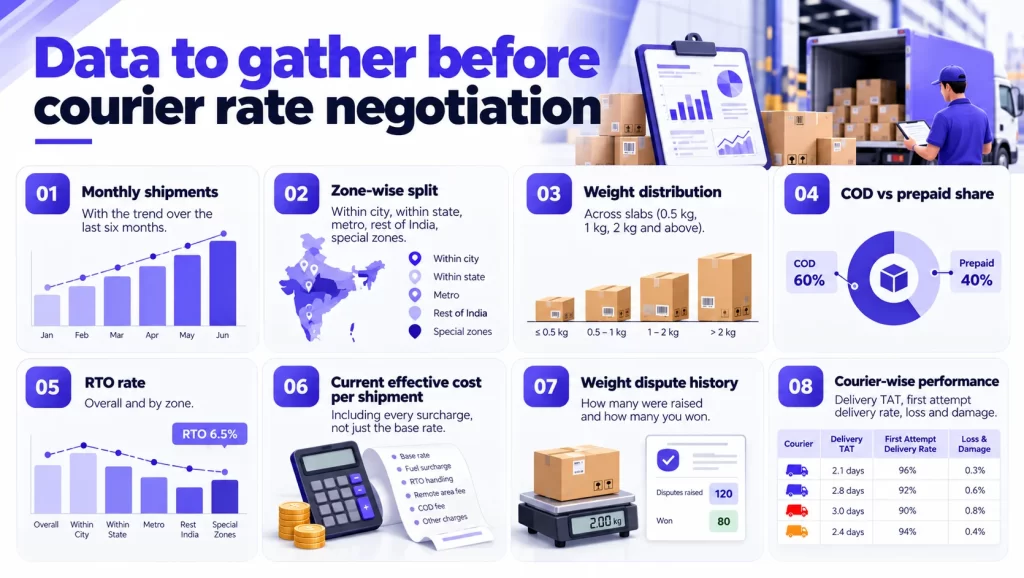
That “effective cost” number is the one most brands get wrong. Base freight is only part of the bill. Fuel surcharge, COD fee, RTO freight and dispute losses can add a big chunk on top. Our breakdown of the true shipping cost per order shows how to calculate it.
Finally, get quotes from at least two or three couriers. A competing quote is the single strongest card you can hold.
How to negotiate courier rates: a step-by-step playbook
- Know your walk-away number. Work out the effective cost per shipment you need to protect your margin. Anything above it is a no.
- Lead with your profile, not your volume. Volume opens the door. Low RTO, high prepaid share and clean weight data are what earn the discount.
- Negotiate zone by zone. Don’t accept one blended discount. If 60% of your orders go metro to metro, push hardest there. A small cut on your biggest zone beats a big cut on a zone you rarely ship to.
- Ask for slab-level pricing. Check the per-0.5 kg increment, not just the first slab. Heavier SKUs can wipe out a good base rate.
- Use competing quotes carefully. Share that you have other offers. Share exact numbers only when you’re close to a deal.
- Offer something in return. A volume commitment, a longer contract or a bigger share of a specific zone gives the courier a reason to move.
- Ask for a review clause. Agree to revisit rates every six months, or automatically when you cross a volume band.
- Start with a pilot. Give a new courier one zone or 20% of volume for a month. Judge them on real performance before shifting more.
One rule above all: never put all your volume with a single courier. A multi-carrier setup keeps every partner honest, because they know you can shift orders overnight.
A worked example: what a better deal is worth
Numbers make this real. Here’s an illustrative D2C skincare brand shipping 3,000 orders a month, with 40% COD, an average order value of ₹900 and a 15% RTO rate.
After three months of tracking its data and collecting two competing quotes, the brand renegotiates three things:
| Line item | Before | After | Yearly saving |
|---|---|---|---|
| Effective forward cost per shipment | ₹78 | ₹71 | ₹2,52,000 |
| COD fee (1,200 COD orders a month) | 2% of order value | 1.5% of order value | ₹64,800 |
| RTO freight (450 returns a month, ₹45 base) | 100% of forward | 75% of forward | ₹60,750 |
| Total | ₹3,77,550 |
None of these cuts is dramatic on its own. A ₹7 drop per parcel sounds small. Together, they’re worth nearly ₹3.8 lakh a year, which could fund a full-time hire or a solid chunk of your ad budget.
Notice what made the deal possible. The brand didn’t win on volume alone. It showed a falling RTO trend, a clear zone split and proof that it had alternatives. That’s the profile couriers reward.
Look beyond the per-kg rate
A low base rate with bad terms is a trap. These clauses often matter more than the headline price.
| Clause | What to ask for |
|---|---|
| COD fee | A lower percentage or a fixed fee per order, whichever is cheaper at your average order value |
| COD remittance | A shorter cycle (for example, D+2 instead of D+7) to free up cash. See COD remittance cycle explained |
| RTO charges | RTO freight at a discount to forward freight, not 100% of it |
| Fuel surcharge | A cap, or a clear formula tied to diesel prices |
| Weight disputes | A fixed window to raise disputes, photo proof from the courier and a clear resolution timeline. More in our guide to weight disputes |
| Loss and damage | Defined liability per shipment and a settlement deadline |
| SLA penalties | Credits when delivery TAT or first attempt rates slip below an agreed level |
| Other surcharges | A full list in writing: ODA, address correction, re-attempt, special zones. Watch for hidden surcharges |
Get every one of these in the contract. Verbal promises disappear the moment your account manager changes.
When to negotiate: timing matters
The same brand can get very different offers depending on when it asks. Pick your moment.
- Before the festive season, not during it. Couriers plan capacity for Diwali and the sale months well in advance. Lock in rates and peak-season capacity two to three months ahead. Our festive season shipping guide has a full prep checklist.
- Right after a strong quarter. When your volume has just jumped and RTO has dropped, your data does the talking.
- When your contract is up for renewal. Start talks 45 to 60 days early, so you have time to run a pilot with another courier if needed.
- When a courier is expanding. A partner opening new hubs or entering new zones is hungry for volume and more flexible on price.
Avoid negotiating right after a bad month of disputes or a spike in returns. Fix the problem first, then come back with better numbers.
Common mistakes to avoid
- Chasing the lowest rate only. A courier that’s ₹4 cheaper but fails 15% more first attempts will cost you more in RTO.
- Overpromising volume. Miss your committed band and the courier can reprice you, sometimes mid-contract.
- Ignoring the zone mix. A great metro rate means little if a third of your orders go to Tier 3 towns.
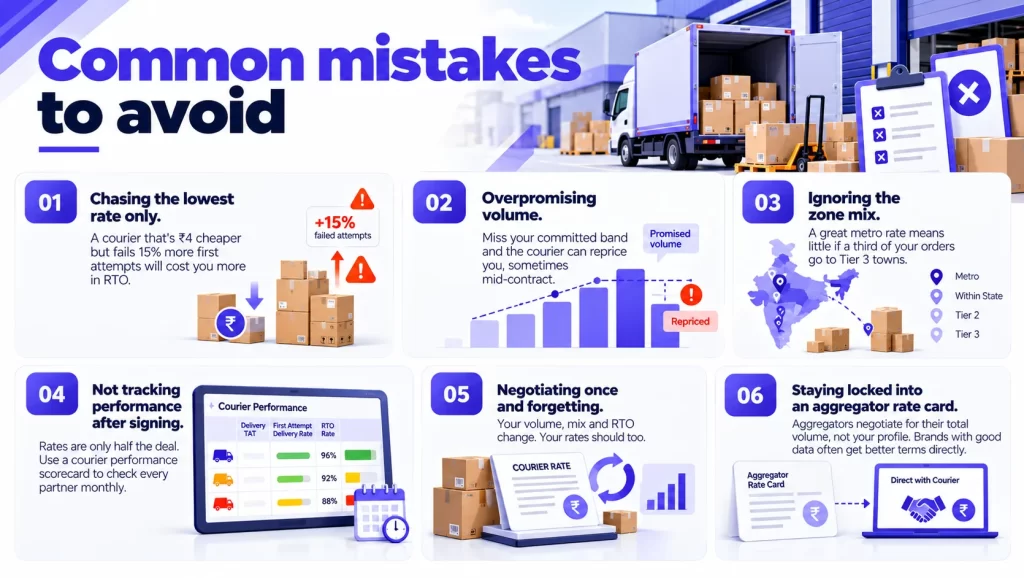
- Not tracking performance after signing. Rates are only half the deal. Use a courier performance scorecard to check every partner monthly.
- Negotiating once and forgetting. Your volume, mix and RTO change. Your rates should too.
- Staying locked into an aggregator rate card. Aggregators negotiate for their total volume, not your profile. Brands with good data often get better terms directly.
Final thoughts
Courier rate negotiation isn’t a one-time event. It’s a habit. The brands that pay the least for shipping aren’t always the biggest. They’re the ones that know their numbers, keep more than one courier in play and walk into every renewal with fresh data.
Start small. Pull your last three months of shipping data this week, work out your true cost per shipment and get one competing quote. That alone will tell you whether you’re overpaying, and by how much.
From there, every point you shave off RTO, every order you move to prepaid and every gram you cut from packaging becomes leverage for your next conversation.
How Metaport helps you negotiate (and keep) better rates
Negotiating is easier when your data is in one place and your contracts are your own. Metaport is built for exactly that.
- Bring your own courier (BYOC). Plug in the direct contracts you negotiate, and keep full control of your rates. Read why brands are moving to BYOC.
- Multi-carrier in one dashboard. Run several couriers side by side so no single partner holds all your volume.
- Courier performance data, ready for the meeting. Zone-wise TAT, RTO, first attempt rates and weight disputes for every partner, exportable before you sit down to negotiate.
- Smart courier allocation. Route each order to the courier with the best cost and performance for that pincode, so the rates you win actually get used.
- Freight reconciliation. Match every invoice against your contracted rates and catch overcharges automatically.
Ready to stop accepting the rate card? Book a free Metaport demo and see what your shipping data says about the rates you deserve.
FAQs
There’s no fixed cutoff, and it varies by courier. Brands shipping a few thousand orders a month usually get a serious conversation. Below that, focus on improving your RTO and prepaid share so you’re ready when volume grows.
Aggregators are often cheaper when you’re small. As volume grows and your RTO and COD numbers improve, direct contracts usually give better rates and more control over terms.
Every six months, or whenever your monthly volume moves to a new band. Festive peaks are also a good moment to revisit terms.
COD fees, remittance cycle, RTO charges, fuel surcharge caps, weight dispute terms, loss and damage liability, and SLA credits.
Yes. Every return costs the courier an extra trip, so a high RTO rate leads to higher quotes. Cutting RTO with smart courier allocation is one of the best ways to earn a better rate.
A 12-month contract can unlock a better rate, but only sign one with a review clause and clear exit terms. If performance slips, you need a way out without heavy penalties.
It does. Lighter, right-sized packaging keeps more parcels in the lowest weight slab and cuts weight disputes. Couriers see fewer billing fights and you see lower bills, which makes both sides more open to a better deal.
Ask what would change their answer. Sometimes a higher volume band, a longer term or a better zone mix gets you there. If not, move part of your volume to a competitor and revisit in three months with fresh data.

Kapil Pathak is a Senior Digital Marketing Executive with over six years of experience in the logistics and supply chain industry. He specializes in SEO, SEM, and multi-channel campaign management. He has a strong track record of building strategies that boost brand visibility and generate qualified leads. His work focuses on driving growth for D2C and B2B technology companies through data-driven digital marketing initiatives.