The sale went well. Orders came in faster than your team could pack them, and the dashboard looked great.
Then, about two weeks after Diwali, the numbers start to turn. Undelivered orders pile up. Return requests flood your inbox. Courier invoices arrive with weight charges you don’t recognise. And your COD cash seems to be stuck somewhere between the courier and your bank.
Sound familiar? You’re not alone. Post festive season returns and the RTO spike that comes with them are among the most predictable problems in Indian ecommerce. Yet most brands only plan for the sale itself, not for what happens after it.
This guide fixes that. It’s a week-by-week, 30-day recovery playbook for D2C brands. You’ll learn how to:
- Clear pending NDRs before they turn into RTO
- Run reverse pickups without losing track of stock
- Reconcile courier invoices, weight disputes and COD remittance
- Use your festive data to fix courier allocation before the next sale
Let’s start with why this happens at all.
Post festive season returns and RTO spike for D2C brands in India Alt text: post festive season returns and RTO spike for D2C brands in India
Why Returns and RTO Spike After the Festive Season
Festive sales change how people buy. During Diwali, the Big Billion Days and the Great Indian Festival, shoppers buy faster, compare less and lean heavily on Cash on Delivery. That behaviour has a cost, and you pay it a few weeks later.
Here are the main reasons the returns spike after a sale:
- Impulse buying. Discounts push people to buy things they haven’t fully thought through. Some of them change their minds before the parcel arrives.
- Sale-season COD orders. COD is easy to place and easy to refuse. A buyer who isn’t committed can simply say no at the door.
- Gifting returns. Many festive orders are gifts. Wrong size, wrong colour or a duplicate gift often ends up as a return.
- Size and fit returns. Fashion and footwear brands see a sharp jump here, especially when shoppers order multiple sizes to “try and return.”
- Peak season backlog. Couriers are stretched thin. Delivery attempts get missed, the buyer isn’t available, and failed delivery attempts quickly add up.
- Tier 2/3 deliveries. Festive demand reaches further into smaller towns. Address quality and courier coverage there are often weaker, which pushes up pincode-level RTO.
In short, you sold more, but you also sold riskier orders. The 30 days after the peak decide how much of that revenue you actually keep.
RTO vs Return: Know Which Problem You’re Fixing
Before we go further, let’s separate two terms people often mix up.
| Problem | RTO (Return to Origin) | Customer Return |
|---|---|---|
| What happens | The order is never delivered and goes back to you | The order is delivered, then the buyer sends it back |
| Common causes | Buyer not available, COD refusal, wrong address, failed delivery attempts | Size and fit issues, damaged product, change of mind |
| Who triggers it | Courier, after failed attempts | Customer, through a return request |
| Cost to you | Forward freight plus return to origin charges | Forward freight, reverse pickup cost, refund |
Both hurt margins. But they need different fixes. RTO is mostly a delivery and NDR problem. Returns are mostly a product, expectation and reverse logistics problem. This playbook covers both.
Before Day 1: Set Your Baseline Numbers
You can’t fix what you can’t see. So before you start the 30-day plan, pull these numbers from your festive period:
- RTO rate (RTO percentage): RTO orders divided by total shipped orders. Split it by prepaid vs COD.
- NDR count: How many orders are currently stuck in non-delivery report status?
- Return rate by SKU: Which products are coming back the most?
- Reverse pickup TAT: How long does it take from return request to pickup?
- Refund cycle: How many days from pickup to refund?
- First attempt delivery rate (FADR): What share of orders were delivered on the first try?
- Courier-wise RTO: Which courier partner has the worst numbers, and on which lanes?
If you’re logging into four different courier portals to collect this, that’s your first warning sign. It’s also why a single dashboard matters so much during peak season. More on that later.
RTO management ecommerce India dashboard showing courier-wise RTO rate Alt text: RTO management ecommerce India dashboard showing courier-wise RTO rate
The 30-Day Plan to Reduce RTO After a Festive Sale
Think of this like cleaning up after a big family function. You don’t do everything at once. You handle the urgent mess first, then the dishes, then the accounts, and finally you note what to do differently next year.
Here’s how the four weeks break down:
| Week | Focus | Goal |
|---|---|---|
| Week 1 | NDR clearance | Save as many undelivered orders as possible |
| Week 2 | Reverse pickups and returns | Get products back fast and resellable |
| Week 3 | Courier reconciliation | Recover money lost to disputes and delays |
| Week 4 | Post-peak review | Fix allocation rules before EOSS |
Week 1: Clear Pending NDRs Before They Become RTO
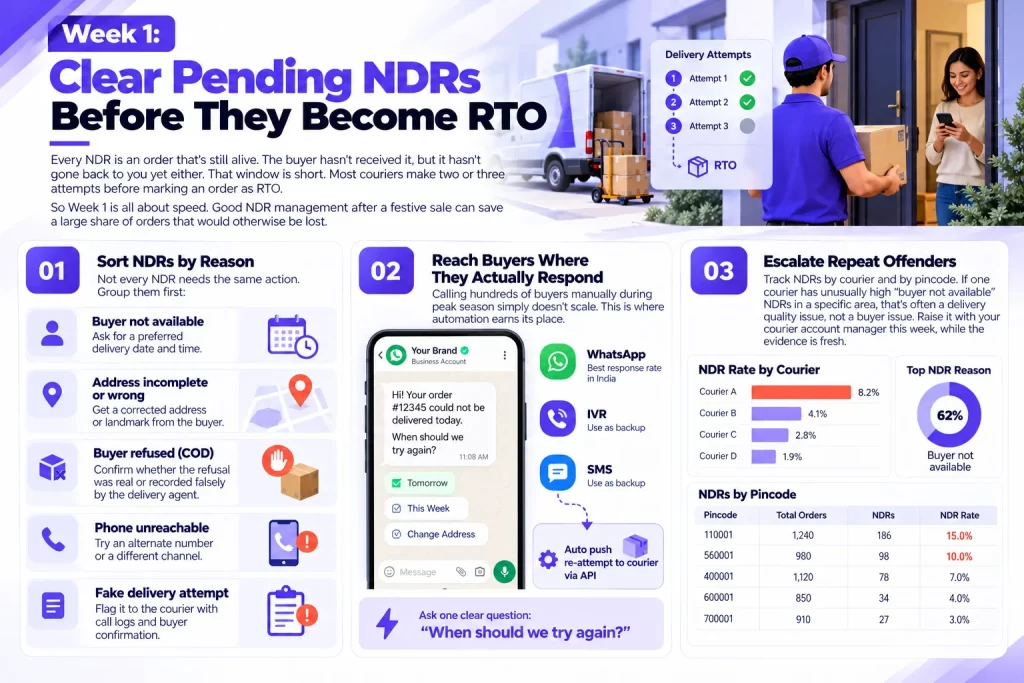
Every NDR is an order that’s still alive. The buyer hasn’t received it, but it hasn’t gone back to you yet either. That window is short. Most couriers make two or three attempts before marking an order as RTO.
So Week 1 is all about speed. Good NDR management after a festive sale can save a large share of orders that would otherwise be lost.
Sort NDRs by Reason
Not every NDR needs the same action. Group them first:
- Buyer not available: Ask for a preferred delivery date and time.
- Address incomplete or wrong: Get a corrected address or landmark from the buyer.
- Buyer refused (COD): Confirm whether the refusal was real or recorded falsely by the delivery agent.
- Phone unreachable: Try an alternate number or a different channel.
- Fake delivery attempt: Flag it to the courier with call logs and buyer confirmation.
Reach Buyers Where They Actually Respond
Calling hundreds of buyers manually during peak season simply doesn’t scale. This is where automation earns its place.
An automated NDR WhatsApp follow-up works well in India because buyers check WhatsApp far more often than email. Pair it with IVR and SMS as backups. Ask one clear question: “When should we try again?”
Once the buyer responds, push the NDR re-attempt to the courier through their API. No spreadsheets, no back-and-forth emails.
Escalate Repeat Offenders
Track NDRs by courier and by pincode. If one courier has unusually high “buyer not available” NDRs in a specific area, that’s often a delivery quality issue, not a buyer issue. Raise it with your courier account manager this week, while the evidence is fresh.
For a deeper look at the full process, see our complete guide to NDR management in ecommerce.
NDR Recovery Checklist
Work through each step to cut RTO and win back failed deliveries.
Week 2: Get Reverse Pickups Under Control
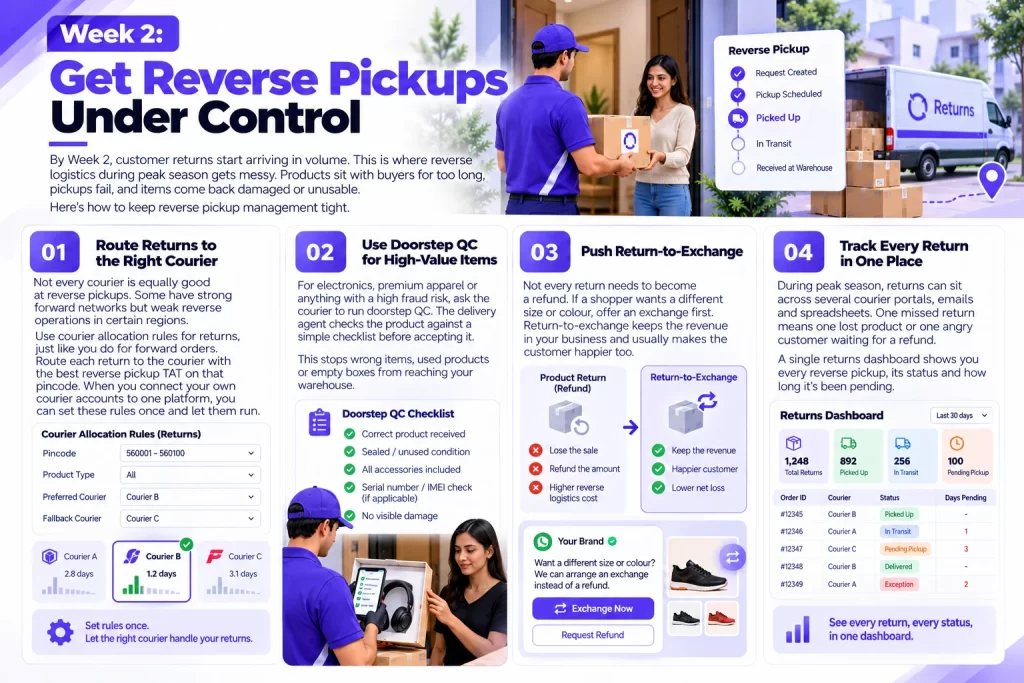
By Week 2, customer returns start arriving in volume. This is where reverse logistics during peak season gets messy. Products sit with buyers for too long, pickups fail, and items come back damaged or unusable.
Here’s how to keep reverse pickup management tight.
Route Returns to the Right Courier
Not every courier is equally good at reverse pickups. Some have strong forward networks but weak reverse operations in certain regions.
Use courier allocation rules for returns, just like you do for forward orders. Route each return to the courier with the best reverse pickup TAT on that pincode. When you connect your own courier accounts to one platform, you can set these rules once and let them run.
Use Doorstep QC for High-Value Items
For electronics, premium apparel or anything with a high fraud risk, ask the courier to run doorstep QC. The delivery agent checks the product against a simple checklist before accepting it.
This stops wrong items, used products or empty boxes from reaching your warehouse.
Push Return-to-Exchange
Not every return needs to become a refund. If a shopper wants a different size or colour, offer an exchange first. Return-to-exchange keeps the revenue in your business and usually makes the customer happier too.
Track Every Return in One Place
During peak season, returns can sit across several courier portals, emails and spreadsheets. One missed return means one lost product or one angry customer waiting for a refund.
A single returns dashboard shows you every reverse pickup, its status and how long it’s been pending. If you’re still doing this manually, our guide to returns automation for D2C brands walks you through the setup.
Reverse Pickup Checklist
Tighten your returns flow, protect margins and keep customers coming back.
- [ ] Set reverse pickup allocation rules by pincode
- [ ] Enable doorstep QC for high-value SKUs
- [ ] Offer exchange before refund
- [ ] Monitor reverse pickup TAT daily
- [ ] Follow up on failed reverse pickups within 24 hours
Week 3: Reconcile Courier Charges and COD Remittance
This is the week most brands skip. It’s also where a lot of quiet money disappears.
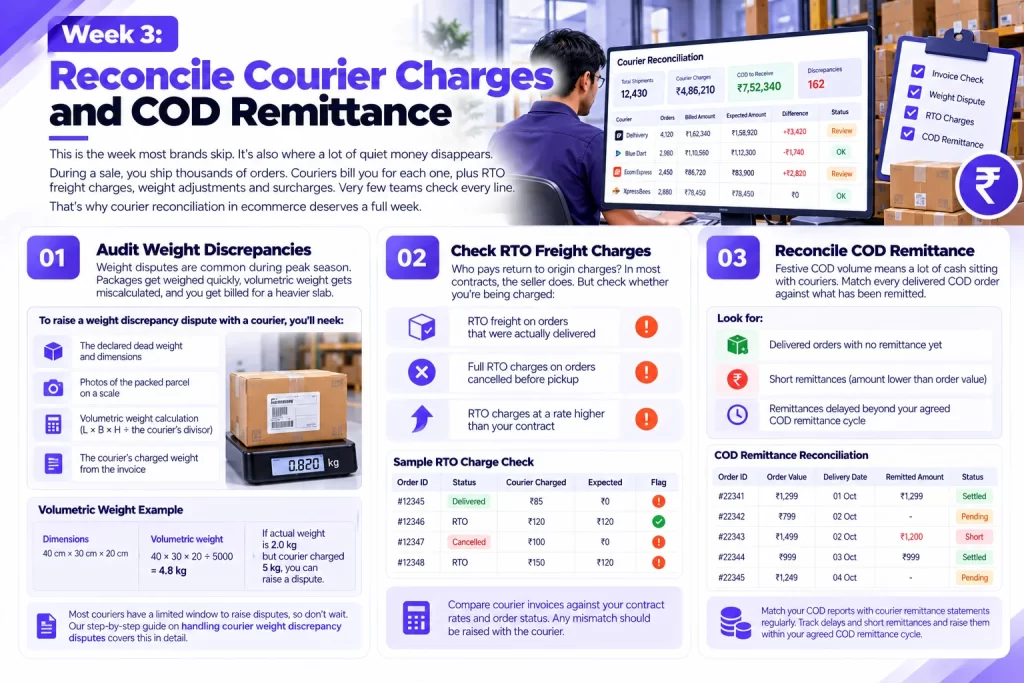
During a sale, you ship thousands of orders. Couriers bill you for each one, plus RTO freight charges, weight adjustments and surcharges. Very few teams check every line. That’s why courier reconciliation in ecommerce deserves a full week.
Audit Weight Discrepancies
Weight disputes are common during peak season. Packages get weighed quickly, volumetric weight gets miscalculated, and you get billed for a heavier slab.
To raise a weight discrepancy dispute with a courier, you’ll need:
- The declared dead weight and dimensions
- Photos of the packed parcel on a scale
- Volumetric weight calculation (L × B × H ÷ the courier’s divisor)
- The courier’s charged weight from the invoice
Most couriers have a limited window to raise disputes, so don’t wait. Our step-by-step guide on handling courier weight discrepancy disputes covers this in detail.
Check RTO Freight Charges
Who pays return to origin charges? In most contracts, the seller does. But check whether you’re being charged:
- RTO freight on orders that were actually delivered
- Full RTO charges on orders cancelled before pickup
- RTO charges at a rate higher than your contract
Reconcile COD Remittance
Festive COD volume means a lot of cash sitting with couriers. Match every delivered COD order against what has been remitted.
Look for:
- Delivered orders with no remittance yet
- Short remittances (amount lower than order value)
- Remittances delayed beyond your agreed COD remittance cycle
If you’re unsure what timelines to expect, read our explainer on the COD remittance cycle.
Here’s the advantage of owning your courier contracts: the data, the invoices and the claims are yours. You deal with the courier directly, so you can see every charge and challenge it. There’s no middle layer between you and your money. If you’re weighing this model, our piece on why brands are moving to bring-your-own-courier (BYOC) explains the trade-offs.
Courier Billing & COD Reconciliation Checklist
Catch overcharges and recover every rupee owed after the festive rush.
Week 4: Run a Post-Peak Courier Performance Review
The urgent work is done. Now it’s time to learn from it.
Week 4 is your courier performance analysis. The goal is simple: make sure the next sale goes better than this one.
Build a Courier Scorecard
Compare each courier partner on the same metrics:
- First attempt delivery rate (FADR)
- RTO rate, split by prepaid and COD
- NDR rate and NDR conversion rate
- Reverse pickup TAT
- Weight dispute frequency
- COD remittance delays
- Lost or damaged shipments
Our guide to building a courier performance scorecard has a ready template you can use.
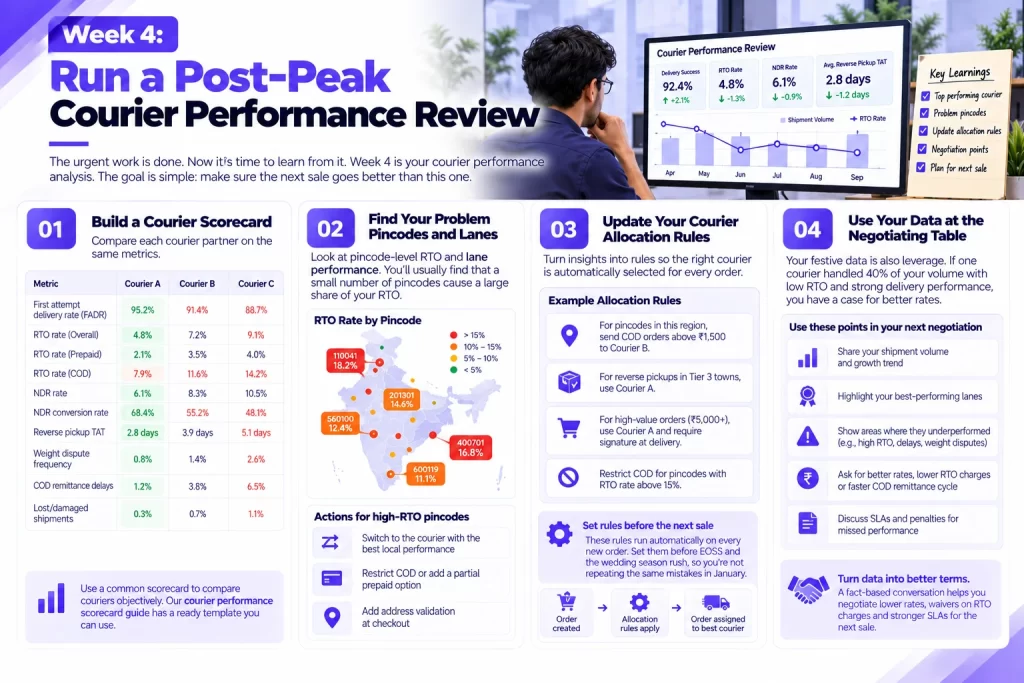
Find Your Problem Pincodes and Lanes
Look at pincode-level RTO and lane performance. You’ll usually find that a small number of pincodes cause a large share of your RTO.
For these areas, consider:
- Switching to the courier with the best local performance
- Restricting COD or adding a partial prepaid option
- Adding address validation at checkout
Update Your Courier Allocation Rules
Now turn insights into rules. For example:
- “For pincodes in this region, send COD orders above ₹1,500 to Courier B.”
- “For reverse pickups in Tier 3 towns, use Courier A.”
These rules run automatically on every new order. Set them before EOSS and the wedding season rush, so you’re not repeating the same mistakes in January.
Use Your Data at the Negotiating Table
Your festive data is also leverage. If one courier handled 40% of your volume with poor FADR, that’s a strong talking point for your next rate discussion. Bring numbers, not complaints.
Courier Performance Review Checklist
Turn festive season data into smarter allocation and stronger rate negotiations.
How to Reduce COD RTO Before the Next Sale
The 30-day plan helps you recover. But the bigger win is preventing the same spike next time. A few changes make a real difference:
- Convert COD to prepaid. Offer a small discount or cashback for prepaid payment. Even a modest shift reduces COD RTO noticeably. Here’s our guide on how to convert COD orders to prepaid.
- Confirm high-risk COD orders. Send a WhatsApp confirmation before dispatch. Cancel orders that don’t respond.
- Validate addresses at checkout. Catch missing landmarks and wrong pincodes before the order ships.
- Show accurate delivery dates. Buyers are less likely to refuse an order that arrives when promised.
- Allocate smarter. Use your Week 4 data to send each order to the courier most likely to deliver it on the first attempt.
Consumer expectations matter here too. A survey reported by Indian Transport & Logistics News found that many Indian shoppers hold back during the festive season because they expect delivery delays and return problems. Smooth deliveries and easy returns aren’t just operations metrics. They affect whether people buy from you at all.
Where a Shipping Automation Platform Fits
Could you run this whole playbook with spreadsheets? Technically, yes. But during peak season, manual work breaks down fast.
A multi-courier shipping automation platform like Metaport helps you:
- Connect your own courier accounts and keep your negotiated rates
- Automate NDR follow-ups on WhatsApp, IVR and SMS
- Allocate orders and returns to the best courier using your own rules
- Track every shipment and return in one dashboard
- Reconcile invoices, weight disputes and COD remittance without juggling courier portals
- Compare courier performance by pincode, lane and payment mode
You own the courier contracts. Metaport gives you the tools to manage them well.
Conclusion: Turn the Post-Festive Mess Into Next Season’s Advantage
Festive sales bring in revenue. The weeks after decide how much of it you keep.
Here’s the 30-day plan in brief:
- Week 1: Clear pending NDRs fast with automated follow-ups.
- Week 2: Get reverse pickups under control with smart routing, doorstep QC and exchanges.
- Week 3: Reconcile weight disputes, RTO charges and COD remittance.
- Week 4: Review courier performance and update allocation rules.
The brands that handle post festive season returns well aren’t the ones with zero RTO. They’re the ones who measure it, act on it quickly and use the data to improve before the next peak.
Want to run this playbook without logging into five courier portals? Book a demo with Metaport and see how your own courier accounts, NDR automation and courier analytics work together in one platform.
For more peak season planning, read our guide to festive season shipping for D2C brands.
Frequently Asked Questions
Returns rise after festive sales because of impulse buying, gifting mismatches, size and fit issues and a heavy share of COD orders. Couriers are also overloaded, which leads to more failed delivery attempts. Most brands see the spike 2 to 4 weeks after the sale ends.
RTO (Return to Origin) happens when an order is never delivered and goes back to the seller, usually after failed delivery attempts or a COD refusal. A return happens when the customer receives the order and then sends it back. RTO is mainly a delivery problem, while returns are mainly a product or expectation problem.
Confirm COD orders on WhatsApp before dispatch, validate addresses at checkout and offer incentives to pay online. After a failed attempt, follow up quickly on NDRs and request a re-attempt. Over time, allocate COD orders in high-RTO pincodes to the courier with the best first attempt delivery rate.
In most courier contracts in India, the seller pays return to origin charges. That’s why it’s important to audit RTO freight charges after every sale. Check for charges on delivered orders, duplicate billing and rates higher than your agreed contract.
It depends on your courier contract. Many couriers remit COD on a fixed weekly or bi-weekly cycle after delivery. During the festive season, delays are more common because of high volumes. Reconcile COD remittance against delivered orders regularly so missing or short payments don’t slip through.

Kapil Pathak is a Senior Digital Marketing Executive with over six years of experience in the logistics and supply chain industry. He specializes in SEO, SEM, and multi-channel campaign management. He has a strong track record of building strategies that boost brand visibility and generate qualified leads. His work focuses on driving growth for D2C and B2B technology companies through data-driven digital marketing initiatives.