The new ecommerce rules 2027 take effect on January 1, and your checkout might already break one of them. Picture this: your store shows ₹799, the customer taps “Place order” and suddenly sees ₹848. A ₹49 COD fee appeared at the very last step.
Until now, that was just bad UX. From January 1, 2027, it could also be a compliance problem.
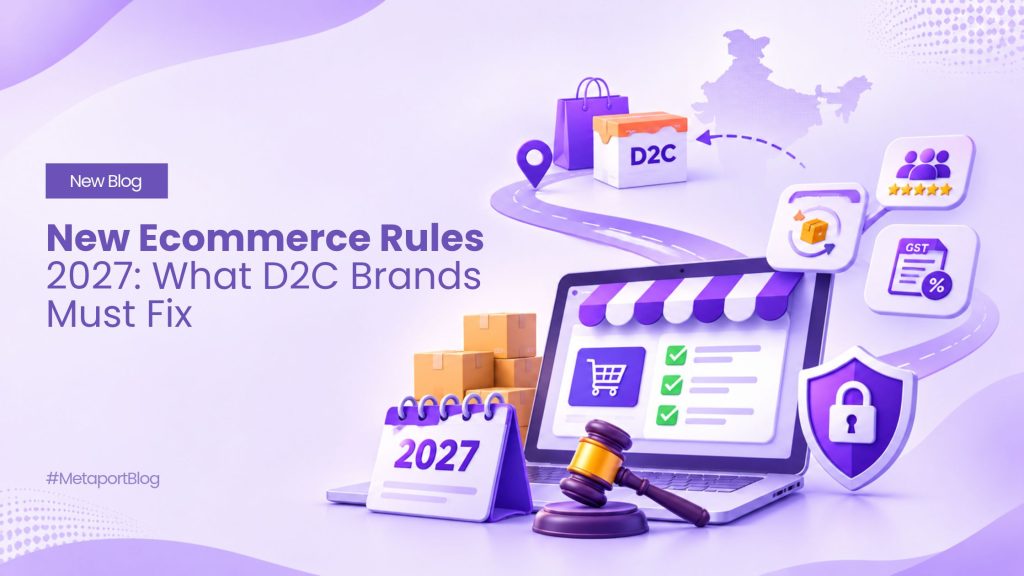
These rules bring India’s dark pattern guidelines into binding law. They also tighten what brands must disclose about delivery, returns and complaints. Most coverage so far comes from law firms, and it is written for lawyers. This guide is for the people who actually run the store.
Here is what we will cover:
- Every key change in the rules, explained in plain words, and which parts apply to a D2C brand’s own website
- The checkout fixes: COD fees, shipping charges and discount pricing
- Shipping and delivery promises, including estimated delivery dates
- Return and refund disclosures
- Complaint handling, WISMO tickets and the National Consumer Helpline
- A checklist you can work through before January 1
A quick note: this is an operations guide, not legal advice. Run your final changes past your legal advisor.
What Are the New Ecommerce Rules 2027?
The official name is a mouthful: the Consumer Protection (E-Commerce) (Amendment) Rules, 2026. The Department of Consumer Affairs notified them on September 9, 2026. They update the original 2020 e-commerce rules.
The key date is January 1, 2027. Lawyers tracking the rules note there is no separate grace period after that. Sales before that date, like this year’s festive season, are not covered.
The main changes at a glance
According to the government’s press release, the amendments cover:
- Consumer grievances: faster acknowledgement and resolution, plus a copy of the complaint for the customer
- National Consumer Helpline: joining its grievance system is now mandatory
- Dark patterns: the 2023 guidelines become binding, with a yearly self-audit
- Price reductions: discounts must show the real prior price
- Seller disclosures: clearer details on delivery, returns and payment options
- Search results and sponsored listings: no manipulation, and clear ad labels
- Imported goods: importer details and country of origin
Do the New Ecommerce Rules 2027 Apply to Your D2C Website?
This is the question most founders ask first. The short answer: yes, many of them do.
The rules cover two kinds of businesses. A marketplace hosts other sellers, like Amazon or Flipkart. An inventory entity sells its own stock, which is what most D2C brand websites are.
Some duties apply to every e-commerce entity. These include grievance handling, NCH participation, discount pricing and the dark pattern self-audit. Other duties, like the ban on bundled fees, are written only for marketplaces.
So think of it this way. If you sell only on your own Shopify or WooCommerce store, the general duties apply to you. If you also sell on marketplaces, the seller duties apply to those listings too.
For a detailed legal breakdown, Bar & Bench’s analysis is a good read.
Every Change in the New Ecommerce Rules 2027, Explained
The list above is the short version. Now let’s go through each change in plain words. For each one, you will see what the rule says and what it means for a D2C brand.
1. Faster, more transparent grievance handling
What the rule says: Every e-commerce entity must have a grievance officer. That officer must acknowledge a complaint within 48 hours and resolve it within one month. The customer must also get a copy of the complaint exactly as it was recorded.
What it means for you: A complaint can no longer sit unanswered in a shared inbox. You need a ticket ID, a timestamp and an automatic acknowledgement for every complaint. We cover the full workflow in Fix 4 below.
2. Mandatory National Consumer Helpline (NCH) integration
What the rule says: Joining the NCH convergence process used to be a best-effort commitment. Now it is mandatory for every e-commerce entity.
What it means for you: A customer who complains to the government helpline can be routed straight to your business. Think of it as a second complaint inbox that you cannot ignore. Someone on your team should own it and track every case to closure.
3. Clear business details on your website
What the rule says: E-commerce entities must prominently show key details. These include the legal name, headquarters and branch addresses, website, customer care contacts and grievance officer details.
What it means for you: Check your footer and “Contact us” page. Is your registered company name there, or only the brand name? Is there a phone number or email that a real person answers? If a customer has to dig for this information, it is not “prominent” enough.
4. Dark patterns become a legal duty, with a yearly self-audit
What the rule says: Under the new Rule 4(15), every e-commerce entity must follow the 2023 Dark Patterns Guidelines. It must also run a self-audit every year and display a certificate confirming its platform is free of dark patterns.
What it means for you: Earlier, these guidelines worked more like advice. In June 2025, the regulator asked platforms to self-audit, but it was not a binding rule. From January 1, 2027, it is. Your site, app, emails and checkout all need a yearly review, with a certificate on display.
The guidelines name 13 dark patterns. Here is how each one could show up on a D2C store:
| Dark pattern | What it means | D2C example to avoid |
|---|---|---|
| False urgency | Fake pressure to buy now | A sale timer that resets on every visit |
| Basket sneaking | Adding items or charges without consent | Shipping insurance auto-added to the cart |
| Confirm shaming | Guilt-tripping users who say no | “No thanks, I don’t care about my skin” |
| Forced action | Making users do something extra to proceed | Forcing app download or sign-up to check out |
| Subscription trap | Easy to join, hard to cancel | A refill subscription with no clear cancel button |
| Interface interference | Design that hides or misleads choices | A faded “Skip” link next to a bright “Add” button |
| Bait and switch | Advertising one thing, delivering another | A deal price that is “out of stock” at checkout |
| Drip pricing | Revealing mandatory charges late | A COD fee shown only on the final screen |
| Disguised advertisement | Ads dressed up as content or reviews | Paid influencer posts shown as customer reviews |
| Nagging | Repeated, disruptive requests | A newsletter pop-up on every single page |
| Trick question | Confusing wording that misleads | “Uncheck to not stop receiving offers” |
| SaaS billing | Hidden recurring charges in software | Silent auto-renewal of a paid membership |
| Rogue malware | Malicious software or scams | Rare for D2C, but keep plugins and apps vetted |
Most D2C brands will not have all 13. But a quick walk through this table usually finds two or three.
5. Honest discounts with the “prior price” rule
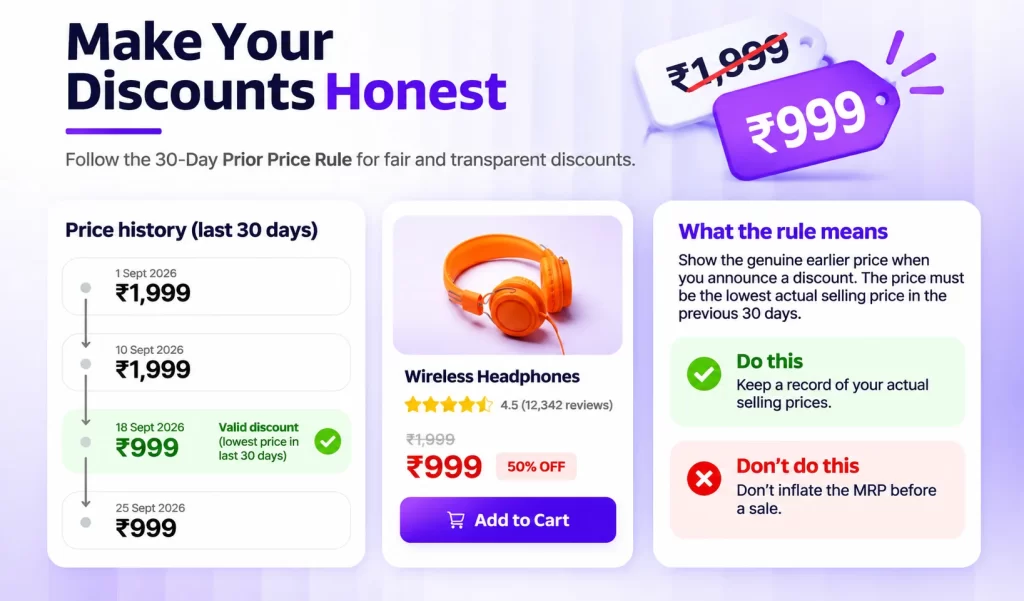
What the rule says: Under the new Rule 4(13), any announced price cut must show the real price it is based on. Law firm AZB describes this as a 30-day look-back rule.
What it means for you: The old trick of raising the MRP before a sale, then “slashing” it, is now a clear risk. Keep a log of your actual selling prices. Then every “was ₹1,999, now ₹999” claim has proof behind it.
6. Seller name on invoices
What the rule says: Under Rule 4(14), the seller’s name on an invoice must appear in the same font size as the platform’s name.
What it means for you: This matters most when you sell through marketplaces. The customer should be able to see clearly who actually sold the product. On your own site, make sure your invoice shows your registered business name, not just a logo.
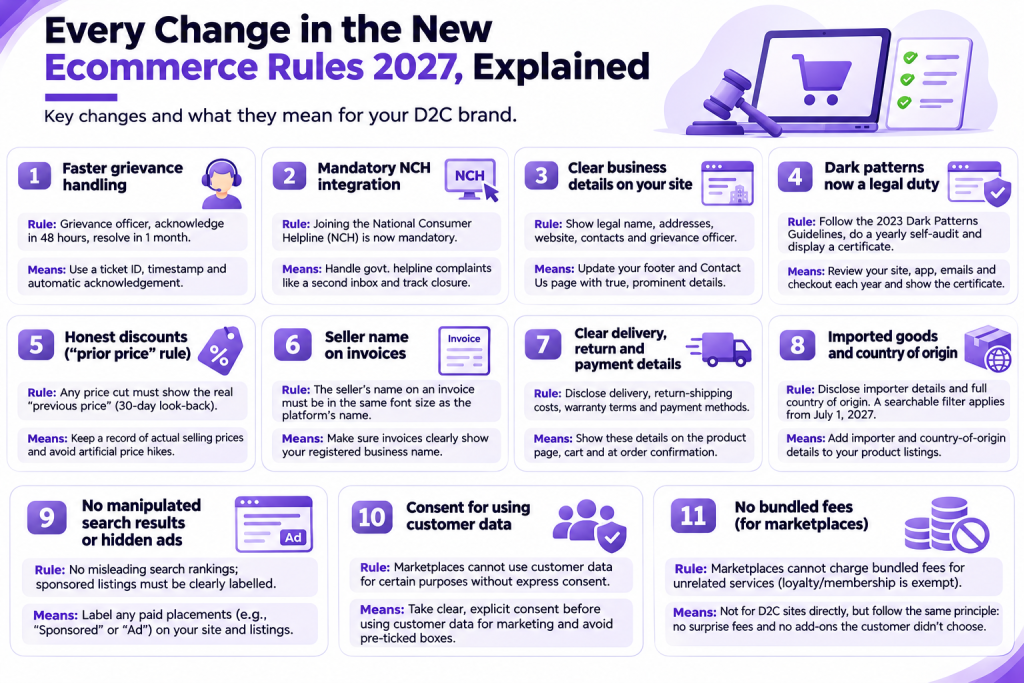
7. Clear delivery, return and payment details
What the rule says: The expanded disclosure duties cover delivery and shipping details, return-shipping costs, warranty terms and available payment methods.
What it means for you: These details can no longer hide in a policy page nobody reads. Show them where buying decisions happen: the product page, cart and order confirmation. Fixes 2 and 3 below show you how.
8. Imported goods and country of origin
What the rule says: For imported goods, the importer’s details and the full country of origin must be disclosed. A searchable and sortable country-of-origin filter applies later, from July 1, 2027.
What it means for you: If you sell imported products, or products made with imported parts, review your listings. Add importer details to the product page, not just the packaging.
9. No manipulated search results or hidden ads
What the rule says: Platforms cannot manipulate search results in a way that misleads users or reduces relevance. Sponsored listings must be clearly labelled, and ranking now covers how sellers are ranked, not just products.
What it means for you: This is mainly a marketplace rule. Still, if your own site has “Featured” or “Recommended” slots that are paid placements, label them honestly. On marketplaces, expect ad labels on your sponsored listings to become more visible.
10. Consent for using customer data
What the rule says: Marketplaces cannot use customer information for certain purposes without the customer’s express and affirmative consent. One example is promoting the marketplace’s own brands.
What it means for you: This rule targets marketplaces directly. But it signals where regulation is heading. Ask for clear consent before you use customer data for marketing, and avoid pre-ticked consent boxes.
11. A ban on bundled fees (for marketplaces)
What the rule says: Under the new Rule 5(7), marketplaces cannot charge bundled fees for services unrelated to the platform. Loyalty or membership programmes are exempt.
What it means for you: This does not apply directly to your own D2C site. However, the same idea shows up in the dark pattern rules through drip pricing and basket sneaking. So the safest approach is the same everywhere: no surprise fees, and no add-ons the customer did not choose.
Now that you know what each change means, let’s turn them into action. The next four sections cover the fixes that matter most for shipping, returns and checkout.
Fix 1: Clean Up Your Checkout for the New Ecommerce Rules
Checkout is where most D2C brands will feel these rules first. That is because the 2023 dark pattern guidelines are now part of the law, not just advice.
Those guidelines list 13 dark patterns. For a D2C checkout, three matter most: drip pricing, false urgency and basket sneaking.
What is drip pricing?
Drip pricing means revealing extra mandatory charges late in the purchase. The customer sees one price on the product page, then pays more at the end.
The regulator has already acted on this. In one case, a baby products retailer showed prices as tax-inclusive but added GST at checkout. A quick commerce app was flagged for adding handling fees at the final step.
Common drip pricing risks on D2C stores include:
- A COD fee that shows up only after the customer picks a payment method
- A shipping fee hidden until the last screen
- “Packaging” or “handling” charges added at payment
- GST added on top of prices that looked final
Is a COD fee still allowed?
The rules do not ban COD fees outright. The issue is when and how you show them.
A safer approach is to show the COD fee early. Mention it on the product page or in the cart, before payment selection. Then the customer knows the full price before they commit.
This also helps your business. A clearly shown COD fee nudges buyers toward prepaid, which cuts RTO risk. Our guide on how to convert COD orders to prepaid covers this in detail.
Show shipping charges upfront
The same logic applies to shipping. If you charge for delivery, say so before the last step.
Here are a few simple fixes:
- Add a shipping estimate on the product page or cart
- Show your free-shipping threshold clearly, for example “Free delivery above ₹499”
- Avoid pre-ticked add-ons like gift wrap or shipping insurance
Of course, you can only show accurate charges if you know your real costs. If courier surcharges keep surprising you, start with these hidden shipping surcharges and work out your true shipping cost per order.
Make your discounts honest
The new prior price rule targets inflated “was ₹1,999, now ₹999” claims. When you announce a price cut, you must show the genuine earlier price. Law firm AZB describes it as a 30-day look-back rule.
In practice, that means no inflating the MRP the week before a sale. Keep a record of your actual selling prices so you can back up every discount.
Fix 2: Make Your Delivery Promises Accurate
The new ecommerce rules 2027 expand what sellers must disclose. Delivery and shipment details are on that list, along with available payment methods.
Think about what your store says today. Does it promise “delivery in 2–3 days” for every pincode in India? If a customer in a tier 3 town waits nine days, that promise starts to look misleading.
Watch out for false urgency
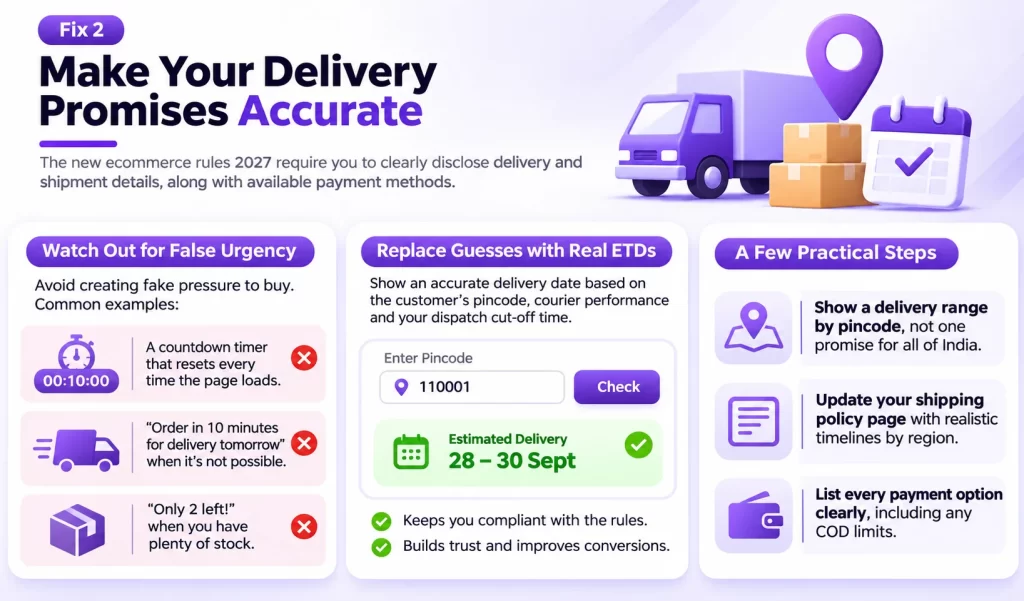
False urgency is another dark pattern on the list. It means creating fake pressure to buy. On a D2C store, it often looks like this:
- A countdown timer that resets every time the page loads
- “Order in 10 minutes for delivery tomorrow” when your courier cannot deliver that fast
- “Only 2 left!” when you have plenty of stock
None of these are illegal when they are true. The problem starts when they are not.
Replace guesses with real estimated delivery dates
The better fix is to show a delivery date based on real data. That means using the customer’s pincode, your courier’s actual performance on that lane and your dispatch cut-off time.
An accurate date does two jobs. It keeps you on the right side of the rules, and it builds trust that lifts conversions. We explain how this works in our post on AI estimated delivery dates.
A few practical steps:
- Show a delivery range by pincode, not one promise for all of India
- Update your shipping policy page with realistic timelines by region
- List every payment option clearly, including any COD limits
Fix 3: Spell Out Returns and Refunds
Returns are where vague policies cause the most angry customers. Under the amended rules, return terms and return-shipping costs must be disclosed clearly.
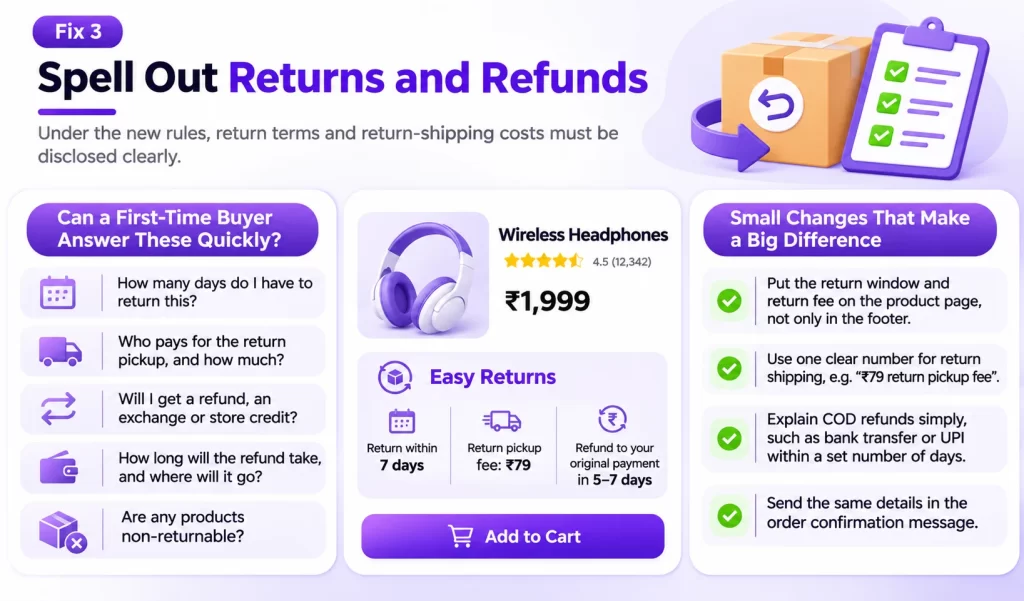
So ask yourself: could a first-time buyer answer these questions in under a minute?
- How many days do I have to return this?
- Who pays for the return pickup, and how much?
- Will I get a refund, an exchange or store credit?
- How long will the refund take, and where will it go?
- Are any products non-returnable?
If the answer is no, your return policy needs work.
Small changes that make a big difference
You do not need to rewrite everything. Start with these:
- Put the return window and return fee on the product page, not only in the footer
- Use one clear number for return shipping, for example “₹79 return pickup fee”
- Explain COD refunds simply, such as bank transfer or UPI within a set number of days
- Send the same details in the order confirmation message
A self-serve returns portal makes this much easier. Customers see the fee, pick a reason and book a pickup without emailing you. Read more in our guide to returns automation for D2C brands.
Fix 4: Get Complaint Handling Ready for the New Rules
This part of the rules hits your CX team directly. Under the amended grievance rules:
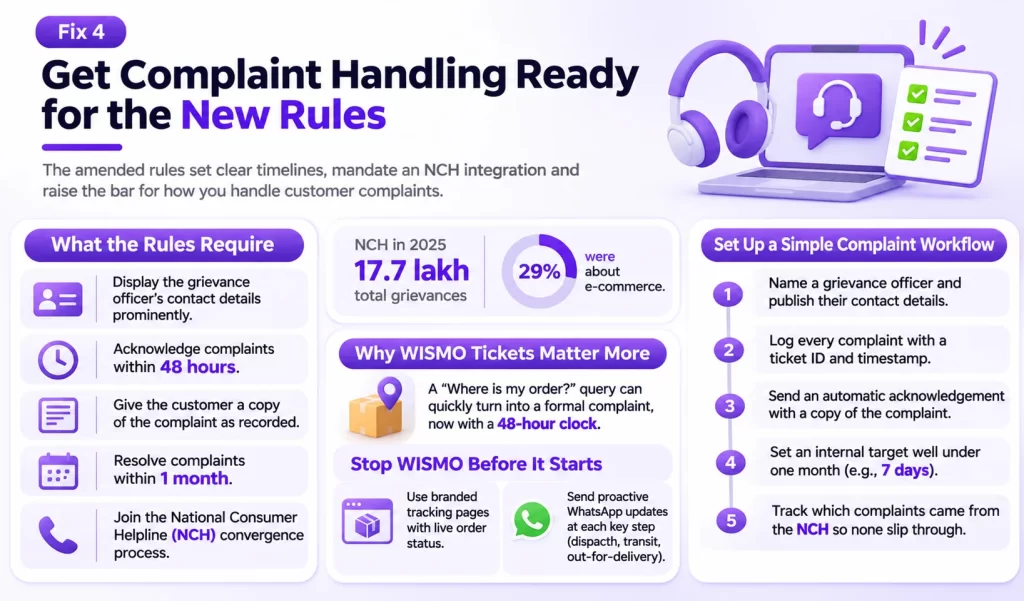
- A grievance officer’s contact details must be displayed prominently
- Complaints must be acknowledged within 48 hours
- The customer gets a copy of the complaint as it was recorded
- Complaints must be resolved within one month
On top of that, every e-commerce entity must now join the National Consumer Helpline (NCH) convergence process. In simple terms, complaints customers file with the government helpline can be routed to you, and you must respond.
How big is this? In 2025, the NCH received over 17.7 lakh grievances. Around 29% of them were about e-commerce.
Why WISMO tickets matter more now
Where does a lot of that e-commerce frustration start? Often with a simple question: “Where is my order?”
A WISMO query is not a formal complaint yet. But when a customer gets no answer for days, it can turn into one. Now, that complaint may come with a 48-hour clock attached.
The smart move is to stop WISMO before it starts. Two tools help most:
- Branded tracking pages that show live status on your own site. See how branded tracking pages cut WISMO tickets.
- Proactive WhatsApp updates at each key step, from dispatch to out-for-delivery. Here is a breakdown of WhatsApp shipping update costs in India.
Set up a simple complaint workflow
You do not need a big team. You need a clear process:
- Name a grievance officer and publish their contact details
- Log every complaint with a ticket ID and timestamp
- Send an automatic acknowledgement with a copy of the complaint
- Set an internal target well under one month, such as seven days
- Track which complaints came from the NCH so none slip through
Your Pre-January Checklist for the New Ecommerce Rules 2027
With only a few weeks to go, here is a simple checklist to share with your team. Work through it like a store walkthrough, one screen at a time.
| Area | What to check | Usually owned by |
|---|---|---|
| Checkout | COD, shipping and handling fees shown before the final step | Growth / tech |
| Checkout | No pre-ticked add-ons or surprise GST | Tech |
| Pricing | Every “was” price matches a real recent selling price | Marketing |
| Urgency | Timers and stock alerts reflect reality | Marketing |
| Delivery | Delivery estimates shown by pincode, not one promise for all | Ops |
| Policies | Shipping, return and refund pages updated with clear fees and timelines | Ops / legal |
| Payments | All payment options and COD limits listed | Tech |
| Grievances | Grievance officer named and contact details visible | CX / legal |
| Grievances | 48-hour acknowledgement and complaint copy automated | CX |
| NCH | Process in place to receive and track helpline complaints | CX |
| Dark patterns | Self-audit done and compliance certificate displayed | Legal |
| Imported goods | Importer and country of origin shown where relevant | Catalogue team |
Try this quick test as well. Ask someone outside your team to buy a product on your phone app or site. Did any charge surprise them? If yes, you have found your first fix.
Conclusion: Turn the New Ecommerce Rules 2027 Into Better CX
The new ecommerce rules 2027 can look like another layer of paperwork. But look closely, and most of them ask for things customers already want.
Let’s recap the four fixes:
- Checkout: show COD, shipping and other fees before the final step, and keep discounts honest
- Delivery: replace blanket promises with accurate, pincode-based delivery dates
- Returns: state return windows, return-shipping fees and refund timelines clearly
- Complaints: acknowledge in 48 hours, resolve within a month and plug into the NCH
Here is the upside. Brands that fix these issues will likely see fewer RTOs, fewer WISMO tickets and more repeat buyers. In other words, the rules push you toward a better shipping experience anyway.
The hard part is having the right data and automation behind it. Metaport helps D2C brands show accurate delivery dates, run branded tracking pages, send proactive updates and automate returns, all from one platform.
Want to get your shipping stack ready before January 1? Book a free demo of Metaport and see where your current setup needs work.
Frequently Asked Questions
They apply to both. Duties like grievance handling, NCH participation, the prior price rule and the dark pattern self-audit cover every e-commerce entity, including a brand’s own website. Some rules, such as the bundled fee ban, are written only for marketplaces.
The rules do not ban COD fees. However, showing a COD fee only at the last step could count as drip pricing under the dark pattern guidelines. To be safe, show it clearly on the product page or cart, before the customer chooses how to pay.
Drip pricing means revealing mandatory charges late in the checkout, so the final price is higher than what the customer first saw. Examples include a surprise handling fee, a hidden shipping charge or GST added to prices that looked tax-inclusive.
Under the new Rule 4(15), every e-commerce entity must comply with the 2023 Dark Patterns Guidelines. It must also run a self-audit every year and prominently display a certificate confirming its platform is free of dark patterns.
The grievance officer must acknowledge a complaint within 48 hours and share a copy of it as recorded. The complaint must then be resolved within one month. Complaints can also reach you through the National Consumer Helpline, so track both channels.

Kapil Pathak is a Senior Digital Marketing Executive with over six years of experience in the logistics and supply chain industry. He specializes in SEO, SEM, and multi-channel campaign management. He has a strong track record of building strategies that boost brand visibility and generate qualified leads. His work focuses on driving growth for D2C and B2B technology companies through data-driven digital marketing initiatives.