Your customer just ordered a kurta. You send “Order confirmed.” Then “Shipped.” Then “Out for delivery.” Three tiny messages. Cheap, simple, done.
Except Meta changed its billing rules on 1 October 2026. Some WhatsApp shipping updates that used to be free now carry a price tag. And the bill grows quietly, one delivered message at a time.
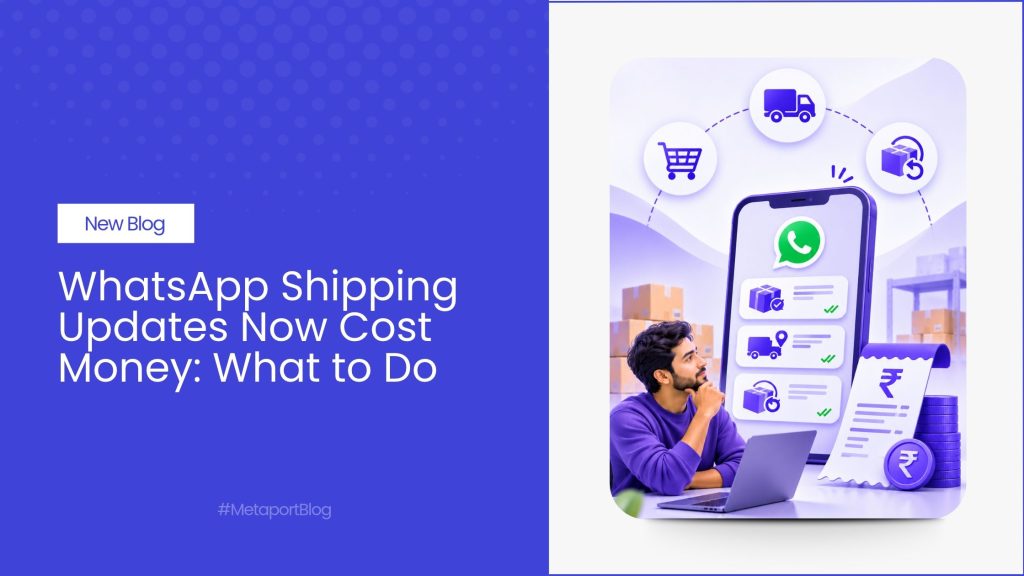
Don’t panic. The cost per message is small in India. But D2C brands send thousands of them every day. A few careless habits can turn a rounding error into a real line item.
In this guide, you’ll learn:
- What changed, and what did not
- What WhatsApp order updates cost in India right now
- Where the new charges really hit (hint: failed-delivery chats)
- Seven practical ways to cut the bill without hurting the customer experience
- Which channel should send which update
Let’s start with the basics.
What Changed in WhatsApp Pricing on 1 October 2026?
Two things changed. Both affect how brands send shipping notifications.
First, free-form replies now have a limit. When a customer messages you, a 24-hour customer service window opens. Replies you send inside it are called service messages. They used to be free and unlimited. Now each business number gets 1,000 free service messages a month. After that, each delivered reply is charged. Twilio’s help center notice lays this out clearly.
Second, utility templates inside that window are billable again. Since July 2025, a utility template sent while a window was open cost nothing. From 1 October, it costs the normal utility rate.
Here is the before-and-after at a glance.
| Message type | Before 1 Oct 2026 | From 1 Oct 2026 |
|---|---|---|
| Service reply (free text inside the 24-hour window) | Free | Free for the first 1,000 per number each month, then charged |
| Utility template sent inside the window | Free | Charged |
| Utility template sent outside the window | Charged | Charged |
| Marketing template | Charged | Charged (no change) |
| Authentication template | Charged | Charged (no change) |
One small warning. Meta’s own pricing documentation was last updated in March and still described the older rules when I checked. Always read the live page before you build a budget.
Also remember that Meta can change prices on the first day of any quarter. That means 1 January, 1 April, 1 July and 1 October. So this is not a one-time adjustment to forget about. Treat WhatsApp cost as something you review every quarter.
What Do WhatsApp Shipping Updates Cost in India?
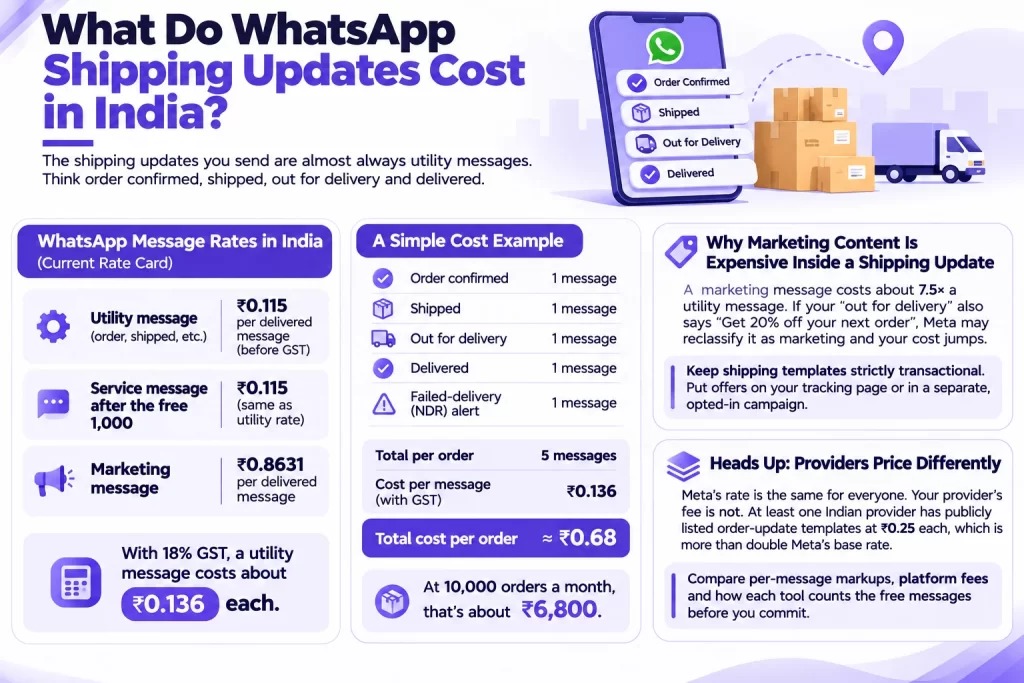
The shipping updates you send are almost always utility messages. Think order confirmed, shipped, out for delivery and delivered.
Here are the India rates reported for the current rate card:
- Utility message: about ₹0.115 per delivered message, before GST
- Service message after the free 1,000: charged at the same utility rate
- Marketing message: about ₹0.8631 per delivered message
Add 18% GST and a utility message lands near ₹0.136. Your provider may also add a platform fee or a markup on top. So your real cost is Meta’s fee, plus your provider’s fee, plus GST.
Let’s make that concrete with a simple example.
- Order confirmed: 1 message
- Shipped: 1 message
- Out for delivery: 1 message
- Delivered: 1 message
- One failed-delivery (NDR) alert: 1 message
That is five messages per order. At about ₹0.136 each, you pay roughly ₹0.68 per order. At 10,000 orders a month, that comes to about ₹6,800. Treat this as a rough planning figure, since your provider’s markup will change it.
Is that scary? Not really. But it is real money, and it only counts the planned messages. Customer replies are where things get slippery. We’ll get there in a moment.
Why Marketing Content Is Expensive Inside a Shipping Update
Here is a trap many brands fall into. A marketing message costs about 7.5 times a utility message at the rates above.
So what happens if your “out for delivery” template also says “Get 20% off your next order”? Meta may reclassify it as marketing. Your cost jumps, and nobody tells you until the invoice arrives.
Keep shipping templates strictly transactional. Put offers on your tracking page or in a separate, opted-in campaign.
Heads Up: Providers Price Differently
Meta’s rate is the same for everyone. Your provider’s fee is not. At least one Indian provider has publicly listed order-update templates at ₹0.25 each, which is more than double Meta’s base rate. Prices may have changed since, but the point stands. Compare before you commit.
If you’re still choosing a provider, compare per-message markups, platform fees and how each tool counts the free service messages. Ask for a sample monthly invoice before you commit.
What Did Not Really Change (And What Did)
Here’s the honest version of the headline.
Most proactive shipping updates were already paid. If you sent “Your order has shipped” and the customer had not messaged you in the last 24 hours, no free window existed. That template was always billed at the utility rate.
So the October change does not suddenly make every update expensive. It mostly affects:
- Utility templates you send while a customer chat is open
- Free-form replies beyond the first 1,000 each month, per number
- Back-and-forth conversations that used to cost nothing
In other words, the cost moves from “one-way notifications” to “two-way conversations.” That’s a big deal for logistics, because delivery is full of conversations.
Where the New Cost Actually Hits You
Think of the old setup like an all-you-can-chat buffet. The new one is closer to a thali with refills that you pay for. Same food, different bill.
The heavy-chat areas in shipping are easy to spot.
Failed Delivery (NDR) Conversations
A courier marks a delivery attempt as failed. Your system asks the customer to confirm the address or pick a new date. The customer replies. You reply back. A few more messages follow.
Each of those replies is a service message. Once your number passes the 1,000 free messages, each one is billed.
Here’s a quick example. Say you handle 1,500 NDR conversations in a month. Each one has four bot replies. That is 6,000 service messages. Subtract the 1,000 free ones. You pay for 5,000, which is about ₹575 before GST at ₹0.115 each. That is a modest number, but it grows with volume. It also grows with every extra reply your flow sends.
If you want a refresher on why these failed attempts matter so much, read our guide on NDR management in ecommerce.
“Where Is My Order?” Chats
WISMO chats are the classic time sink. A customer asks for an update, and your team or bot answers. Every answer is now a possible charge once you pass the free tier.
The cheapest WISMO message is the one you never have to send. We’ll fix that in the tactics below.
Support Threads With Long Flows
A bot that sends ten short messages where two would do is quietly expensive. Under the old rules, that was free. Now it is not. Shorter flows are no longer just good design. They are good budgeting.
7 Ways to Keep WhatsApp Shipping Updates Affordable
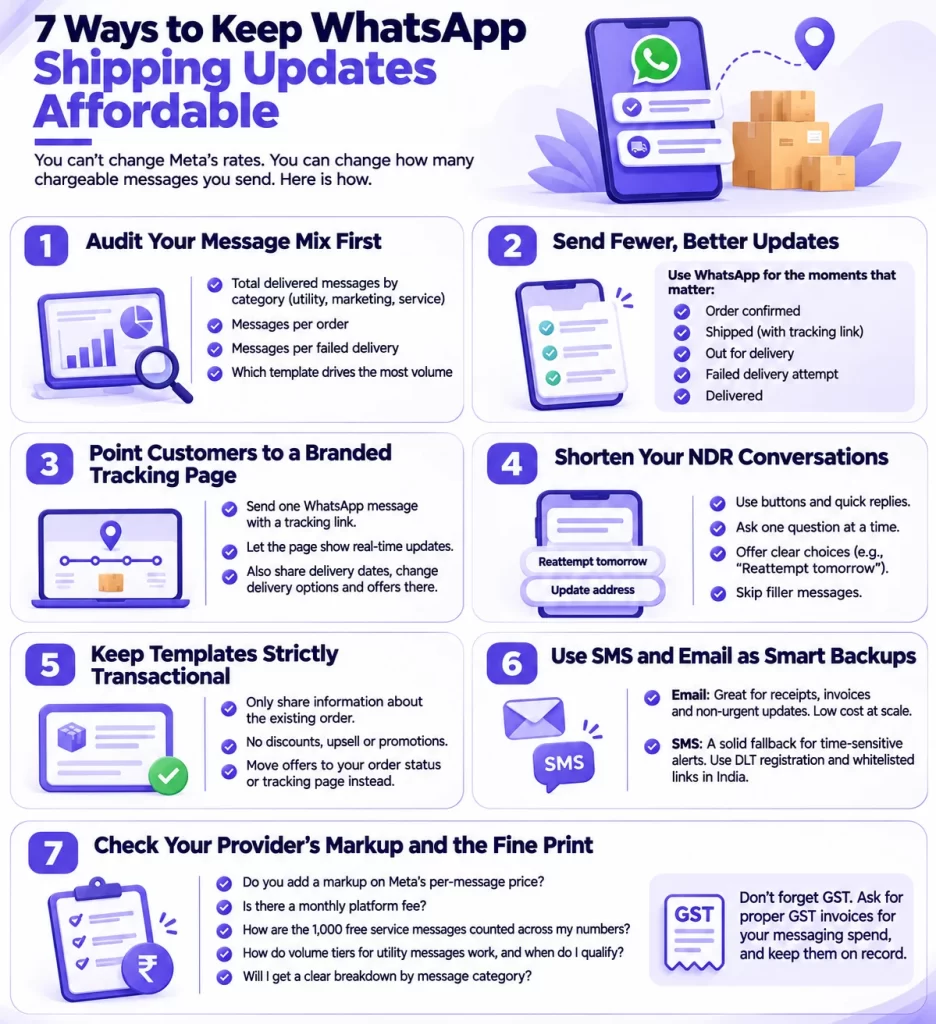
You can’t change Meta’s rates. You can change how many chargeable messages you send. Here is how.
1. Audit Your Message Mix First
You can’t fix what you can’t see. Start by pulling one full month of data from your WhatsApp provider or Meta’s analytics.
Look at:
- Total delivered messages by category (utility, marketing, service)
- Messages per order
- Messages per failed delivery
- Which template drives the most volume
You will usually find two or three templates causing most of the cost. Fix those first.
2. Send Fewer, Better Updates
Do customers really need a message for every scan? Probably not.
A good rule is to use WhatsApp for the moments that matter:
- Order confirmed
- Shipped (with the tracking link)
- Out for delivery
- Failed delivery attempt
- Delivered
Minor scans such as “arrived at hub” or “in transit” rarely need a push message. They create noise and cost.
3. Point Customers to a Branded Tracking Page
A tracking page is the cheapest answer to “Where is my order?” It updates itself, and it doesn’t bill you per view.
Send one WhatsApp message with a link. Let the page show the details. Customers can check as often as they like.
A good page can also show delivery dates, let customers change delivery preferences and carry offers, all outside your WhatsApp template. You can see how this works in Metaport’s shipment tracking solution.
4. Shorten Your NDR Conversations
NDR is the biggest conversation driver, so design it carefully.
- Use buttons and quick replies instead of free typing
- Ask one question at a time
- Offer clear choices like “Reattempt tomorrow” or “Update address”
- Skip filler such as “Thanks for your response! We are processing it.”
Two clean messages beat six chatty ones. The customer also gets resolved faster, which helps your delivery success rate.
Prevention helps too. Fewer failed attempts means fewer NDR chats. Moving more orders from cash on delivery to prepaid is one way to get there. Our guide on how to convert COD orders to prepaid walks through what works.
5. Keep Templates Strictly Transactional
We covered this earlier, but it deserves its own slot. Marketing content in a utility template is a costly mistake.
A simple check before you submit any shipping template:
- Does it only tell the customer something about their existing order?
- Is there any discount, upsell or promotion in it?
- Could the same message work without the promotional line?
If the answer to the second question is yes, move that line elsewhere. Your store’s order status page or your branded tracking page can carry banners and cross-sell blocks instead.
6. Use SMS and Email as Smart Backups
WhatsApp is not the answer for every message or every customer. Some customers are not on it. Others don’t have data on hand when the courier calls.
Use the right channel for the right job:
- Email works well for receipts, invoices and non-urgent updates. It costs very little at scale, and most store platforms and email tools can send it automatically.
- SMS is a solid fallback for time-sensitive alerts when a customer has no WhatsApp. Just remember that Indian SMS needs DLT registration, and links in templates must be whitelisted or the message can be blocked.
This is not about abandoning WhatsApp. It is about not paying WhatsApp rates for messages that email can deliver just fine.
7. Check Your Provider’s Markup and the Fine Print
You’re paying for more than Meta’s rate. Ask your provider these questions:
- Do you add a markup on Meta’s per-message price?
- Is there a monthly platform fee?
- How are the 1,000 free service messages counted across my numbers?
- How do volume tiers for utility messages work, and when do I qualify?
- Will I get a clear breakdown by message category?
And don’t forget GST. Ask for proper GST invoices for your messaging spend, and keep them organized. Then fold that spend into your true shipping cost per order, so notifications show up in your margins.
Which Channel Should Send Which Update?
There’s no single perfect setup. Still, this table gives you a sensible starting point for a D2C brand in India.
| Shipping event | Best primary channel | Good backup | Why |
|---|---|---|---|
| Order confirmed | Customers expect this fast, and the email doubles as a receipt | ||
| Shipped with tracking link | SMS | The link drives customers to your free tracking page | |
| In transit scans | Tracking page only | None | Low value as a push message |
| Out for delivery | SMS | Time sensitive and helps avoid failed attempts | |
| Failed delivery (NDR) | WhatsApp with buttons | SMS or call | Needs a quick, structured reply |
| Delivered | WhatsApp or email | None | A simple confirmation plus a review request |
| Refund or return updates | Customers often want a written record |
Notice the pattern. WhatsApp handles the moments where speed and replies matter. Your tracking page and email handle the rest.
A Simple Monthly Cost Check
Once you’ve made changes, don’t set it and forget it. Run a quick review each month.
Track these numbers:
- WhatsApp cost per order: total spend divided by orders shipped
- Messages per order: a rising number means a flow is getting chatty
- Service messages per number: are you close to the 1,000 free limit?
- WISMO ticket rate: are fewer customers asking where their parcel is?
- NDR recovery rate: do customers still respond and get re-delivered?
That last one matters most. Saving a few rupees is pointless if more parcels go back to the warehouse. Cut cost where it doesn’t hurt delivery, and protect the messages that save shipments.
If you log monthly messaging spend, track it next to your other D2C shipping metrics, such as RTO rate and first-attempt delivery. That shows whether savings are hurting delivery.
Where Automation Helps (Without Adding Cost)
Manual updates don’t scale. Automation can trigger the right message at the right moment, route it to the right channel and stop duplicates.
Automation works best across the whole dispatch flow, not just messages. See how to automate your ecommerce dispatch workflow so couriers, labels and notifications trigger together.
Just remember the new pricing rule. A chatty bot is a billable bot. Design for fewer, clearer replies.
How Metaport Fits In
Metaport’s CX Engagement solution lets brands send shipment updates through SMS, email, WhatsApp and branded tracking pages from one place. Customers can also manage delivery preferences without starting a long chat.
That setup suits the strategy in this guide: use WhatsApp for moments that need a reply, and let the tracking page and other channels carry the rest. How exactly your WhatsApp charges are billed depends on how your account is set up, so confirm that during a demo.
See every shipping update in one place
Bring your current notification flow to a free call. We will show you where to send fewer, smarter WhatsApp, SMS and email updates.
Book a free demo30 minutes. No commitment.
Channels in one flow
- SMS
- Branded tracking page
Conclusion: Spend on the Messages That Save Shipments
WhatsApp shipping updates aren't a bad deal. They're still fast, familiar and effective in India. They just aren't free-flowing anymore.
Here's the quick recap:
- From 1 October 2026, service messages beyond 1,000 a month and in-window utility templates are charged.
- Utility messages cost about ₹0.115 before GST in India, which is roughly ₹0.136 with GST.
- Most proactive updates were already paid. The new cost mostly hits conversations like NDR chats and WISMO replies.
- Keep templates transactional so they aren't reclassified as marketing.
- Send fewer push updates, lean on your tracking page and keep NDR flows short.
- Use SMS and email as sensible backups, and review your provider's markup.
Start this week. Pull last month's message data, find your top three templates and trim one chatty flow. You'll know quickly whether the numbers move.
Want to see how a single dashboard can handle shipping updates across channels? Book a demo with Metaport and bring your current notification flow with you.
FAQs About WhatsApp Shipping Updates and Pricing
No. Utility templates, which cover most shipping updates, are charged per delivered message. Before 1 October 2026, utility templates sent inside an open customer service window were free. From that date, they're charged too. Free-form service replies are free only up to 1,000 per business number each month.
The reported Meta rate for a utility message in India is about ₹0.115 before GST, or roughly ₹0.136 with 18% GST. Your provider may add its own platform fee or markup, so your final price can be higher. Check your provider's current rate card before you budget.
A service message is a free-form reply you send inside the 24-hour window after a customer messages you. A utility template is a pre-approved message about an existing order, such as "Your order has shipped." Both are now chargeable in some cases, but service messages get a monthly free allowance of 1,000 per number.
Often, yes. WhatsApp allows rich links, buttons and replies, which suits tracking and failed-delivery flows. But SMS and email still make good backups for customers without WhatsApp or for low-urgency updates. A mix usually works best, and it keeps your WhatsApp cost under control.
Send push updates only for key moments, link to a branded tracking page and keep NDR chats short with buttons. Avoid promotional lines in shipping templates so they aren't billed as marketing. Then watch your WISMO ticket rate and NDR recovery rate each month to make sure savings aren't hurting delivery.

Kapil Pathak is a Senior Digital Marketing Executive with over six years of experience in the logistics and supply chain industry. He specializes in SEO, SEM, and multi-channel campaign management. He has a strong track record of building strategies that boost brand visibility and generate qualified leads. His work focuses on driving growth for D2C and B2B technology companies through data-driven digital marketing initiatives.