When was the last time you remembered a checkout process? Probably never. But you definitely remember the time your package arrived late, damaged, or with zero tracking updates.
That’s the power of last-mile customer experience. It’s the final stretch of the delivery journey, and it’s the moment that sticks. Whether your customer becomes a loyal advocate or a one-star reviewer often comes down to what happens in those last few kilometers.
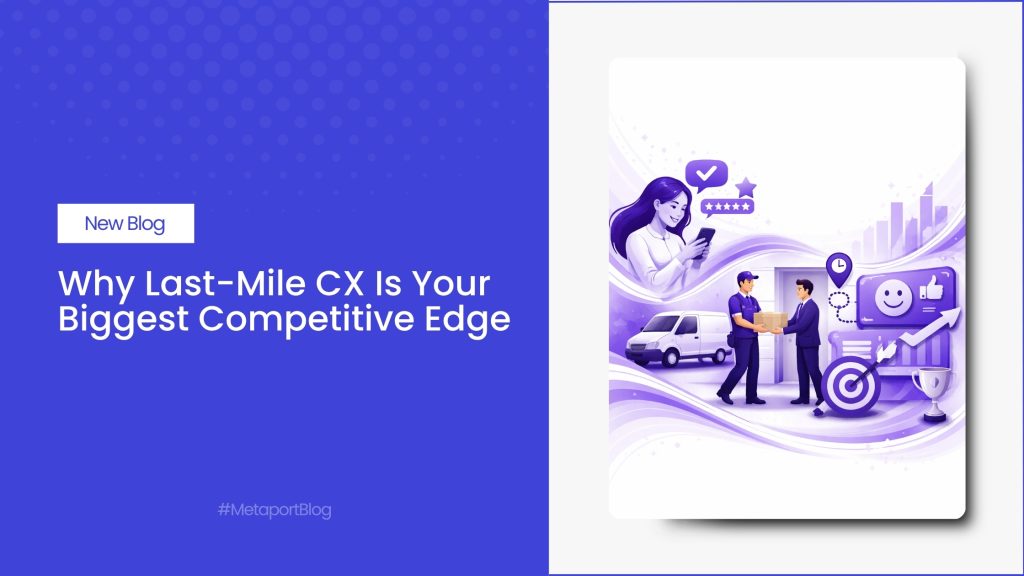
In a market where products look alike and prices are easy to compare, the last-mile delivery experience has quietly become the single biggest differentiator for brands. Modern platforms now enable everything from real-time tracking and branded consumer notifications to customizable scheduling and consumer insights, turning every delivery into a brand extension. If you’re not investing here, your competitors almost certainly are.
This guide breaks down what last-mile CX means, why it matters more than ever, and exactly how to turn it into your strongest competitive advantage, whether you run a D2C brand, an ecommerce store, or a logistics operation.
What Is Last-Mile Customer Experience?
Last-mile customer experience refers to every interaction a customer has during the final leg of delivery, from the moment an order is dispatched to the point it reaches their hands.
Most people confuse last-mile logistics with last-mile CX. They’re related, but fundamentally different:
- Last-mile logistics is about moving packages efficiently from a warehouse to the customer’s doorstep. It’s operational.
- Last-mile CX is about how the customer feels during that process. It’s experiential.
Think of it this way: logistics is the engine. CX is the entire driving experience, the seat comfort, the dashboard, the sound system. Both matter, but one shapes perception.
The key customer touchpoints in this phase include:
- Order confirmation and dispatch notifications
- Real-time delivery tracking
- Delivery time estimates and updates
- Communication with the delivery agent
- The actual package handoff
- Post-delivery follow-up and feedback
Each of these moments is a chance to build trust or break it.
Why the Last Mile Is the Most Critical Part of the Customer Journey
Last-mile delivery accounts for up to 53% of total shipping costs. It’s the most expensive part of the supply chain, and ironically, it’s where most brands drop the ball on satisfaction.
But cost isn’t the only reason it matters. There’s a psychological principle called the peak-end rule: people judge an experience based on how they felt at its most intense point and at its end. The last mile is the end. So it disproportionately shapes how customers remember your brand.
Consider two scenarios:
A customer orders a birthday gift. It arrives a day late. The entire shopping experience, no matter how smooth, is now tainted.
Another customer orders the same product. It arrives on time with a personalized notification and a thank-you note inside. That customer tells three friends.
Same product. Same price. Completely different outcomes. That’s the last-mile competitive advantage in action.
How Last-Mile Delivery Impacts Customer Satisfaction, By the Numbers
The data is unambiguous:
- 84% of consumers say they won’t return to a brand after a poor delivery experience (Convey/Project44 Consumer Survey, 2024)
- 96% of satisfied customers cite delivery as a key factor in their overall satisfaction (MetaShip Logistics Report, 2025)
- Brands with strong last-mile delivery satisfaction see 20–30% higher repeat purchase rates (Narvar Post-Purchase Benchmark, 2025)
When customers rate your brand, they don’t separate the product from the delivery. It’s all one experience. This is why improving last-mile CX isn’t just a logistics problem. It’s a brand problem.
Understanding what happens when deliveries fail is critical. If you’re unfamiliar with concepts like NDR and RTO, the two biggest culprits behind delivery failures and rising return costs, this beginner’s guide to NDR and RTO in ecommerce is a great starting point.
The Biggest Challenges in Last-Mile CX
If last-mile CX is so important, why do so many companies struggle with it? Because it’s genuinely hard.
1. Lack of Real-Time Visibility Many brands still rely on outdated tracking that offers vague updates like “out for delivery.” Customers in 2026 expect live tracking with precise ETAs. Without real-time visibility, anxiety builds and so do support tickets.
2. Inconsistent Communication Some brands send too many notifications. Others send none. The sweet spot is proactive, branded communication that keeps customers informed without overwhelming them.
3. Failed or Delayed Deliveries Traffic, weather, incorrect addresses, unavailable recipients. Each failed delivery is a CX disaster that costs money and erodes trust. Automated NDR workflows can rescue these orders before they become costly returns. MetaPort’s NDR management system is purpose-built to handle exactly this, automating follow-ups and reattempts so fewer orders turn into RTOs.
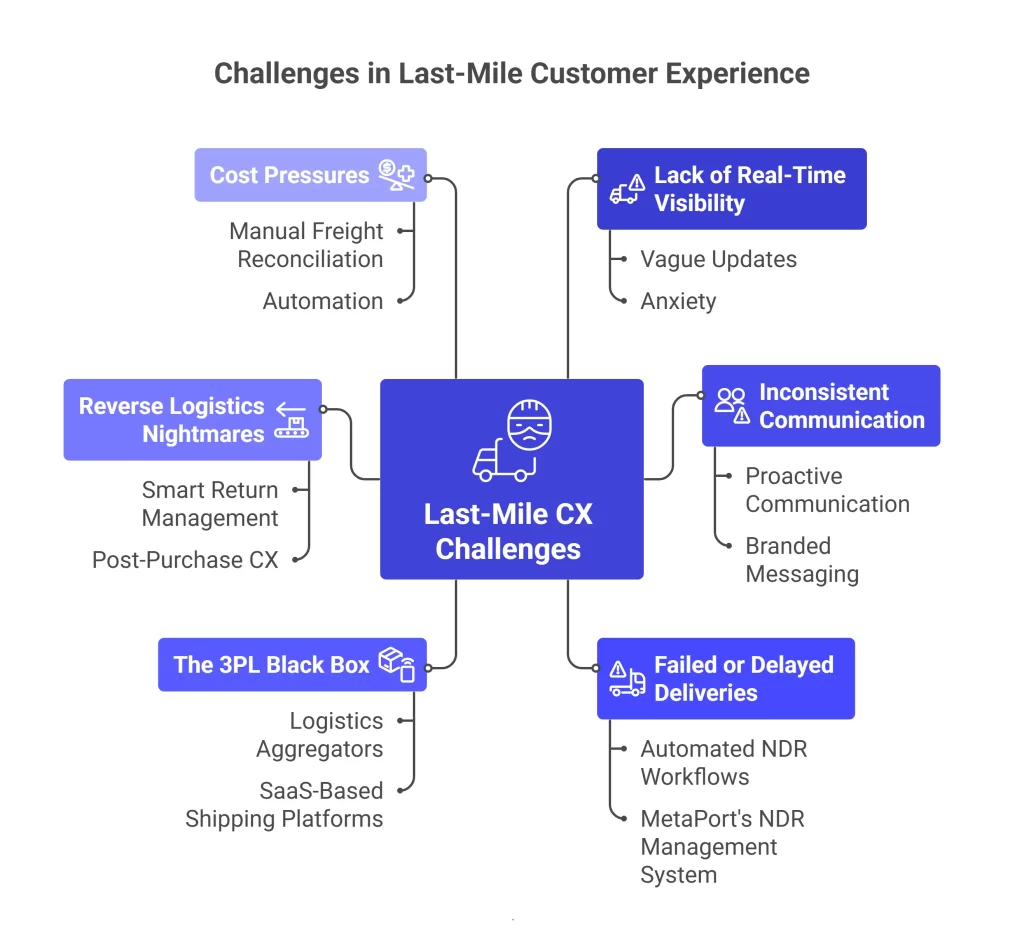
4. The 3PL Black Box When you outsource delivery, the driver becomes the face of your brand, and you have little control over that interaction. Many brands don’t realize there’s a fundamental difference between working with a logistics aggregator and using a SaaS-based shipping platform. This detailed comparison of logistics aggregators vs. SaaS platforms breaks down which model gives you more control over your last-mile CX.
5. Reverse Logistics Nightmares A clunky, confusing return process can undo all the goodwill your brand built during the forward journey. Smart return management is now essential for protecting post-purchase CX.
6. Cost Pressures Balancing cost efficiency with service quality is a constant tightrope walk. Cutting corners on delivery often backfires through higher churn and lower customer lifetime value. What many brands overlook is how much money quietly leaks through manual freight reconciliation. Mismatched invoices, overcharges, and unreconciled COD remittances add up fast. This deep dive into the hidden costs of manual freight reconciliation reveals just how much you might be losing and how automation solves it.
How to Improve Your Last-Mile Customer Experience
Here’s a practical, actionable strategy:
Invest in Real-Time Delivery Tracking This is non-negotiable. Customers want to know exactly where their package is. A modern shipment tracking platform provides branded live tracking pages where customers can watch their delivery in real time, receive AI-powered delay alerts, and stay informed at every step without ever needing to call support. This dramatically reduces WISMO (“Where is my order?”) calls and builds confidence.
Set Accurate Delivery Expectations from Day One One of the most underrated CX improvements: show a reliable estimated delivery date on the product page itself. When expectations are set correctly upfront, customers are far more patient and satisfied. MetaPort’s EDD Delivery Predictor makes this possible by calculating accurate delivery dates across multiple carriers and pin codes, so your customers know exactly when to expect their order before they even click “Buy.”
Personalize the Delivery Experience Not every customer is the same. Personalization means giving customers control:
- Choosing delivery time slots
- Safe-place delivery options
- Last-minute address changes
- Delivery preference surveys after the first order
Dynamic delivery options and customizable real-time tracking are quickly becoming the new standard for exceeding customer expectations.
Master Proactive Communication Don’t wait for customers to ask. Reach out first:
- Dispatch confirmation immediately
- Tracking link with real-time updates
- Alert when the driver is nearby
- Post-delivery feedback request
The key: be helpful without being annoying. Think conversation, not broadcast.
Use AI-Powered Courier Allocation Not all carriers perform equally across all regions. A delivery partner that excels in metro cities might struggle in tier-2 towns. AI-powered courier allocation automatically assigns every order to the best-performing carrier for that specific route, pin code, and order type, directly improving on-time delivery rates and overall CX. This guide on why AI courier allocation is crucial for ecommerce brands explains the mechanics and the impact in detail.
Leverage Multi-Carrier Shipping Relying on a single carrier is risky. Service disruptions, capacity issues, or regional weaknesses can cripple your delivery performance overnight. A multi-carrier approach gives you the flexibility to route orders through the best available partner, ensuring consistent service quality nationwide. If you’re exploring this model, here’s a comprehensive overview of how multi-carrier shipping works and why it matters.
Build a Feedback Loop After every delivery, collect feedback. Track NPS and customer effort score specifically for delivery. Then act on the data. If a specific region consistently reports late deliveries, investigate. If a carrier gets low ratings, address it. CX analytics should drive continuous improvement, not just dashboards that look pretty.
The Role of Technology in Last-Mile CX
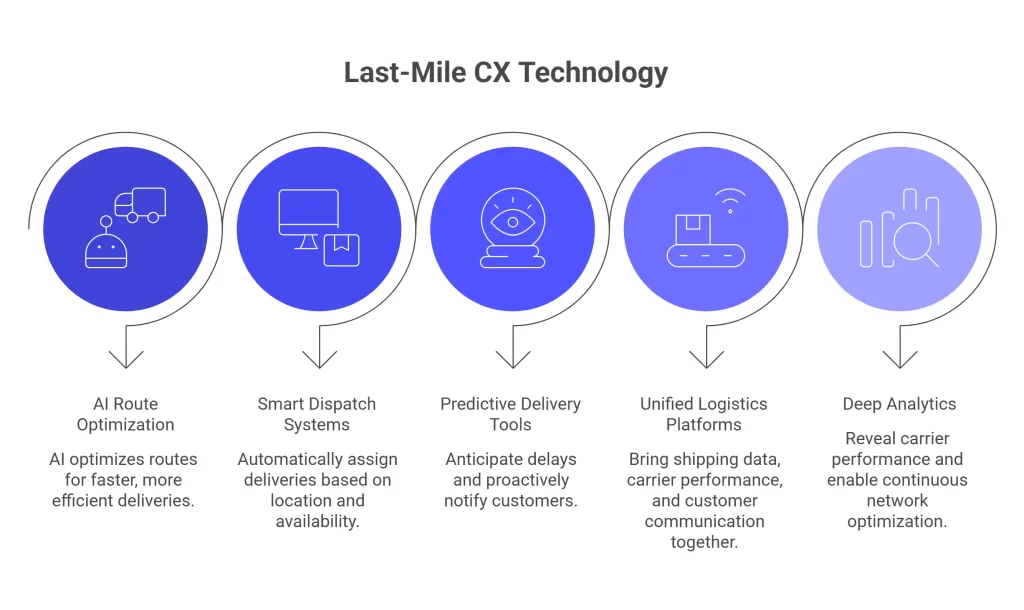
Technology is the backbone of modern last-mile optimization. The most impactful tools include:
- AI-powered route optimization for faster, more efficient deliveries
- Smart dispatch systems that automatically assign deliveries based on location, availability, and load capacity
- Predictive delivery tools that anticipate delays and proactively notify customers
- Unified logistics intelligence platforms that bring shipping data, carrier performance, customer communication, and delivery analytics into one place
- Deep analytics that reveal where carriers excel or fall short, enabling continuous network optimization
The brands winning at last-mile CX aren’t necessarily spending more. They’re spending smarter.
How Last-Mile CX Drives Retention and Loyalty
People remember how you made them feel. A consistently great delivery experience builds loyalty that competitors can’t easily break.
What the data shows:
- Customers who rate delivery 5 stars are 3x more likely to reorder within 30 days
- Word-of-mouth driven by exceptional delivery has a higher conversion rate than paid ads
- Reducing delivery complaints by just 10% can improve customer lifetime value by 15–25%
- Strong post-purchase experiences significantly reduce churn and increase repeat purchase rates
Every rupee invested in last-mile CX comes back multiplied through retention, referrals, and revenue.
Can Small Businesses Compete on Last-Mile CX?
Absolutely, and they often have an advantage. Small D2C brands are closer to their customers, more agile, and can personalize in ways large corporations can’t.
A small D2C brand in India can include handwritten thank-you notes, offer WhatsApp-based delivery updates, or provide flexible scheduling. These touches cost almost nothing but create a white-glove feel customers love.
Affordable SaaS-based shipping platforms and AI-powered allocation tools have leveled the playing field. The key is treating the post-purchase journey as part of your product, not a logistics afterthought.
Essential KPIs for Last-Mile CX
| KPI | What It Measures |
|---|---|
| On-Time Delivery Rate | Deliveries made within the promised window |
| Post-Delivery CSAT | Customer satisfaction for the delivery experience |
| Delivery-Specific NPS | Likelihood of recommending based on delivery |
| WISMO Rate | Volume of “Where is my order?” inquiries |
| First Attempt Delivery Rate | Successful first-attempt deliveries |
| Delivery Cost Per Order | Cost efficiency of last-mile operations |
| Return Rate (Delivery-Related) | Returns caused by delivery issues |
| Customer Effort Score | How easy it was to receive the order |
Track these monthly. Benchmark against industry standards. Set improvement targets quarterly.
Last-Mile Delivery Trends Shaping 2026
- Hyperlocal fulfillment with dark stores and micro-warehouses for sub-2-hour delivery
- Omnichannel last-mile blending online orders with in-store pickup and curbside delivery
- Sustainable delivery via EV fleets and bicycle couriers gaining real consumer preference
- AI-driven predictive CX resolving issues before customers even notice them
- Autonomous delivery through drones and robots moving from pilot to production in select markets
- End-to-end unified platforms covering purchase through post-delivery in a single dashboard
Turn Every Delivery into a Brand Experience with MetaPort
Here’s the truth most brands learn the hard way: your product gets customers in the door, your price keeps them interested, but your last-mile customer experience is what makes them stay, come back, and tell their friends.
The challenge? Delivering a consistently exceptional post-purchase experience across thousands of orders, multiple carriers, and hundreds of pin codes is incredibly complex. That’s exactly the problem MetaPort was built to solve.
MetaPort is an AI-powered supply chain and logistics SaaS platform designed specifically for D2C and ecommerce brands in India, and it brings every piece of the last-mile CX puzzle under one intelligent roof.
Here’s what that looks like in practice:
- Smart Dispatch & Courier Allocation — Every order is automatically routed to the best-performing carrier for that specific pin code, order type, and delivery timeline. No more guesswork. No more blanket carrier assignments. Just data-driven decisions that maximize on-time delivery rates.
- Real-Time Shipment Tracking — Your customers get a branded, live tracking experience that keeps them informed at every stage. Fewer WISMO calls. Fewer anxious customers. More trust.
- Proactive CX Engagement — Automated, branded notifications via WhatsApp, SMS, and email keep your customers in the loop from dispatch to doorstep to post-delivery feedback. Every message feels like it’s coming from your brand, not a faceless logistics provider.
- Automated NDR Management — When deliveries fail, MetaPort’s intelligent NDR workflows kick in automatically, reaching out to customers, capturing updated information, and triggering reattempts before the order spirals into an RTO. This alone can save brands lakhs in reverse logistics costs every month.
- EDD Delivery Predictor — Show accurate estimated delivery dates right on your product and checkout pages. Set the right expectations from the start, and watch customer satisfaction climb.
- Powerful Analytics — Carrier performance, delivery SLAs, RTO trends, customer satisfaction scores, everything lives in one dashboard. You see exactly where things are working and where they’re breaking, so you can optimize continuously.
What truly sets MetaPort apart is how it connects the dots. Most brands cobble together 4 to 5 different tools for shipping, tracking, communication, and analytics. MetaPort unifies all of it. Your shipping data, carrier performance, customer communication, and delivery intelligence all live in one place. That means fewer tools to manage, fewer blind spots in your operations, and a dramatically better experience for your customers.
Whether you’re a growing D2C brand shipping 100 orders a day or an established ecommerce operation handling 100,000+ shipments monthly, MetaPort gives you the infrastructure to deliver not just packages but memorable experiences that drive loyalty, reduce returns, and grow revenue.
In an era where competitive advantage through customer experience is the new battleground, the last mile is where wars are won and lost. Don’t leave it to chance.
Ready to turn your last-mile CX into your biggest competitive edge? 👉 Get in touch with the MetaPort team and see the difference for yourself.
Frequently Asked Questions
Last-mile logistics focuses on operations like route optimization, fleet management, and delivery scheduling. Last-mile CX encompasses how the customer perceives the entire delivery process, including tracking, communication, agent behavior, and the post-purchase journey. Both work together, but CX is about perception while logistics is about execution.
Through personalization and agility. WhatsApp-based updates, personalized packaging, flexible delivery slots, and seamless returns all elevate the experience. Affordable SaaS platforms like MetaPort with AI-powered courier allocation bridge the capability gap without massive investment.
A delivery management platform with real-time tracking, smart dispatch and allocation software, AI-powered route optimization, a proactive notification engine, and CX analytics tools for tracking CSAT, NPS, and customer effort scores.
Directly and significantly. Customers with positive post-purchase experiences have higher repeat purchase rates and lifetime value. Smooth delivery with proactive communication builds trust; poor experiences drive churn and negative word-of-mouth.
On-time delivery rate, post-delivery CSAT, delivery-specific NPS, WISMO rate, first-attempt delivery success, delivery cost per order, and customer effort score. Review monthly and set quarterly improvement targets.