Let’s be honest. Nobody gets into logistics because they love matching invoices to bills of lading at 2 a.m. on a Tuesday.
Yet that’s exactly what thousands of supply chain professionals across India do every single week. They sit in front of spreadsheets, cross-referencing carrier invoices against contracted rates, hunting for shipping cost variances, and wondering if that accessorial charge on line 47 is legitimate or a billing error.
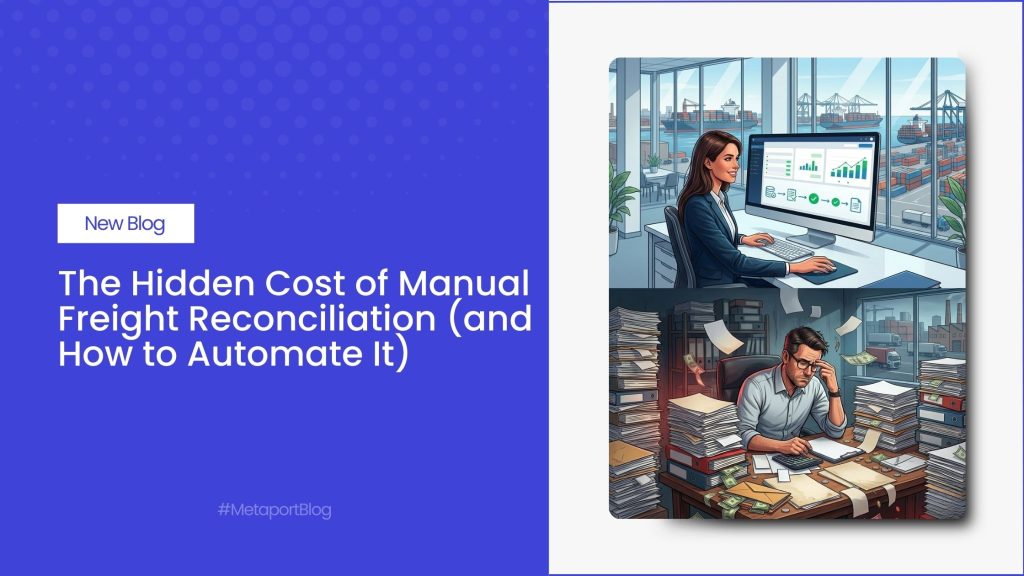
Manual freight reconciliation is one of those back-office processes that quietly bleeds money from your organization. It doesn’t show up as a dramatic line item on your P&L. Instead, it chips away at your margins through overpayments, wasted labour hours, delayed dispute resolution, and missed freight overcharge recovery opportunities.
Industry data suggests that up to 20% of freight invoices contain billing errors. And when you’re processing hundreds or thousands of invoices per month by hand, those errors add up fast.
In this article, we’ll break down the true cost of manual freight reconciliation, explain why freight billing errors are so common, and walk you through how freight reconciliation automation can transform your transportation spend management. Whether you’re a logistics manager drowning in spreadsheets or a CFO looking for smarter ways to optimize supply chain cost management, this guide is for you.
What Is Freight Reconciliation, Exactly?
Before we dive into the costs, let’s get on the same page.
Freight reconciliation is the process of comparing carrier invoices against the rates, services, and charges you actually agreed to. It’s essentially invoice matching at scale. You’re verifying that what a carrier billed you lines up with your contracted rates, the actual shipment details on the bill of lading (BOL), and any accessorial charges that were legitimately incurred.
Think of it like checking your restaurant bill before you pay. Did they charge you for that appetizer you sent back? Is the service charge already included? Now imagine doing that for 5,000 meals a month, each with a different menu and pricing structure. That’s freight bill reconciliation in a nutshell.
The process typically involves:
- Collecting invoices from multiple carriers across different modes (LTL, FTL, parcel, ocean, air)
- Matching each invoice line to the corresponding shipment record
- Validating rates against contracted pricing agreements
- Checking for duplicate freight payments
- Verifying accessorial charge validation (fuel surcharges, liftgate fees, detention charges, etc.)
- Flagging discrepancies for dispute and resolution
- Approving clean invoices for payment
- Coding charges to the correct GL accounts
When done manually, this process is painfully slow, error-prone, and expensive. Let’s look at why.
The Hidden Costs You’re Probably Overlooking
Most companies know that manual freight reconciliation takes time. What they don’t realize is just how many hidden costs are lurking beneath the surface.
1. Freight Billing Errors and Overpayments
Here’s a stat that should make any finance leader uncomfortable: industry studies consistently show that 3% to 5% of total freight spend is lost to billing errors. For a company spending ₹8 crore annually on transportation, that’s ₹24 lakh to ₹40 lakh walking out the door every year.
Common errors include:
- Incorrect weight or classification charges
- Wrong rate tier applied to a shipment
- Duplicate invoices for the same shipment
- Unauthorized accessorial charges like demurrage and detention charges
- Fuel surcharge miscalculations
- Failure to apply negotiated discount rates
Manual processes simply can’t catch all of these. When your team is reviewing invoices one by one in Excel, they’re going to miss things. It’s human nature.
2. Labour Costs That Keep Growing
Manual freight invoice reconciliation is labour-intensive. A single analyst might spend 15 to 20 minutes reconciling one complex invoice. Multiply that across thousands of invoices per month, and you’re looking at entire teams dedicated to a process that adds no strategic value.
Consider this: if you have three full-time employees focused on freight payment reconciliation at an average loaded cost of ₹6 lakh each per annum, that’s ₹18 lakh per year. And that’s before you factor in turnover, training, and the opportunity cost of not having those people work on logistics cost optimization or carrier performance benchmarking.
3. Late Payment Penalties and Strained Carrier Relationships
When reconciliation backlogs pile up, payments get delayed. Late payments lead to penalty fees, strained carrier relationships, and sometimes even service disruptions. Carriers who don’t get paid on time are less likely to prioritize your loads or offer favourable rates during the next negotiation cycle.
In a tight freight market, your carrier relationships are everything. Manual bottlenecks in your freight AP automation process can quietly erode the goodwill you’ve built.
4. Poor Spend Visibility
If your reconciliation data lives in disconnected spreadsheets, you don’t have real-time freight cost visibility. You can’t answer basic questions like:
- What’s our actual cost per shipment by lane?
- Which carriers are consistently overbilling?
- How accurate are our freight accruals?
- Where are the biggest opportunities for freight cost reduction?
Without clean, reconciled data feeding into your analytics, your transportation spend management strategy is built on guesswork. This is where having a robust analytics and reporting layer becomes essential, turning raw shipment data into actionable spend insights.
5. Audit and Compliance Risk
Manual processes are difficult to audit. When there’s no clear digital trail showing who approved what, when, and why, you’re exposed to compliance risk. This is especially problematic for companies subject to statutory audits under the Companies Act or GST compliance requirements.
A missed duplicate payment or an unauthorized charge that slips through can create headaches during internal or external audits.
Why Do Freight Invoices Have So Many Errors?
You might be wondering: if carriers know their rates, why are so many invoices wrong?
The answer is complexity. Modern freight billing involves dozens of variables:
- Multi-modal freight billing across LTL, FTL, parcel, intermodal, and ocean
- Complex accessorial charge structures that vary by carrier and lane
- Frequent rate changes and contract amendments
- Manual data entry on both the shipper and carrier side
- Differences between contracted vs. actual freight rates due to reclassification or reweighing
- EDI (Electronic Data Interchange) freight billing mismatches
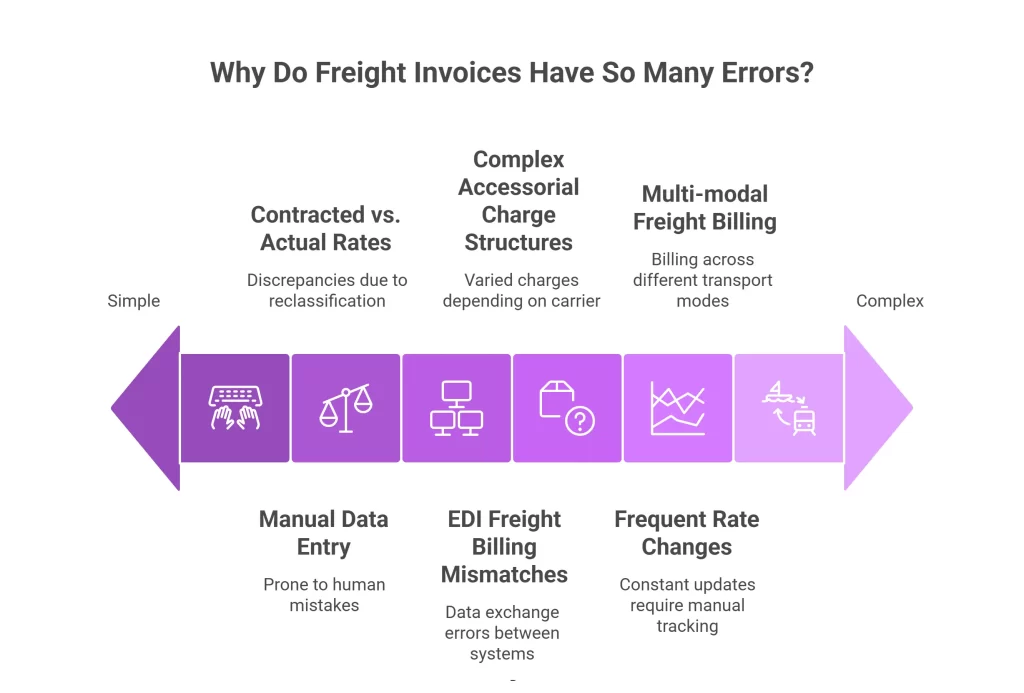
Most billing errors aren’t intentional. They’re the result of complex systems, human mistakes, and a lack of automated rate discrepancy detection on both sides of the transaction.
However, the responsibility for catching those errors falls on you, the shipper. And if you’re relying on manual processes, you’re almost certainly paying more than you should.
How Does Freight Reconciliation Automation Work?
Now for the good news. Freight reconciliation automation has matured significantly in recent years. Modern freight audit software can handle the entire reconciliation workflow with minimal human intervention.
Here’s how it typically works:
Step 1: Invoice Ingestion
The system collects invoices from all your carriers, regardless of format. Whether invoices arrive via EDI, email, PDF, or carrier portals, technologies like OCR for freight invoice processing and machine learning extract the relevant data automatically.
Step 2: Automated Invoice Matching
The software matches each invoice line against your shipment records, purchase orders, and bills of lading. It compares billed charges against your contracted rates, including base rates, fuel surcharges, and accessorial fees.
Step 3: Rate Discrepancy Detection
Any variance between the billed amount and the expected amount is automatically flagged. The system identifies common issues like:
- Overcharges based on incorrect rates
- Duplicate freight payment detection
- Unauthorized accessorial charges
- Weight or classification disputes
Step 4: Exception Management
Flagged invoices are routed to your team for review, but only the exceptions. Clean invoices, which often represent 80% to 90% of the total, are auto-approved and sent to payment. This dramatically reduces the manual workload.
Step 5: GL Coding and ERP Integration
Approved invoices are automatically coded to the correct general ledger accounts and pushed to your ERP or accounting system. This ERP integration for freight billing eliminates manual data entry and ensures freight accrual accuracy. For Indian businesses using Tally, SAP, or Oracle, most modern platforms offer pre-built connectors. You can explore how platforms handle multi-carrier integrations to understand the breadth of connectivity available today.
Step 6: Analytics and Reporting
All reconciled data feeds into dashboards that give you real-time freight cost visibility, freight spend analytics, and carrier performance benchmarking. You can finally see where your money is going and make data-driven freight management decisions.
Platforms like Metaport are building this kind of integrated technology layer for Indian logistics teams, combining automated reconciliation, spend analytics, and carrier management into a single workflow so businesses don’t have to stitch together multiple disconnected tools.
The ROI of Freight Audit Automation
Let’s talk numbers. What kind of return can you expect from automating freight reconciliation?
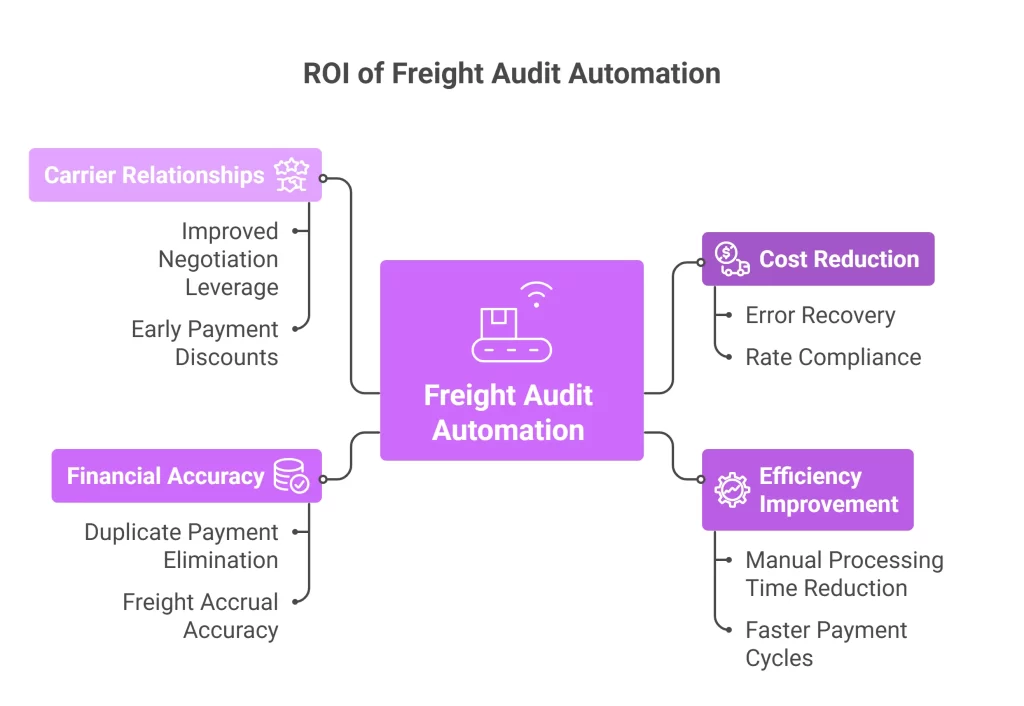
Companies that implement freight audit and payment (FAP) solutions typically see:
- 2% to 5% reduction in overall freight spend through error recovery and rate compliance
- 70% to 90% reduction in manual processing time
- Faster payment cycles, improving carrier relationships and sometimes unlocking early payment discounts
- Near-zero duplicate payments
- Improved freight accrual accuracy, leading to cleaner financial reporting
- Better negotiation leverage with carriers, backed by accurate shipment-level cost tracking data
For a mid-size Indian shipper spending ₹15 crore on freight annually, even a conservative 2% savings through freight overcharge recovery translates to ₹30 lakh per year. Add in labour savings and improved spend visibility, and the ROI becomes hard to ignore.
Can a TMS Handle Freight Reconciliation?
This is a question that comes up often. Many companies already use a Transportation Management System (TMS) and wonder if TMS freight reconciliation capabilities are enough.
The short answer: it depends.
Some TMS platforms offer basic freight bill audit functionality. They can match invoices against planned shipments and flag obvious discrepancies. However, most TMS tools are designed primarily for shipment execution, not deep financial reconciliation.
For robust carrier invoice audit, accessorial charge validation, duplicate detection, and multi-modal freight billing reconciliation, you’ll typically need a dedicated freight audit and payment solution. Many companies use both, with the TMS handling execution and a specialized FAP tool managing the financial reconciliation layer.
The key is ensuring your tools integrate well. Look for solutions that offer seamless connectivity with your TMS, ERP, and accounting systems. If you’re also managing multi-carrier shipping across several providers, having a unified platform that handles both dispatch and reconciliation becomes even more critical.
Freight Payment Outsourcing vs. In-House Automation
Another common decision point: should you outsource freight reconciliation to a third-party freight audit and payment company, or bring automation in-house?
Outsourcing works well for companies that:
- Don’t have the internal resources to manage the process
- Want a hands-off approach
- Are comfortable sharing shipment and rate data with a third party
In-house automation is often preferred by companies that:
- Want full control over their data and processes
- Have complex, custom billing arrangements
- Need real-time integration with internal systems
- Are already investing in supply chain invoice automation
For brands evaluating the broader question of whether to use an aggregator or a SaaS-based logistics platform, this detailed comparison of logistics aggregators vs. SaaS platforms is worth reading. It covers the trade-offs that directly impact how much control you retain over processes like freight reconciliation.
Both approaches can deliver strong results. The worst option is doing nothing and continuing to reconcile freight invoices manually in spreadsheets.
Getting Started: A Practical Roadmap
If you’re ready to move away from manual freight reconciliation, here’s a simple roadmap to get started:
- Audit your current process. Document how many invoices you process monthly, how many people are involved, your average error rate, and your current cost per invoice. This becomes your baseline.
- Quantify the cost. Use the data above to calculate what manual reconciliation is actually costing you in labour, overpayments, and missed savings. Even a rough estimate in lakhs per annum can be eye-opening for leadership.
- Evaluate solutions. Look at freight audit software options that fit your volume, modes, and integration requirements. Consider both SaaS platforms and managed service providers that support Indian carriers and billing formats. Solutions like Metaport are worth exploring if you need a platform built with Indian logistics workflows in mind.
- Start with a pilot. Don’t try to automate everything at once. Pick your highest-volume carrier or most error-prone mode and run a pilot. Measure the results. If courier allocation is part of your challenge, understanding why AI-based courier allocation matters can help you see how automation extends beyond just reconciliation.
- Scale and optimize. Once you’ve proven the value, expand automation across all carriers and modes. Use the freight spend analytics to continuously improve your carrier rate negotiation and logistics cost optimization strategies.
The Bottom Line
Manual freight reconciliation is a hidden tax on your logistics operation. It drains your team’s time, lets billing errors slip through, and keeps you in the dark about your true transportation costs.
The good news is that freight reconciliation automation is more accessible and affordable than ever. Whether you choose to implement freight audit software in-house or partner with a freight audit and payment company, the path to better spend visibility, fewer errors, and significant cost savings is clear.
Every month you delay is another month of overpayments, wasted labour, and missed opportunities for freight cost reduction. The question isn’t whether you can afford to automate. It’s whether you can afford not to.
Frequently Asked Questions
Freight audit is the broader process of reviewing carrier invoices for accuracy, including rate compliance and duplicate detection. Freight reconciliation is the specific step where you match invoiced amounts against expected charges based on contracted rates. The terms are often used interchangeably, but reconciliation is technically the matching component of a full freight audit and payment workflow.
Freight billing errors typically cost shippers between 3% and 5% of total transportation spend. For an Indian company spending ₹12 crore annually on freight, that’s ₹36 lakh to ₹60 lakh lost to overpayments from incorrect rates, unauthorized accessorial charges, and duplicate invoices.
Industry reports suggest up to 20% of freight invoices contain some form of billing error. Error rates tend to be higher for LTL and multi-modal shipments due to complex accessorial charges and variable pricing structures.
Many providers now offer SaaS-based pricing where you pay per transaction or per invoice, removing the need for large upfront costs. Some companies use a gain-share model, taking a percentage of recovered savings only, so there’s minimal financial risk.
Most modern platforms offer pre-built connectors or APIs for ERP systems like SAP, Oracle, NetSuite, and Tally. The integration automates GL coding, pushes approved payments into accounts payable, and syncs shipment-level cost data, eliminating manual entry and improving accrual accuracy.