Picture this: You’ve just launched your eCommerce store, orders are flowing in, and everything seems perfect. Then you get hit with a reality check—half of your shipments are coming back undelivered. Your profits are bleeding, customers are frustrated, and you’re wondering what went wrong.
Welcome to the world of Non-Delivery Reports (NDR) and Return to Origin (RTO)—two terms that can make or break your eCommerce business profitability. If you’re an online seller, understanding these logistics challenges isn’t optional anymore; it’s essential for survival.
In this comprehensive guide, we’ll dive deep into what NDR and RTO actually mean, why they happen, and most importantly, how you can tackle these issues head-on. Whether you’re dealing with failed delivery attempts, undelivered orders, or mounting shipping costs, this article will give you the strategies you need to turn things around.
Let’s get started.
What is a Non-Delivery Report (NDR) in eCommerce?
A Non-Delivery Report (NDR) is essentially a notification from your courier partner that they couldn’t deliver a shipment to the customer. Think of it as a red flag that pops up when something goes wrong during the last-mile delivery process.
When a delivery attempt is unsuccessful, the courier partner raises an NDR with specific reasons—maybe the customer wasn’t available, the address was incomplete, or they refused the package. This gives you a brief window (usually 24-72 hours) to take corrective action before the shipment automatically heads back to you.
Here’s the thing: NDR in eCommerce isn’t just about one failed delivery. It’s a critical decision point that determines whether you’ll successfully complete the sale or lose money on return shipping. Implementing a robust NDR management system can help you handle these situations more effectively.
How Does NDR Work?
The NDR process typically follows these steps:
- Delivery attempt fails – The courier tries to deliver but encounters an issue
- NDR is raised – The courier partner notification goes out to the seller
- Action window opens – You have 1-3 days to resolve the issue
- Reattempt or return – Based on your action (or inaction), the courier either tries again or returns the shipment
Many online seller challenges stem from not having a proper system to manage NDRs quickly. Every hour counts when an NDR is raised.
What is Return to Origin (RTO) in eCommerce?
Return to Origin (RTO) is what happens when all delivery attempts fail, and the shipment makes its way back to your warehouse or pickup location. It’s the final outcome of an unresolved NDR—and it’s expensive.
When we talk about RTO eCommerce, we’re looking at the complete failure of order fulfillment. The customer doesn’t get their product, you’ve paid for shipping twice (forward and reverse), and you’re left with inventory that’s been sitting in transit for days.
The Difference Between NDR and RTO
Here’s a simple way to understand it:
NDR = The problem alert (you can still fix it)
RTO = The problem outcome (it’s too late)
Think of NDR as your smoke detector going off, while RTO is the actual fire damage. One gives you a chance to act; the other is the consequence of inaction or an unresolvable issue.
Common Reasons for NDR in eCommerce
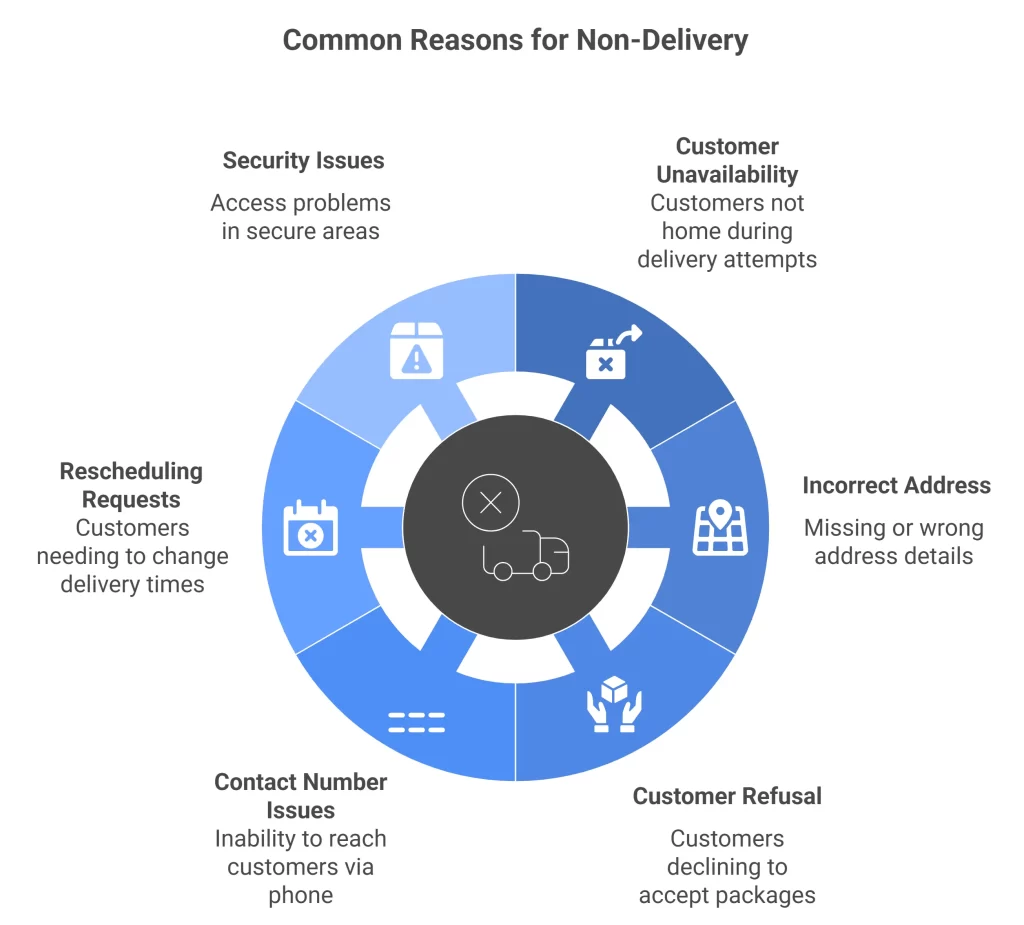
Understanding shipment non-delivery reasons is crucial for prevention. Let’s break down the most common culprits:
1. Customer Unavailability
This is the #1 reason for failed delivery attempts. Customers aren’t always home when the delivery person arrives, especially during working hours. Without proper communication or flexible delivery windows, packages just pile up as delivery exceptions. Using real-time tracking solutions can help keep customers informed about delivery timing.
2. Incorrect or Incomplete Address
Ever tried delivering to “Near the big tree”? Address verification issues cause massive headaches. Missing apartment numbers, wrong pin codes, or vague landmarks lead to courier delivery failure every single time. Implementing pre-shipping verification processes helps catch these errors before shipment.
3. Customer Refusal
Sometimes customers change their mind, order duplicate items by mistake, or simply refuse to accept the package. This is particularly common with COD orders where payment happens at delivery.
4. Contact Number Issues
If the delivery person can’t reach the customer to confirm the delivery, it’s game over. Wrong numbers, switched-off phones, or customers not responding create unnecessary logistics management eCommerce problems.
5. Customer Rescheduling Requests
Customers want to reschedule to a more convenient time, but if the courier partner doesn’t have flexible reattempt delivery options, it results in NDR. Customer engagement tools can facilitate better communication for rescheduling.
6. Security or Access Issues
Gated communities, locked office buildings, or high-security residential areas where the delivery person can’t gain entry without customer assistance.
The Real Cost of NDR and RTO
Let’s talk money—because NDR and RTO impact on your bottom line is brutal.
Direct Financial Losses
When you face an RTO, here’s what you’re paying for:
- Forward shipping charges – Already paid to send the product
- Reverse shipping charges – Paying again to get it back
- Payment gateway fees – Non-refundable processing costs
- Packaging costs – Materials that can’t be reused
- Inventory holding costs – Products tied up in transit
For a typical ₹500 product with ₹100 shipping (both ways), you’re looking at ₹200 loss per RTO—that’s 40% of your product value gone before you even factor in operational costs. Using analytics tools to track these costs helps identify problem areas quickly.
Hidden Operational Costs
Beyond direct expenses, consider:
- Staff time spent managing NDR orders
- Customer service resources handling complaints
- Damaged relationships with courier partners
- Inventory management complications
- Cash flow disruptions especially critical for small businesses
Impact on Business Growth
High RTO rates create a vicious cycle:
- Lower profit margins → Less money for marketing
- Poor delivery experience → Negative reviews
- Strained courier relationships → Higher shipping rates
- Reduced operational efficiency → Slower scaling
According to industry estimates, eCommerce businesses with RTO rates above 20% struggle to maintain profitability. For COD-heavy businesses, this number can climb to 30-40%, making it nearly impossible to sustain operations.
How NDR and RTO Impact eCommerce Business Profitability
The eCommerce business profitability equation is simple: Revenue minus all costs equals profit. When NDR and RTO rates spike, that profit margin shrinks rapidly—or disappears entirely.
The Ripple Effect
Reduced Customer Lifetime Value (CLV): When customers don’t receive their orders smoothly, they’re less likely to return. One bad delivery experience can cost you a customer forever.
Increased Customer Acquisition Costs (CAC): You’re spending money to acquire customers who never complete their purchases. Your marketing ROI tanks when delivery failures are high.
Inventory Turnover Issues: Products stuck in the RTO cycle aren’t generating revenue. They’re occupying warehouse space and tying up working capital that could be used for new inventory.
Competitive Disadvantage
In today’s eCommerce landscape, delivery experience is a key differentiator. When Amazon promises next-day delivery with near-zero failures, your business can’t afford high NDR rates. Customers simply won’t tolerate it. Implementing accurate delivery prediction systems helps set realistic customer expectations.
NDR Management Best Practices
Now for the good news—NDR management doesn’t have to be complicated. Here are proven strategies that work:
1. Implement Automated NDR Communication
Don’t wait for manual intervention. Set up automated SMS, WhatsApp, or email alerts the moment an NDR is raised. Give customers clear options:
- Reschedule delivery
- Update address details
- Confirm availability
- Choose an alternative delivery location
Speed matters. Every hour you delay reduces the chance of successful reattempt delivery. A comprehensive NDR management platform automates these communications instantly.
2. Strengthen Address Verification
Prevention is better than cure. Use:
- Google Maps integration for address validation at checkout
- Pin code serviceability checks before accepting orders
- Mandatory fields for apartment/floor numbers
- Phone verification via OTP before order confirmation
One extra minute at checkout can save you hundreds in RTO costs. Pre-shipping validation tools catch address errors before dispatch.

3. Enhance Pre-Delivery Communication
Keep customers in the loop:
- Send order confirmation with expected delivery date
- Share tracking link proactively
- Send delivery day reminders via SMS/WhatsApp
- Provide courier contact details for real-time coordination
When customers know exactly when their order is arriving, customer unavailability drops significantly. Customer experience platforms make proactive communication seamless.
4. Offer Multiple Delivery Attempts
Work with courier partners who provide:
- 2-3 delivery attempts before RTO
- Flexible time slots for reattempts
- Weekend/evening delivery options
- Nearby pickup point alternatives
Don’t let one failed attempt result in automatic RTO. Smart dispatch allocation helps assign orders to the most reliable courier partners.
5. Create an NDR Action Dashboard
Build or use tools that give you:
- Real-time NDR alerts
- Customer contact automation
- Reason code analysis
- Resolution tracking
- RTO prediction algorithms
Manual NDR management doesn’t scale. You need NDR automation tools to handle volume efficiently. Modern analytics dashboards provide actionable insights for continuous improvement.
How to Reduce RTO Rates in Your Online Business
RTO reduction strategies eCommerce businesses should implement immediately:
Strategy 1: Optimize Your COD Policy
COD orders have notoriously high RTO rates (3-5x higher than prepaid). Consider:
- Setting minimum order values for COD
- Offering prepaid discounts or incentives
- Implementing partial prepayment systems
- Using COD verification calls for high-value orders
You don’t have to eliminate COD entirely, but making prepaid more attractive significantly reduces failed deliveries.
Strategy 2: Build a Customer Risk Profile
Use data to identify high-risk orders:
- First-time buyers (higher RTO risk)
- Certain pin codes with historical high RTO
- Specific product categories
- Order value ranges
For high-risk orders, consider:
- Requiring prepayment
- Making confirmation calls
- Using more reliable courier partners
- Shorter NDR action windows
Strategy 3: Partner with Quality Courier Services
Not all courier partners are created equal. Evaluate based on:
- First-attempt delivery success rates
- NDR communication speed and quality
- Flexibility in reattempt scheduling
- Coverage in your key markets
- Technology integration capabilities
Sometimes paying slightly more for better service saves money in the long run by reducing RTO. Integration capabilities with multiple courier partners give you flexibility to choose the best option per order.
Strategy 4: Implement Smart Packaging
Clear, professional packaging reduces refusals:
- Clearly labeled packages with brand identity
- Accurate product descriptions on labels
- Tamper-proof packaging for high-value items
- QR codes for easy customer verification
First impressions matter even in shipping.
Strategy 5: Use Data-Driven Decision Making
Track and analyze:
- NDR reasons by category
- RTO rates by pin code, courier, product type
- Time-to-resolution for NDRs
- Success rates of different intervention methods
- Seasonal patterns in delivery failures
What gets measured gets managed. Use insights to continuously reduce RTO rates.
Technology Solutions for NDR Management
Modern logistics management eCommerce relies heavily on technology. Here are tools that make a difference:
AI-Powered Prediction Tools
Machine learning algorithms can:
- Predict RTO likelihood before shipment
- Recommend optimal courier partners per order
- Identify fraudulent or high-risk orders
- Automate customer communication timing
Integrated Communication Platforms
Unified systems that connect:
- Your eCommerce platform
- Courier partner APIs
- Customer communication channels (SMS, email, WhatsApp)
- CRM for customer history
Everything in one place means faster response times and better delivery exception management.
Real-Time Tracking and Alerts
Modern tracking goes beyond “out for delivery”:
- Live location sharing with customers
- Predictive ETAs based on traffic
- Proactive delay notifications
- Two-way communication with delivery personnel
Analytics Dashboards
Visualization tools that show:
- NDR and RTO trends over time
- Performance metrics by courier
- Financial impact calculations
- Actionable insights for improvement
Conclusion: Taking Control of Your Delivery Success
NDR in eCommerce and Return to Origin aren’t just logistics terms—they’re critical business metrics that directly impact your profitability, customer satisfaction, and long-term sustainability. The difference between thriving eCommerce businesses and struggling ones often comes down to how well they manage these last-mile delivery problems.
Remember: Every NDR is an opportunity, not a failure. It’s a chance to save the sale, improve your processes, and build better customer relationships. But you need the right systems, tools, and strategies in place to act quickly and effectively.
Start by implementing these foundational steps:
- Audit your current NDR and RTO rates – Know where you stand
- Identify your biggest problem areas – Pin codes, courier partners, or customer segments causing issues
- Set up automated communication systems – Speed is everything
- Strengthen your address verification – Prevention beats cure
- Invest in the right technology – Manual processes don’t scale
Ready to Transform Your Delivery Success?
Don’t let poor delivery management kill your eCommerce dreams. Whether you’re facing mounting RTO costs or struggling with undelivered orders, the time to act is now.
Explore AI-powered logistics management tools that can automate your NDR handling, predict potential failures before they happen, and give you real-time visibility into every shipment. The right technology can cut your RTO rates in half while improving customer satisfaction.
Discover how MetaPort’s NDR management solution can help you reduce RTO rates by up to 60% with automated workflows, intelligent customer engagement, and real-time analytics. Contact us to learn more about transforming your delivery operations.
Your delivery experience is your brand experience. Make it exceptional.
Frequently Asked Questions (FAQs)
NDR (Non-Delivery Report) is a notification when delivery fails, giving you 24-72 hours to fix the issue. RTO (Return to Origin) happens when the delivery cannot be completed and the shipment returns to you. NDR is your warning to act; RTO is the costly consequence if you don’t resolve it quickly.
Focus on address verification at checkout, send proactive delivery communications, offer prepaid incentives, and set up automated NDR management systems. Most importantly, respond to NDRs within hours—not days. Speed is critical for preventing returns and improving successful delivery rates.
The top reasons include customer unavailability, incorrect addresses, package refusals (especially COD orders), unreachable phone numbers, and access issues in gated communities. Understanding these causes helps you implement targeted solutions like better address validation and flexible delivery windows.
For a ₹500 product, you could lose ₹150-250 per RTO (30-50% of product value) including forward/reverse shipping, payment gateway fees, and packaging costs. Hidden costs like staff time, customer service resources, and lost customer lifetime value make it even worse. Businesses with RTO rates above 20% often struggle with profitability.
Yes! NDR automation tools provide instant alerts, automatically contact customers via SMS/WhatsApp/email, and trigger reattempt requests within minutes. Manual processes are too slow—automated systems increase successful delivery rates by 40-60% by responding before the optimal action window closes.









Hi, this is a comment.
To get started with moderating, editing, and deleting comments, please visit the Comments screen in the dashboard.
Commenter avatars come from Gravatar.