Let’s be honest. If you’ve been running a D2C brand for any length of time, you’ve probably had that moment. The one where a customer messages you furious about a delayed order, and you check the tracking only to find your courier aggregator has zero useful updates. You’re stuck. You can’t call the courier directly. You can’t escalate meaningfully. You’re just… waiting. This is exactly why the BYOC (Bring Your Own Courier) model is gaining serious traction in 2026, as more brands are moving away from aggregators in search of real logistics control.
Modern D2C brands are bypassing shipping aggregator platforms entirely and building their own direct courier relationships. It’s a shift that’s reshaping ecommerce logistics, and if you’re still relying solely on an aggregator, it’s worth understanding why. Brands that adopt the direct-to-consumer model want full control over their operations, from pricing and customer experience to shipping and delivery speed. The BYOC shipping model fits perfectly into that philosophy.
In this article, we’ll break down what the bring your own courier model actually means, why brands are moving away from aggregators, the real benefits (and challenges) of BYOC logistics, and how you can implement it for your own brand. Let’s get into it.
What Is BYOC (Bring Your Own Courier) in Ecommerce?
At its core, BYOC logistics is simple: instead of relying on a courier aggregator to assign and manage your shipping partners, you negotiate directly with couriers, onboard them yourself, and integrate them into your own logistics tech stack.
Think of it like this. A courier aggregator is like a travel agent who books flights for you. They handle the relationship with the airline, and you just pay a fee. BYOC is like booking directly with the airline, getting loyalty perks, choosing your own seat, and having a direct line to customer service if something goes wrong. If you want a deeper dive into how these two models compare, check out this detailed logistics aggregator vs. SaaS platform guide.
With the BYOC ecommerce shipping approach, brands typically:
- Negotiate shipping rates directly with courier partners
- Integrate courier APIs into their order management system
- Use a multi-carrier shipping software or logistics SaaS platform to manage operations
- Maintain full control over carrier performance tracking and delivery SLAs
It’s not about doing everything manually. It’s about owning the relationship and the data. Platforms like MetaPort are specifically built to support this model, giving brands the infrastructure to manage their own courier partnerships without the aggregator middleman.
Why Are D2C Brands Moving Away from Courier Aggregators?
This is the million-dollar question. Aggregators built their businesses on a compelling promise: simplified shipping for everyone. And for a long time, that worked. But as D2C brands scale, cracks start to show. The BYOC bring your own courier approach directly addresses these pain points.
Here’s what’s driving the shift.
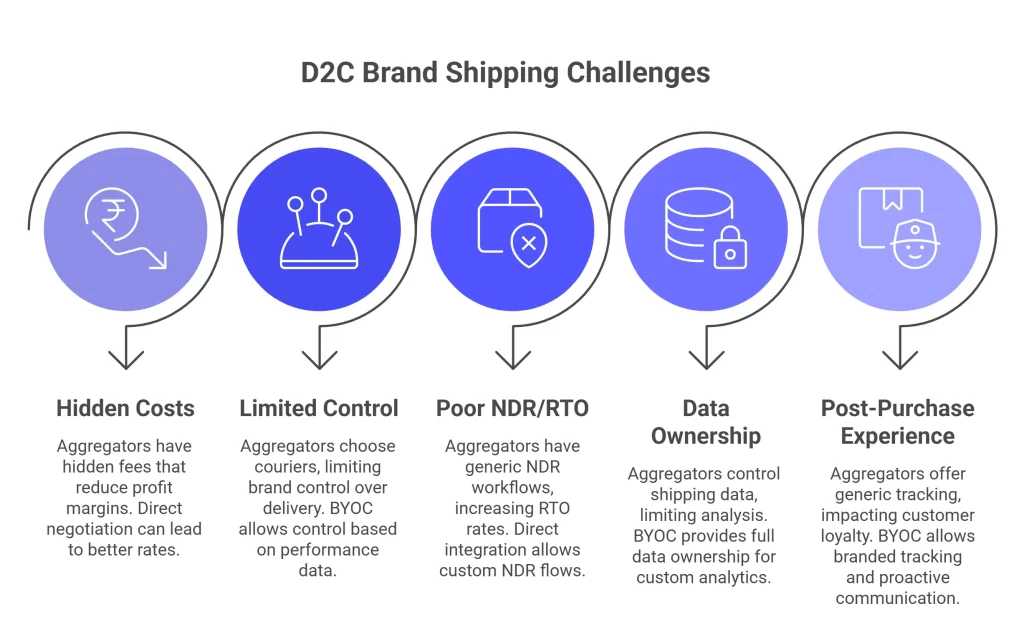
1. Hidden Costs That Eat Into Margins
One of the biggest complaints about aggregators is the lack of pricing transparency. Sure, you get “discounted” rates. But those discounts come with platform fees, weight discrepancy charges, and COD reconciliation delays that quietly chip away at your margins. To understand just how much these invisible costs add up, read about the hidden cost of manual freight reconciliation and how to automate it.
When brands negotiate directly, they often discover they can get better rates than what aggregators offer, especially at higher volumes. The middleman markup disappears, and suddenly shipping cost optimization becomes a real possibility.
2. Limited Control Over Last Mile Delivery
Aggregators decide which courier handles your shipment. That means you have little say over who’s delivering your product to your customer’s doorstep. If a particular courier has poor performance in a specific pin code, tough luck. The aggregator’s algorithm made the call.
With the bring your own courier model, you control the courier allocation engine. You decide which partner handles which region based on real performance data, not the aggregator’s commercial arrangements. Learn how smart dispatch and allocation works in practice.
3. Poor NDR and RTO Management
If you’ve dealt with high RTO (Return to Origin) rates, you know the pain. Every returned shipment is money lost. Aggregators often have generic NDR (Non-Delivery Report) management workflows that don’t allow for brand-specific interventions. If you’re unfamiliar with these terms or want to understand their full impact, here’s a comprehensive explainer on what NDR and RTO mean in ecommerce.
Direct courier integration lets you build custom NDR flows. You can trigger automated calls, WhatsApp messages, or reattempt deliveries on your terms. Brands that switch to BYOC consistently report a measurable reduction in RTO rates because they can act faster and more specifically. Tools like MetaPort’s NDR management system make this process seamless.
4. Data Ownership and Shipment Visibility
When you use an aggregator, your shipping data lives on their platform. You’re dependent on their dashboards, their reports, and their analytics. If you want to do deep analysis on carrier performance tracking or delivery SLA compliance, you’re often limited.
BYOC gives you full data ownership. You can build custom dashboards, run your own analytics, and make decisions based on your data, not a filtered version of it.
5. The Post-Purchase Experience Gap
Here’s something many brands overlook. The post-purchase customer experience is a massive loyalty driver. Customers don’t just want their package. They want real-time shipment visibility and tracking, branded tracking pages, and proactive communication.
Aggregators offer generic tracking pages. With BYOC and the right logistics platform, you can create a fully branded tracking experience that reinforces your identity and reduces “Where is my order?” support tickets by up to 40%. Discover how last mile customer experience can become your competitive edge.
How Does the BYOC Model Work in Ecommerce Logistics?
Let’s walk through the practical mechanics. Implementing a BYOC bring your own courier strategy isn’t as complicated as it sounds, but it does require some upfront effort.
Step 1: Identify and Negotiate With Courier Partners
Start by identifying the best courier partners for your D2C brand based on your shipping volumes, geographic coverage, and product type. Reach out directly. Most couriers, including Delhivery, BlueDart, Ecom Express, and regional players, are happy to work directly with brands that have decent volume.
Negotiate rates, delivery SLAs, weight slab structures, and COD remittance cycles. You’ll be surprised how flexible couriers can be when there’s no aggregator in the middle.
Step 2: Integrate via Direct Shipping API
Once you’ve finalized your courier partners, integrate them using their courier API integration. Most modern couriers offer well-documented APIs for order creation, tracking, cancellation, and returns.
If you’re on Shopify, WooCommerce, or a custom platform, there are plugins and middleware solutions that make this process smoother. Check out MetaPort’s integrations page to see how many courier and platform connections are available out of the box. The goal is seamless shipping partner integration without manual data entry.
Step 3: Use a Multi-Courier Management Platform
This is where the magic happens. You don’t need an aggregator to manage multiple couriers. Instead, use a multi-carrier shipping software or logistics SaaS platform that supports BYOC. For a deeper understanding of how this works, explore this guide on multi-carrier shipping.
These platforms allow you to bring your own courier contracts while still getting features like:
- Automated courier allocation based on performance data
- Unified tracking dashboard
- NDR management workflows
- Branded tracking pages
- Reverse logistics management
- COD reconciliation tools
Think of it as the control panel for your brand-owned delivery network without the aggregator tax.
Step 4: Monitor, Optimize, Repeat
Once live, continuously monitor carrier performance. Track metrics like delivery success rates, average delivery time, RTO percentages, and customer complaints per courier. Use this data to optimize your courier allocation engine and hold partners accountable to their SLAs.
This feedback loop is something aggregators rarely provide at a granular level. With BYOC, it becomes your competitive advantage.
Courier Aggregator vs. Direct Courier: A Side-by-Side Comparison
| Factor | Courier Aggregator | BYOC (Direct Courier) |
|---|---|---|
| Pricing | Bundled with platform markup | Directly negotiated, often lower |
| Courier Selection | Algorithm-driven, limited control | Brand-controlled, data-driven |
| Data Ownership | Platform-dependent | Fully owned by the brand |
| NDR/RTO Management | Generic workflows | Custom, brand-specific flows |
| Tracking Experience | Generic tracking page | Branded tracking page |
| Scalability | Easy to start, hard to customize | Requires setup, highly scalable |
| Supply Chain Control | Low | High |
| Onboarding Effort | Minimal | Moderate (one-time) |
For brands at an early stage with low volumes, aggregators still make sense. But once you’re shipping hundreds or thousands of orders daily, the BYOC bring your own courier model starts delivering clear advantages.
What Tools Help Brands Implement a BYOC Shipping Strategy?
You don’t have to build everything from scratch. The ecommerce logistics tech stack has matured significantly, and several platforms are designed specifically for brands that want logistics independence.
Here are the categories of tools you’ll need:
- Multi-Carrier Shipping Software: Platforms that let you plug in your own courier contracts and manage everything from one dashboard. Look for features like AI-based courier selection for ecommerce, automated label generation, and unified tracking. Learn more about why AI courier allocation is crucial for ecommerce brands.
- Courier API Middleware: If you’re on Shopify or WooCommerce, middleware solutions and plugins can handle the direct shipping API integration without heavy development work.
- Shipping Automation Tools: Automate order processing, courier assignment, label printing, and manifest generation. This is critical for scaling without adding headcount.
- Analytics and Reporting Platforms: Dedicated tools for carrier performance tracking, delivery SLA monitoring, and cost analysis. Some multi-courier platforms include this natively.
- Customer Communication Tools: For proactive delivery updates via SMS, email, or WhatsApp. This directly improves the post-purchase customer experience and reduces support load.
The combination of these tools essentially replicates everything an aggregator does, but on your terms, with your data, and at your negotiated rates.
How Can Brands Reduce Shipping Costs Without Aggregators?
This is one of the most common concerns. “Won’t I lose the volume discounts that aggregators provide?”
Not necessarily. Here’s why:
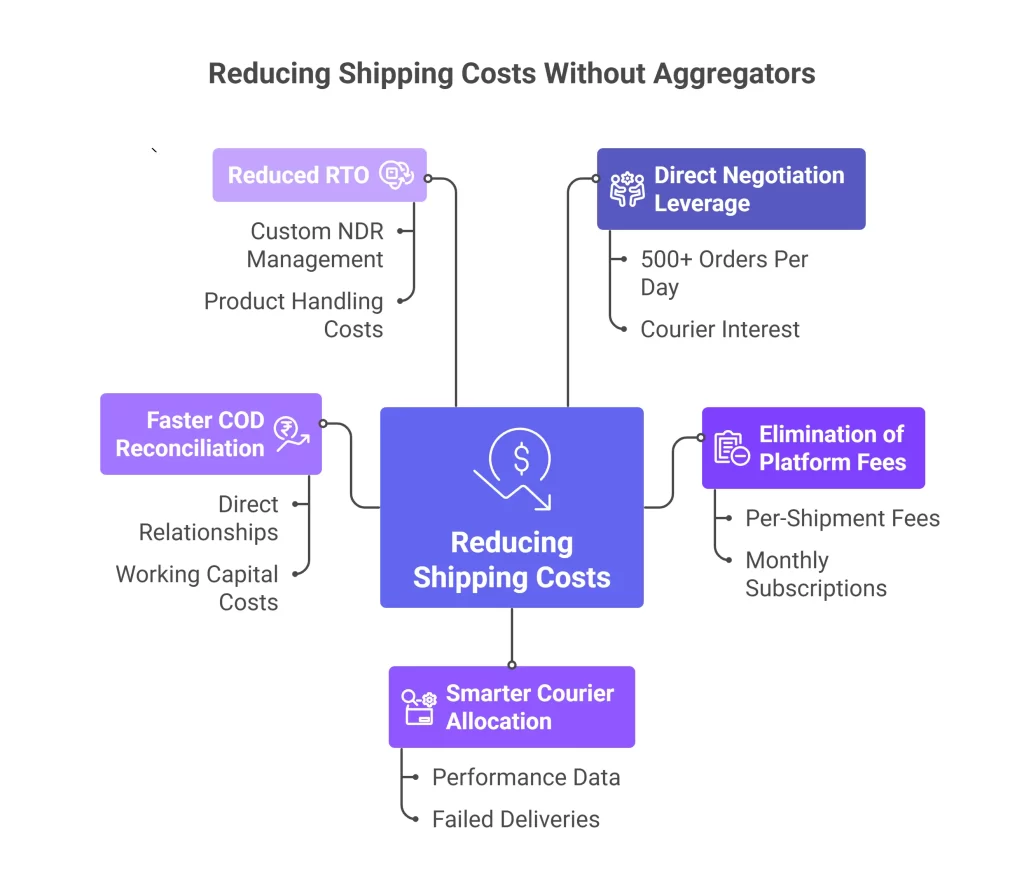
- Direct negotiation leverage: If you’re shipping 500+ orders per day, couriers want your business. You can often negotiate rates that match or beat aggregator pricing.
- Elimination of platform fees: Aggregators charge per-shipment fees or monthly subscriptions. Remove those, and your effective per-shipment cost drops.
- Smarter courier allocation: By using performance data to assign the right courier for each shipment, you reduce failed deliveries, which are a hidden but significant cost.
- Faster COD reconciliation: Direct relationships mean faster remittance cycles. Better cash flow means lower working capital costs.
- Reduced RTO: Custom NDR management and better courier selection directly translate to fewer returns, saving you both shipping and product handling costs.
The math usually works out in favor of BYOC once you cross a certain volume threshold. For most brands, that threshold is somewhere between 200 and 500 daily orders.
Is BYOC Right for Every Brand?
Let’s be fair. The BYOC model isn’t a universal solution. If you’re a small brand just starting out with 10 to 20 orders a day, an aggregator is probably the smarter choice. You need simplicity, and you don’t have the volume to negotiate meaningful direct rates.
However, if you’re a growing D2C brand that’s experiencing any of these symptoms, it might be time to explore courier aggregator alternatives:
- Rising RTO rates that your aggregator can’t help you control
- Lack of visibility into why deliveries are failing in specific regions
- Customer complaints about delivery experience that you can’t address
- Shipping costs that keep climbing despite growing volume
- Dependence on a single platform for a critical part of your business
The transition doesn’t have to be all-or-nothing either. Many brands start by onboarding one or two direct courier partnerships alongside their aggregator, testing performance, and gradually shifting volume as they build confidence.
Ecommerce Shipping Trends in 2026: Where BYOC Fits
The broader trend in ecommerce fulfillment strategy 2026 is clear: brands want more control. Control over their supply chain, their customer experience, and their data.
We’re seeing several converging trends:
- AI-based courier selection is becoming mainstream, allowing brands to automatically pick the best courier for each order based on real-time performance data.
- White-label courier solutions are emerging, where brands can offer delivery under their own name.
- Reverse logistics is getting its own dedicated tech stack, separate from forward shipping.
- Hyperlocal delivery partners are being integrated alongside national couriers for same-day and next-day delivery.
All of these trends favor the BYOC model because they require flexibility, direct integration, and data access that aggregators typically don’t provide.
Conclusion
The shift toward BYOC (Bring Your Own Courier) isn’t just a logistics trend. It’s a strategic move by modern brands to take control of one of the most critical touchpoints in the customer journey: delivery.
Aggregators served their purpose. They democratized ecommerce shipping and made it accessible to everyone. But as brands mature, the limitations become bottlenecks. Hidden costs, limited control, generic experiences, and data dependency all add up.
The BYOC shipping model offers a clear path forward: better rates, stronger courier relationships, superior delivery performance, and a post-purchase experience that actually builds loyalty.
If you’re shipping at scale and still relying entirely on an aggregator, it’s worth asking yourself: what would change if you owned your courier relationships directly?
The answer, for most brands, is quite a lot. Ready to explore the BYOC model for your brand? Get in touch with MetaPort to see how you can take control of your logistics today.
Frequently Asked Questions (FAQs)
A courier aggregator acts as a middleman with pre-negotiated courier contracts and manages shipping on your behalf. A BYOC-supporting logistics platform lets you bring your own courier contracts while providing tools for multi-courier management, tracking, and automation. The key difference is who owns the courier relationship and the data.
Brands use multi-carrier shipping software that offers unified dashboards for courier API integration, automated allocation, shipment tracking, NDR management, and reverse logistics. The brand maintains direct contracts with each courier and uses the platform purely as an operational layer.
Small brands with very low volumes typically benefit more from aggregators due to simplicity and pooled rates. However, even smaller brands can adopt a hybrid approach, maintaining an aggregator while building one or two direct courier tie-ups for high-volume regions and gradually transitioning as they scale.
BYOC enables brands to build custom NDR workflows, including automated reattempts, WhatsApp-based address corrections, and proactive delivery confirmations. Direct access to courier operations teams means faster escalations, which significantly reduces failed deliveries and RTO rates.
AI-based courier selection uses historical delivery data, pin code performance, and real-time factors to assign the optimal courier for each shipment. In a BYOC setup, this is especially powerful because the brand owns all performance data, leading to better SLA compliance, lower costs, and improved customer experience.