“Where is my order?” If you run an ecommerce store in India, that question probably haunts your support inbox daily. The good news is branded tracking reduce WISMO tickets dramatically when implemented correctly. By pairing branded tracking pages with real-time shipment updates and proactive notifications, Indian D2C brands are slashing WISMO volume by 60 percent or more within just 60 days. Some have even reported drops as high as 73 percent.
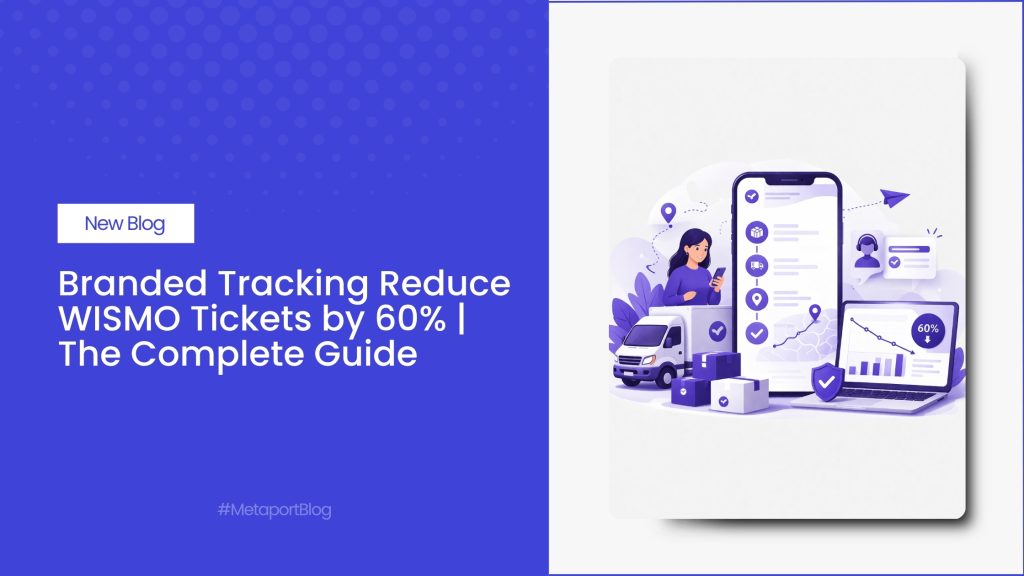
WISMO is responsible for 30 to 50 percent of all ecommerce support tickets. That’s expensive, exhausting, and entirely avoidable. In this article, we’ll break down exactly why WISMO queries pile up, how branded tracking reduce WISMO at the root cause, and what steps you can take today to cut your support ticket volume while improving the post-purchase experience your customers remember.
What Is WISMO and Why Should You Care?
WISMO stands for “Where Is My Order?” It’s the single most common question ecommerce support teams What Is WISMO and Why Should You Care?
WISMO stands for “Where Is My Order?” It’s the single most common question ecommerce support teams face. Customers place an order, receive a confirmation email, and then… silence. The package enters a black hole somewhere between the warehouse and their doorstep.That silence creates order anxiety. And anxious customers do what anyone would do. Some reach out via email. Others open live chat. A few pick up the phone and call. Sometimes they do all three. Sometimes they do all three. In India, where COD orders add another layer of complexity and customers are used to WhatsApp-speed communication, this anxiety hits even harder.Here’s what makes WISMO so costly:
- Each support ticket costs between ₹150 and ₹500 to resolve depending on the channel.
- WISMO queries account for 30 to 50 percent of total support volume.
- They don’t require expertise to answer. They just need information that should already be available.
As Gartner’s customer service research highlights:
“By 2025, proactive customer engagement interactions will outnumber reactive customer engagement interactions, as organisations realise that resolving issues before customers notice them dramatically reduces service costs and improves satisfaction.” — Gartner, Customer Service and Support Predictions
The real problem isn’t that customers are impatient. The problem is that most ecommerce brands hand off the customer experience post-purchase to carriers. And carriers like Delhivery, BlueDart, Ecom Express, or DTDC don’t care about your brand. They care about delivering packages. Understanding the full scope of NDR and RTO challenges in ecommerce helps illustrate just how much post-purchase friction impacts your bottom line.
Why Generic Carrier Tracking Fails and Branded Tracking Reduce WISMO
When a customer clicks a tracking link and lands on a carrier’s website, something subtle but important happens. They leave your brand entirely.
The page looks nothing like your store. The language is technical. The updates are vague. “In transit” could mean the package is 10 kilometres away or sitting in a sorting hub in another city.
This is the core difference between carrier tracking vs branded tracking. Carrier pages offer minimal information wrapped in someone else’s branding. Branded tracking pages keep the customer inside your ecosystem with clear, real-time updates they can actually understand. That’s precisely why branded tracking reduce WISMO so effectively.
Think of it this way. Your brand spends lakhs on performance marketing to acquire a customer. The storefront is beautifully crafted on Shopify or a custom platform. Every product description is written to convert. Then the moment they buy, you send them to a plain tracking page on a courier’s website. Then the moment they buy, you send them to a plain tracking page on a courier’s website. That’s a missed opportunity.A branded tracking page fixes this by:
- Displaying your logo, colours, and messaging
- Showing real-time delivery status notifications in plain language
- Providing estimated delivery dates that update dynamically
- Offering product recommendations and upsell opportunities
- Keeping the customer on your domain instead of a carrier’s site
It’s not just about aesthetics. It’s about shipment visibility and trust. When customers can see exactly where their package is, in an environment they recognise, they don’t need to contact support.
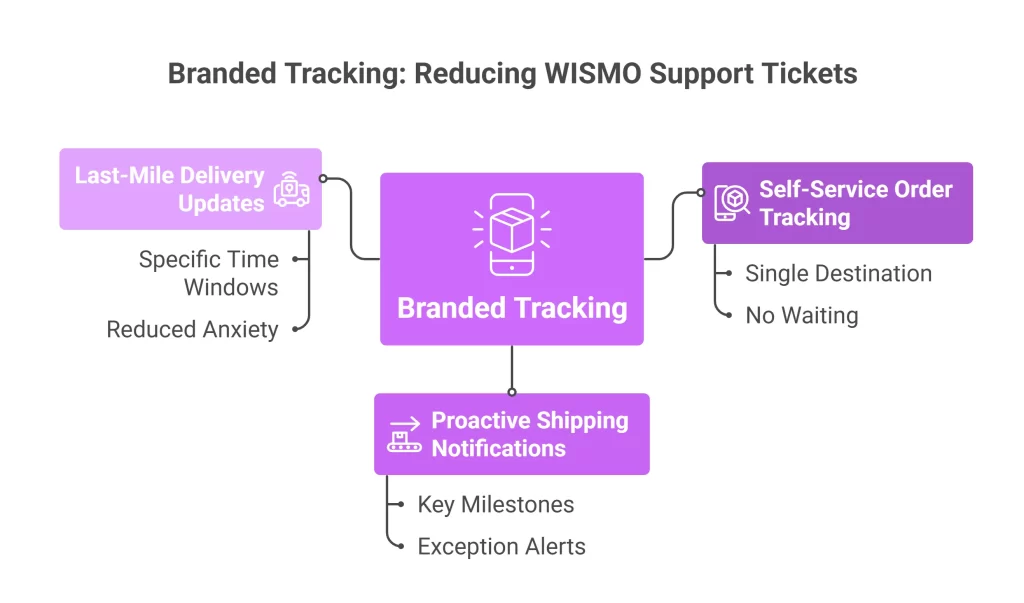
How Branded Tracking Reduce WISMO: The 3 Core Mechanisms
So how does a branded tracking page actually cut WISMO support tickets by 60 percent? It comes down to three mechanisms working together.
1. Self-Service Order Tracking That Deflects WISMO Tickets
Most WISMO tickets exist because customers can’t find answers on their own. A branded tracking page gives them a single destination where they can check their order status 24/7. No waiting for an agent. No digging through emails. Just a clean, updated page with everything they need.Self-service order tracking is the simplest form of support ticket deflection. You’re not solving the problem faster. You’re eliminating the problem entirely.
2. Proactive Shipping Notifications
Here’s a stat that might surprise you. 60 percent of WISMO tickets occur within 24 hours of scan inactivity. That means the package hasn’t actually been scanned or updated in a day, and the customer panics.
Proactive shipping notifications solve this by sending automated updates via email, SMS, or WhatsApp at every key milestone. Shipped. In transit. Out for delivery. Delivered. And critically, when there’s a delay.
Proactive exception alerts are especially powerful. When you message a customer first to say, “Hey, your package is running a day behind due to weather in your region,” you completely remove their reason to open a ticket. You’ve answered the question before they asked it.
Brands using proactive, brand-owned notifications report 60 to 70 percent WISMO reduction within 60 days. Some platforms even report up to 90 percent reduction when combining notifications with branded tracking pages.
3. Last-Mile Delivery Updates
The last-mile delivery stage is where WISMO anxiety peaks. The package is close. The customer is excited. Every hour without an update feels like an eternity. In India, where last-mile logistics across Tier 2 and Tier 3 cities can be unpredictable, this anxiety is amplified.
Branded tracking pages that show last-mile delivery updates with specific time windows dramatically reduce this anxiety. Instead of “Out for delivery,” the customer sees “Arriving between 2:00 PM and 4:00 PM today.” That specificity makes all the difference. Brands looking to turn last-mile delivery into a true competitive advantage should explore how last-mile CX can become your competitive edge.
Branded Tracking Reduce WISMO: Impact by the Numbers
To truly understand the scale of the WISMO problem and the ROI of solving it, here’s a breakdown for a typical Indian D2C brand:
| Metric | Before Branded Tracking | After Branded Tracking (60 Days) |
|---|---|---|
| Monthly support tickets | 5,000 | 5,000 |
| WISMO share of tickets | 40% (2,000 tickets) | 16% (800 tickets) |
| Cost per WISMO ticket | ₹250 | ₹250 |
| Monthly WISMO cost | ₹5,00,000 | ₹2,00,000 |
| Monthly savings | — | ₹3,00,000 |
| Annual savings | — | ₹36,00,000 |
| Average CSAT score | 3.2 / 5 | 4.4 / 5 |
| Repeat purchase rate | 18% | 27% |
| Tracking page conversion (upsell) | 0% | 3–5% |
Note: Figures are based on industry benchmarks for Indian D2C brands processing 10,000–50,000 orders per month. Individual results vary based on carrier mix, product category, and notification strategy.
The numbers speak for themselves. This isn’t a marginal improvement. It’s a fundamental shift in how your support team spends its time and how your customers experience your brand after checkout.
What a Great Branded Tracking Page Looks Like
Not all branded tracking pages are created equal. The best ones share a few common elements that What a Great Branded Tracking Page Looks Like
Not all branded tracking pages are created equal. The best ones share a few common elements that maximise shipment visibility and minimise support tickets.Essential features include:
- Your brand identity across the entire page including logo, fonts, and colours
- Real-time tracking timeline showing each milestone from fulfilment to delivery
- Estimated delivery date that updates dynamically based on carrier data
- Multi-carrier tracking page support for stores using more than one shipping provider
- Product recommendations to drive repeat purchases while the customer is engaged
- Marketing banners for promotions, loyalty programmes, or social media links
- Mobile-responsive design since the vast majority of Indian customers check tracking on their phones
The goal is to create an on-brand tracking experience that feels like a natural extension of your store. Not an afterthought. Not a redirect. A destination. If your store ships through multiple carriers, having a robust multi-carrier shipping setup is essential to powering a unified branded tracking experience.
Smart Courier Allocation: How It Helps Branded Tracking Reduce WISMO Further
Here’s something most articles about WISMO overlook. The carrier you choose for each shipment directly impacts how many tracking updates the customer receives and how accurate those updates are.
Not all carriers perform equally across all pin codes, product categories, or delivery speeds. A courier that delivers reliably in Mumbai might struggle with serviceability in Northeast India. When you use AI-powered courier allocation, each order gets matched to the carrier most likely to deliver on time with the best tracking coverage for that specific route.
Fewer delivery failures mean fewer WISMO tickets. Better tracking coverage means more proactive updates. It’s a virtuous cycle that amplifies how branded tracking reduce WISMO when paired with intelligent dispatch. Learn more about why AI courier allocation is crucial for ecommerce brands.
Why Branded Tracking Reduce WISMO Best for Indian D2C Brands
If you’re running a Shopify store or a custom-built D2C storefront in India, several solutions make it straightforward to set up branded order tracking without heavy development effort.Popular approaches include:
- SaaS logistics platforms that offer built-in branded tracking pages with multi-carrier support, proactive notifications, and analytics dashboards.
- Standalone tracking apps like ParcelPanel, AfterShip, or Malomo that plug into Shopify. One merchant using ParcelPanel reported a 73 percent drop in WISMO tickets.
- Full-stack shipping platforms that combine courier allocation, tracking, NDR management, and CX engagement under one roof.
For Indian D2C brands shipping thousands of orders monthly across diverse pin codes, the third option often makes the most sense. You need a solution that handles Delhivery, BlueDart, Ecom Express, Shadowfax, and dozens of other regional carriers seamlessly.As a Forrester Research report on customer experience noted:
“Brands that invest in post-purchase experience see up to 2.4x higher customer lifetime value compared to those that treat the journey as complete at checkout. The tracking page is the most visited post-purchase touchpoint and the most underleveraged.” — Forrester, The Post-Purchase Experience Gap Report
If you’re evaluating whether a logistics aggregator or a SaaS platform is the right fit for your tech stack, this logistics aggregator vs SaaS platform guide breaks down the pros and cons clearly.
The ROI of Reducing WISMO Tickets
Let’s dig deeper into the financial impact. Because reducing WISMO isn’t just about happier customers. It’s about real money.Suppose your D2C store handles 5,000 support tickets per month. If 40 percent are WISMO-related, that’s 2,000 tickets. At an average cost of ₹250 per ticket, you’re spending ₹5,00,000 per month just answering “Where is my order?”A 60 percent reduction brings that down to 800 tickets. That saves you ₹3,00,000 per month or over ₹36,00,000 per year. For a growing D2C brand, that’s the budget for an entire marketing campaign or a new product launch.Additional ROI drivers include:
- Higher NPS and CSAT scores because customers feel informed and cared for
- Improved repeat purchase rate since a positive post-purchase experience drives loyalty
- Reduced agent burnout by freeing your team to handle complex issues that actually need human attention
- Increased revenue from tracking page upsells through product recommendations shown during high-engagement moments
- Lower RTO rates because informed customers are less likely to refuse delivery
And if you’re still reconciling freight costs manually, you’re leaving even more money on the table. Here’s how to tackle the hidden cost of manual freight reconciliation.
5 Steps to Implement Branded Tracking and Reduce WISMO
Ready to slash your WISMO volume and transform your post-purchase experience? Here’s a practical roadmap.
Step 1: Audit Your Current WISMO Volume Pull data from your helpdesk. Tag tickets related to order status, shipping updates, and delivery inquiries. Establish your WISMO rate benchmark so you can measure improvement. Most Indian D2C brands are shocked to discover WISMO accounts for 40 percent or more of their total ticket volume.
Step 2: Choose a Branded Tracking Platform Evaluate tools based on your ecommerce platform, carrier mix, and customisation needs. For Indian brands, ensure the platform supports all major domestic carriers and offers WhatsApp notification capabilities alongside email and SMS.
Step 3: Design Your Branded Tracking Page Match your store’s look and feel. Add your logo, brand colours, and messaging. Include product recommendations and marketing banners. Ensure the page is mobile-responsive since over 80 percent of Indian ecommerce traffic comes from smartphones.
Step 4: Set Up Proactive Shipping Notifications Configure automated messages for key milestones across email, SMS, and WhatsApp. Don’t forget proactive exception alerts for delays, failed deliveries, and scan inactivity. In India, WhatsApp notifications see significantly higher open rates than email, so prioritise that channel.
Step 5: Monitor, Measure, and Optimise Track your WISMO ticket volume weekly. Monitor tracking page engagement. A/B test notification timing and messaging. Most brands see significant results within 60 days, but continuous optimisation keeps the numbers improving.
Common Mistakes That Stop Branded Tracking Reduce WISMO Results
Even with the right tools, some brands don’t see the full benefit. Here are pitfalls to watch for.
- Not sending delay notifications. Happy-path updates are easy. But the real ticket deflection happens when you proactively communicate problems. Indian logistics is unpredictable. Own that communication.
- Ignoring mobile optimisation. The overwhelming majority of Indian shoppers track orders on their phones. If your page doesn’t load well on a ₹10,000 smartphone with patchy 4G, customers will call instead.
- Forgetting about multi-carrier support. If you use multiple shipping providers, your tracking page needs to aggregate data from all of them into a single multi-carrier tracking page.
- Skipping WhatsApp as a channel. In India, WhatsApp is the default communication app. Not offering tracking updates on WhatsApp is leaving your most effective channel unused.
- Treating it as a set-and-forget project. Your post-purchase communication and tracking page should evolve based on customer feedback and performance data.
The Bigger Picture: Post-Purchase as a Growth Channel
Reducing WISMO tickets is a compelling reason to invest in branded tracking. But the bigger opportunity is what happens when you start thinking about the post-purchase experience as a growth channel rather than a cost centre.
Every time a customer checks their tracking page, that’s an impression. That’s attention. That’s a chance to deepen the relationship. Showcase new arrivals while they’re already engaged. Invite them to join your loyalty programme at the perfect moment. Even ask for a review before the product arrives.
Brands that master this stage see higher repeat purchase rates, stronger customer lifetime value, and lower customer acquisition costs because retention becomes a bigger part of the growth engine.
Ecommerce customer support automation isn’t about removing the human touch. It’s about reserving human attention for moments that truly need it. Let technology handle the repetitive “where is my order” questions so your team can focus on solving real problems and creating real connections.
Final Thoughts
WISMO tickets don’t have to drain your support budget or frustrate your team. The combination of branded tracking pages, real-time shipment tracking, and proactive shipping notifications addresses the root cause of these inquiries rather than just treating the symptoms.
The data is clear. A 60 percent reduction is not aspirational. It’s achievable. And the brands that act on this opportunity don’t just save money. They build stronger customer relationships, drive more repeat purchases, and turn a historically neglected touchpoint into a competitive advantage.
If you’re looking for a platform that brings all of this together for Indian D2C and ecommerce brands, MetaPort is built exactly for this. As a courier and aggregator-agnostic AI-powered logistics SaaS platform, MetaPort gives you smart dispatch, branded tracking, NDR management, and real-time analytics under one roof. No more juggling multiple tools or being locked into a single aggregator’s ecosystem.
Your customers are already looking for their orders. Make sure they find answers on your branded tracking page, not in your support inbox. Get started with MetaPort today.
Frequently Asked Questions
WISMO stands for “Where Is My Order?” and accounts for 30 to 50 percent of all ecommerce support tickets. For Indian D2C brands spending ₹150 to ₹500 per ticket, branded tracking reduce WISMO costs by lakhs annually.
They consolidate shipment updates into a single, real-time branded interface where customers can self-serve. Combined with proactive notifications via email, SMS, and WhatsApp, most WISMO inquiries are eliminated before they reach support.
Carrier tracking sends customers to a generic courier page, removing them from your brand. Branded tracking keeps them on your domain with your identity, real-time updates, and upsell opportunities.
A brand with 2,000 monthly WISMO tickets at ₹250 each spends ₹5,00,000 per month. A 60 percent reduction saves roughly ₹3,00,000 monthly or over ₹36,00,000 per year.
Most brands see a 60 to 70 percent drop in WISMO tickets within 60 days. Results depend on carrier mix, notification setup, and continuous optimisation of WhatsApp messaging and tracking page design.